


































What Is Business Process Outsourcing? A Complete Guide for Modern Businesses
Business Process Outsourcing (BPO) is when a company delegates non-core business functions — like payroll, data entry, or customer service — to an external vendor.
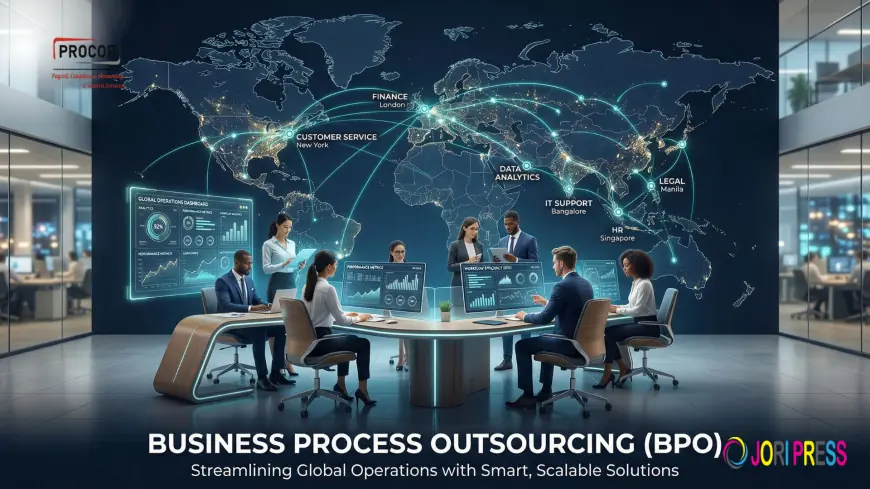
Business Process Outsourcing (BPO) is the practice of contracting specific business operations — such as customer support, finance, HR, or IT — to a third-party service provider. Companies use BPO to reduce costs, improve efficiency, and focus internal resources on their core strategic goals.
Why Is BPO Growing So Fast?
The global BPO market is no longer a niche — it's a cornerstone of modern business strategy. The global business process outsourcing market was estimated at USD 328.37 billion in 2025 and is projected to reach USD 695.77 billion by 2033, growing at a CAGR of 9.9%.
This growth is being powered by three converging forces: the rise of AI and automation, the demand for cost-efficient operations, and a post-pandemic shift toward flexible, distributed work models.
74% of firms worldwide rely on the BPO industry for their IT needs, and 28% of businesses outsource specifically to gain access to global talent.
Simply put, outsourcing is no longer just about saving money — it's about gaining capability.
Types of Business Process Outsourcing
Understanding BPO starts with knowing its core categories. Each serves a different business function and strategic goal.
Back-Office BPO
Back-office outsourcing covers internal operations that don't directly touch the customer. These include:
- Finance & Accounting (F&A) — bookkeeping, invoicing, tax compliance
- Human Resources (HR) — payroll, recruitment, benefits administration
- Data Entry & Processing — order management, data cleansing, document handling
- IT Support & Infrastructure — system monitoring, helpdesk, cloud management
The finance & accounting segment accounted for the largest market share at 21.4% in 2025, driven by RPA, AI, and advanced analytics being integrated into finance operations.
Front-Office BPO
Front-office outsourcing focuses on customer-facing functions:
- Customer Service & Call Centres
- Sales & Lead Generation
- Technical Support
- Marketing Operations
In 2025, the customer services segment accounted for a 33% revenue share, driven by the growing number of global service centres requiring both online and offline technical support.
Knowledge Process Outsourcing (KPO)
KPO represents the high-value end of the BPO spectrum — outsourcing knowledge-intensive work like legal research, financial analysis, market intelligence, and clinical data management. It goes beyond task execution into expert advisory.
Key Benefits of Business Process Outsourcing
Cost Reduction and Operational Flexibility
The most obvious driver is cost. Outsourcing non-core tasks eliminates the need for additional infrastructure, training, and full-time headcount. BPO providers leverage economies of scale and advanced technologies such as automation and analytics to deliver cost-effective solutions, amplifying the client's overall competitiveness.
Access to Global Talent and 24/7 Operations
Offshore and nearshore BPO models give businesses round-the-clock coverage and access to skilled professionals in high-talent markets like India, the Philippines, and Eastern Europe. Key advantages of BPO include access to global talent, scalability, 24/7 operations, and enhanced service quality.
Focus on Core Competencies
When routine processes are handled externally, leadership bandwidth shifts toward innovation and strategy. Companies are increasingly outsourcing to focus on strategic, revenue-generating activities rather than routine tasks.
BPO and AI: The Transformation Already Underway
Artificial intelligence is reshaping BPO from a labour-cost play into an intelligent operations model. Generative AI is enabling automation of complex, language-based tasks such as customer support, content generation, and data processing — allowing BPO providers to deliver faster, more personalised, and cost-efficient services through intelligent chatbots, real-time summarisation, and adaptive knowledge management.
This shift is significant. Traditional outsourcing sold time and headcount. The new model sells outcomes and intelligence.
According to a National University of California study from March 2025, 77% of companies are either using or exploring the use of AI in their businesses — and BPO providers are at the forefront of deploying it at scale.
Common BPO Models: Offshore, Nearshore, and Onshore
Offshore BPO
Partnering with providers in geographically distant countries (e.g., India, Philippines) primarily for cost arbitrage and talent depth.
Nearshore BPO
Working with providers in neighbouring or nearby countries, balancing cost savings with time-zone compatibility and cultural alignment.
Onshore BPO
Outsourcing within the same country — higher cost, but maximum regulatory alignment and communication ease.
The right model depends on your priorities: cost, compliance, communication, or capability.\
Industries That Rely Most on BPO
BPO isn't industry-specific — it's industry-agnostic. But some sectors have adopted it most deeply:
- BFSI (Banking, Financial Services & Insurance) — compliance, fraud detection, loan processing
- Healthcare — medical billing, coding, patient data management
- IT & Telecommunications — helpdesk, infrastructure, software QA
- Retail & E-Commerce — order fulfilment, customer care, returns processing
- Manufacturing — supply chain management, procurement
The IT & Telecommunications segment dominated the BPO market with the largest revenue share in 2025.
How to Choose the Right BPO Partner
This is where most businesses get stuck. The market is crowded, and not all providers deliver equally. Here's a practical framework:
1. Define Your Scope Clearly
List every process you want to outsource. Be specific — "customer service" is too vague; "inbound B2C support for e-commerce returns, English-speaking, 8am–10pm IST" is actionable.
2. Evaluate Domain Expertise
A generic BPO that handles everything may not be your best choice. Look for providers with a proven track record in your specific function or industry.
3. Assess Technology Stack
Modern BPO partners should offer RPA, AI-driven analytics, cloud integration, and real-time reporting dashboards. Technology readiness is a non-negotiable differentiator.
4. Check Compliance and Data Security
Depending on your industry, look for GDPR, HIPAA, or ISO 27001 compliance. High dependence on third-party vendors is a key risk factor — organisations must ensure partners meet data protection and regulatory standards.
5. Start with a Pilot
Before committing to a full engagement, run a 60–90 day pilot on a well-defined process. Measure quality, turnaround time, communication, and escalation handling.
BPO vs. ITO: What's the Difference?
A common source of confusion: BPO (Business Process Outsourcing) covers operational and administrative functions, while ITO (IT Outsourcing) focuses specifically on technology services like software development, infrastructure management, and cybersecurity. Many large engagements today blur these lines — which is why the term Global Business Services (GBS) is increasingly used to describe integrated outsourcing strategies.
Challenges and Risks of BPO to Know Before You Start
No strategic decision is without trade-offs. The most common BPO challenges include:
- Loss of process control — quality can drift if SLAs aren't tightly defined
- Data security risks — sharing sensitive data with third parties requires rigorous governance
- Cultural and communication gaps — especially in offshore models
- Vendor dependency — over-reliance on a single provider creates operational risk
- Hidden costs — transition, training, and management overhead can erode projected savings
Mitigating these risks starts with choosing the right partner and investing in a structured onboarding and governance framework.
The Future of BPO: Outcome-Based, AI-Augmented, and Strategic
The BPO of 2025 and beyond looks very different from the call centres of the early 2000s. The growing adoption of cloud-based delivery, automation, and nearshore models is reshaping traditional cost-driven outsourcing into outcome-based and analytics-led partnerships across industries.
The most competitive businesses are moving from "outsource to save" to "outsource to grow." Strategic BPO partnerships now influence product development timelines, customer experience quality, and competitive differentiation.
Ready to Optimise Your Business Operations?
Whether you're a startup looking to scale without bloating headcount or an enterprise streamlining global operations, outsourcing the right processes can unlock measurable growth.
Procor helps businesses design, implement, and manage outsourcing strategies that deliver real outcomes — not just cost savings. From process mapping to vendor selection and performance governance, Procor brings the expertise your business needs to outsource smarter.
Talk to Procor today and find out which processes you should outsource first.
Frequently Asked Questions About Business Process Outsourcing
What does BPO stand for?
BPO stands for Business Process Outsourcing — the practice of contracting business functions to external service providers.
What are examples of BPO services?
Common examples include customer support, payroll processing, data entry, IT helpdesk, finance & accounting, HR administration, and content moderation.
Is BPO the same as a call centre?
No. While call centres are one type of BPO, the category also covers back-office functions, knowledge processes, HR, finance, and IT — far beyond phone-based customer service.
Which countries are the top BPO destinations?
India, the Philippines, Poland, Malaysia, and Colombia are among the leading global BPO hubs, each offering distinct advantages in talent, cost, and language capability.
What's Your Reaction?
 Like
0
Like
0
 Dislike
0
Dislike
0
 Love
0
Love
0
 Funny
0
Funny
0
 Angry
0
Angry
0
 Sad
0
Sad
0
 Wow
0
Wow
0