








































Entry-Level vs Senior Data Roles: What Changes Over Time?
Understand the key differences between entry-level and senior data roles, including skills, responsibilities, and career growth in the data analytics field. Learn how data careers evolve over time and what changes as professionals move up.

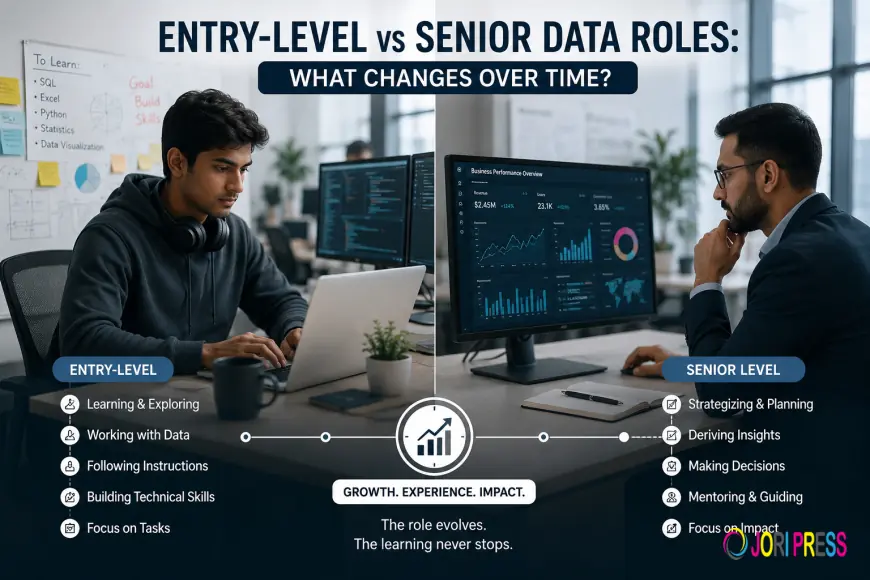
A career in data analytics is one of the fastest-growing paths in today’s digital economy. However, many beginners often wonder how data roles evolve over time and what really changes as professionals move from entry-level positions to senior roles. The difference is not just about salary or job title, but also about responsibility, mindset, and impact.
Entry-Level Data Roles: Learning and Execution Stage
At the entry level, data professionals primarily focus on learning tools and executing tasks. Common roles include Junior Data Analyst or Associate Data Analyst. The work usually involves cleaning datasets, creating basic dashboards, writing simple SQL queries, and generating reports.
At this stage, professionals are expected to build strong foundational skills in Excel, SQL, Python, and data visualization tools. The focus is on accuracy, consistency, and understanding how data flows within a business. Entry-level employees are often guided closely by senior team members and follow predefined processes.
Mistakes are common in this phase, but they are also part of the learning curve. The main goal is to understand how raw data transforms into business insights.
Senior Data Roles: Strategy and Decision-Making Stage
As professionals grow into senior roles such as Senior Data Analyst, Data Scientist, or Analytics Lead, their responsibilities shift significantly. Instead of just executing tasks, they begin to design solutions and guide decision-making.
Senior professionals are expected to understand business problems deeply and translate them into data questions. They often work closely with stakeholders, influence strategy, and ensure that insights actually lead to action.
At this level, technical skills are still important, but communication, leadership, and business understanding become even more critical. Senior roles also involve mentoring junior team members, reviewing work, and improving overall data processes within the organization.
Key Differences Over Time
The biggest change between entry-level and senior roles is the shift from doing work to driving impact. Entry-level professionals focus on tools and tasks, while senior professionals focus on outcomes and business value.
Another important difference is independence. Beginners rely heavily on guidance, whereas senior professionals are expected to take ownership of projects and decisions.
Role of Analytics Shiksha in Data Careers
Platforms like Analytics Shiksha play an important role in helping learners understand this career progression. Analytics Shiksha focuses on data analytics roles, practical learning, and career-oriented guidance. It helps beginners build strong foundations in data analytics while also preparing them for real-world job expectations.
By bridging the gap between learning and industry requirements, Analytics Shiksha supports learners in transitioning smoothly from entry-level understanding to senior-level thinking.
Conclusion
A data career is a journey of continuous growth. While entry-level roles build your foundation, senior roles shape your influence and impact. Understanding this evolution early helps professionals prepare better and grow faster in the field of data analytics.
What's Your Reaction?
 Like
0
Like
0
 Dislike
0
Dislike
0
 Love
0
Love
0
 Funny
0
Funny
0
 Angry
0
Angry
0
 Sad
0
Sad
0
 Wow
0
Wow
0