



































The Uganda Constitution, Dual Citizenship, Lawrence Muganga And Tik Tok
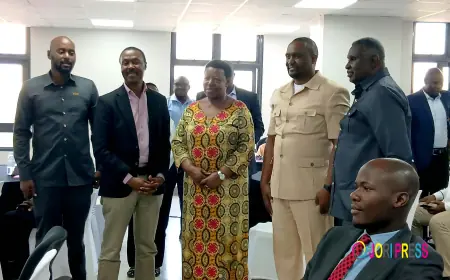
Dr. Lawrence Muganga was appointed Uganda's Minister of State for Internal Affairs


By Ssemambo Rashid
29th May, 2026 : We again find ourselves at the usual intellectual (or lack thereof) crossroads in Uganda now stemming from inter-alia, the appointment of Dr. Lawrence Muganga to Minister of State in charge of Internal Affairs whilst he holds dual citizenship (CANADA and UGANDA). The storm in the tea-cup (sic) derives from the presumed expert “Constitutional” and “Legal” interpretation of the Uganda Citizenship and Immigration Control (Amendment) Act 2009, where it has been argued, limits the appointments of dual citizens to the listed portfolios under the 5th schedule to the Act including Item 4. “Cabinet Minister and other Ministers.”
It is imperative to comment from the outset that dual citizenship was introduced into the Ugandan jurisprudence through an amendment of the Uganda constitution by enacting
Article 15. Of relevance to the debate, Article 15 2) provides thus;
“A person who is not a citizen of Uganda, may, on acquiring the citizenship of Uganda, subject to this constitution and any law enacted by Parliament, retain the citizenship of another country”
Importantly also is that citizenship is generally defined as “a legal status of being a member of a political community. It guarantees the individual rights, protections and political privileges in exchange of their allegiance to that state and generally operates synonymously with nationality” Halsbury’s Black’s Law dictionary.
Similarly dual citizenship is defined as “a legal status in which an individual is concurrently recognized as a citizen or national of two different sovereign states under the operation of each country’s respective laws”.
From a close reading of the foregoing, generally, dual citizenship does not in any way diminish the responsibilities of the dual citizen to the countries in which they acquire both citizenships on the one hand and neither does it prima facie, limit the rights / entitlements of such dual citizen in the countries of citizenship.
As shall be highlighted hereinafter, in the Ugandan context, dual citizenship does not confer half duties and half rights to the dual citizen but rather the full duties and full rights upon them as available to any other Ugandan citizen unless expressly limited by the Constitution.
Indeed and as a further illustration, the Oath of allegiance sworn before one seeking to acquire Ugandan citizenship reads as follows;
“I ……………………………………. swear that I will be, faithful and bear true allegiance to the sovereign state of Uganda, and that I will Preserve, Protect and Defend the Constitution. So, help me God.”
Clearly, a dual citizen assumes ALL obligations and rights under the Constitution of the Republic of Uganda.
The duties of a Ugandan Citizen are provided for under Article 17 of the Constitution. The same are also found in the National Objectives and Directive Principles of State Policy No. XXIX.
Evidently, these are obligations upon “ALL CITIZENS”.
It is clear therefore that upon acquiring Ugandan citizenship, the dual citizen is obliged to observe fidelity to the constitution and shall at all material times be bound by the duties enumerated hereinbefore without exception, just like any other citizen.
Importantly, the same Constitution, Chapter 4, (Bill of Rights) provides for the protection and promotion of fundamental and other human rights and freedoms. Specifically, Article 21 provides for equality and freedom from discrimination.
Just like the duties before, these rights are available to all, dual citizens included.
To understand the not-so complicated matter before us, one needs to be reminded that there exists, the doctrine of “harmonious interpretation” (latin: ex visceribus actus) which demands that “individual clauses, sections, or words cannot be interpreted in isolation or in competition / conflict with one another. To understand the true intent of a constitutional provision, courts must look at the instrument as a single cohesive document”.
To read and interpret the constitution otherwise, would be fallacious and would lead to an absurdity.
It is understood that the constitution is the grand norm meaning that it is the ultimate (mother) of the entire legal system in a jurisdiction that gives validity and legitimacy to all other laws, rules and government authority.
Article 2 (1) of the Constitution provides;
“This Constitution is the Supreme law of Uganda and shall have binding force on all authorities and persons throughout Uganda.”
Article 2 (2):
“If any other law or any custom is inconsistent with any of the provisions of this constitution, the Constitution shall prevail and that other law or custom shall to the extent of the inconsistency be void” (emphasis mine).
I now wish to contextualize the issue at hand in regard to the Constitutional qualifications and disqualifications of the relevant public offices.
Qualifications and disqualifications of the President, Members of Parliament and by extension Ministers, are provided for under the Constitution.
In regard to the President, Article 102 (1)
“a person is qualified for election as President if that person”
a) “is a citizen of Uganda by birth”
In regard to Cabinet Ministers (Or other Ministers); Article 113 (1)
“Cabinet ministers, shall be appointed by the President with the approval of Parliament from among Members of Parliament or persons qualified to be elected Members of Parliament”
In regard to Members of Parliament, Article 80 1) a) provides:
“A person is qualified to be a member of Parliament if that person is a citizen of Uganda” (emphasis mine).
It is clear from the foregoing provisions, that whereas the Constitution limits the eligibility of persons seeking election to the office of President to only those who are citizens by birth, the same constitution allows all citizens to be appointed as Ministers. There is no qualification or limitation expressed thereby.
It is my humble submission therefore, that to limit by excluding dual citizens from appointment as Ministers, is unconstitutional and thereby null and void in terms of Article 2 2) of the Uganda 1995 constitution.
As already highlighted hereinabove, whereas the amendment to the constitution that introduced dual citizenship references the enactment of an enabling law to put into effect the new constitutional imperative, S. 19D of the said Uganda Citizenship and Immigration Control (Amendment) Act is null and void to the extent of its inconsistency with the provisions of the Constitution highlighted hereinabove.
Section 19D (4th item of the Fifth Schedule) is of no legal effect to the extent that it introduces limitations contrary to Article 80 that is permissive to all citizens without exception and therefore no authority can purport to rely on it to make a Constitutionally sound decision.
In MacFoy Versus United Africa Co. Ltd (1961)
“if an act is void, then it is in law a nullity. It is not only bad but incurably bad. There is no need for an order of the Court to set it aside. It is automatically null and void without more ado, though it is sometimes convenient to have the court declare it to be so”
From the foregoing and our humble reading as well as understanding of the doctrines of “Constitutional supremacy” as well as that of “harmonious interpretation”, an Act of Parliament that contradicts the constitution (as does the Uganda Citizenship and Immigration Control (Amendment) Act), is automatically void (not voidable) to the extent of its inconsistency (Section 19D, 5th Schedule-fourth item discussed above).
In conclusion therefore and following the well reasoned judgement in the MacFoy case above, no court order is required to declare it a nullity and therefore any authority like Parliament, has an inherent constitutional mandate to disregard and reject such repugnant provision.
…
Lest I forget, while the Arusha Declaration of 1967 identified “Ignorance” as one of the ailments of Africa, we continue to erode knowledge by accepting and allowing the free flow of social media like Tik Tok regardless of content and age of users much to the continued social degeneration of society.
I have oftentimes argued that for Africa, the flooding of social media is akin to the flooding of Guangzhou with opium by the white “civilized” British as a means to tilt the Balance of Trade with China in a further attempt to make more profit for Britain at the expense of the Chinese population. This inevitably led to the China – Opium wars. Tik Tok et al are our opium and Africa shall never prosper until and unless we take charge of the quality and quantity of information availed to our users.
For God and my Country.
What's Your Reaction?
 Like
0
Like
0
 Dislike
0
Dislike
0
 Love
0
Love
0
 Funny
0
Funny
0
 Angry
0
Angry
0
 Sad
0
Sad
0
 Wow
0
Wow
0