






































Assistant Controller vs Accounting Manager: How Do Their Responsibilities Compare?
Assistant Controller vs Accounting Manager, Learn the key differences, responsibilities, skills, and career paths for these important finance leadership roles.

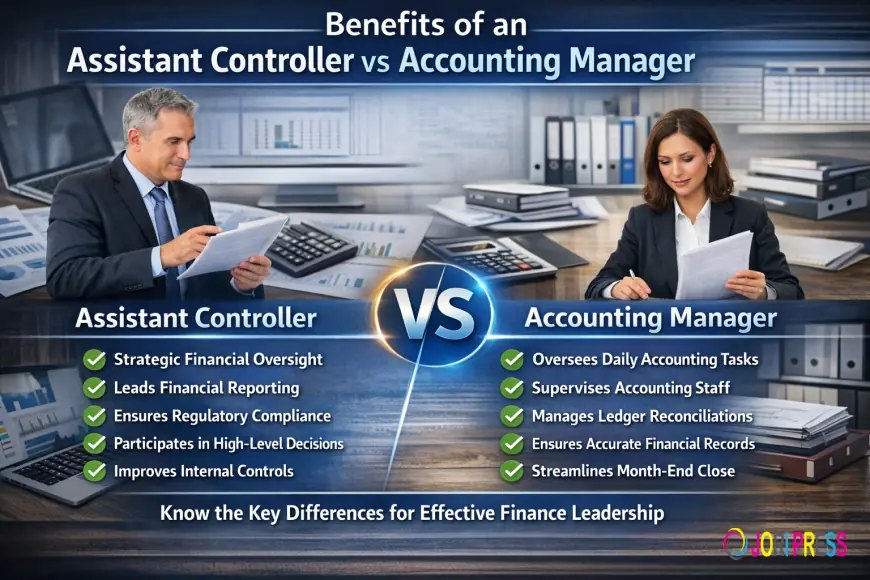
In modern finance departments, both Assistant Controllers and Accounting Managers play essential roles in maintaining financial accuracy, compliance, and operational efficiency. While these positions may appear similar, their responsibilities, level of authority, and strategic involvement can differ significantly. Understanding the distinction between an Assistant Controller vs Accounting Manager helps organizations structure their finance teams effectively and helps professionals plan their career paths.
This guide explains the responsibilities, key differences, required skills, and career paths of both roles.
What Is an Assistant Controller?
An Assistant Controller is a senior finance professional who supports the Controller in managing the organization's accounting operations and financial reporting processes. This role typically exists in medium to large organizations where financial operations are complex.
The Assistant Controller acts as the second-in-command in the accounting department and ensures that financial records are accurate, compliant with regulations, and aligned with company policies.
Key Responsibilities of an Assistant Controller:
Some of the primary duties include:
-
Assisting the Controller with financial reporting and compliance
-
Supervising accounting teams and reviewing their work
-
Managing the month-end and year-end close process
-
Ensuring compliance with GAAP, tax regulations, and internal policies
-
Preparing financial statements and reports for leadership
-
Supporting audits and coordinating with external auditors
-
Improving internal accounting processes and financial controls
Because of the strategic nature of the role, Assistant Controllers often participate in financial planning, budgeting, and internal control development.
What Is an Accounting Manager?
An Accounting Manager focuses primarily on overseeing daily accounting operations and managing the accounting team. This role ensures that transactions are recorded accurately and that routine financial processes run smoothly.
While Accounting Managers may contribute to financial reporting, their responsibilities are typically more operational and team-focused than strategic.
Key Responsibilities of an Accounting Manager
Typical duties include:
-
Managing the day-to-day accounting activities
-
Supervising accountants, bookkeepers, and accounting staff
-
Reviewing journal entries and account reconciliations
-
Ensuring accuracy in accounts payable, accounts receivable, and general ledger
-
Assisting with the monthly and quarterly closing process
-
Maintaining financial records and documentation
-
Supporting internal and external audits
Accounting Managers ensure the accounting department operates efficiently and that financial data remains accurate and organized.
Assistant Controller vs Accounting Manager: Key Differences:
Although both roles work closely together, their responsibilities differ in several important areas.
1. Level of Authority
The Assistant Controller typically holds a higher leadership position and reports directly to the Controller or Chief Financial Officer (CFO). They help oversee the entire accounting department.
In contrast, the Accounting Manager usually reports to the Controller or Assistant Controller and focuses on managing specific accounting functions.
2. Strategic vs Operational Focus
Assistant Controllers often work on strategic financial oversight, internal controls, and financial reporting frameworks.
Accounting Managers concentrate on operational accounting tasks, ensuring daily financial processes are completed correctly.
3. Financial Reporting Responsibility
Assistant Controllers take a larger role in preparing and reviewing financial statements, regulatory reports, and compliance documentation.
Accounting Managers primarily ensure that the underlying data used in those reports is accurate and properly recorded.
4. Team Leadership
Both roles involve leadership, but the scope differs.
-
Assistant Controllers supervise multiple accounting functions and teams.
-
Accounting Managers manage accountants and operational accounting staff.
5. Decision-Making Authority
Assistant Controllers often participate in high-level financial decisions, internal control design, and financial policy development.
Accounting Managers focus more on process management and team supervision.
Required for Both:
While their responsibilities differ, both positions require a strong foundation in accounting principles and leadership skills.
Essential for Assistant Controllers
-
Advanced knowledge of financial reporting and compliance
-
Leadership and team management
-
Strategic thinking and financial analysis
-
Knowledge of GAAP and regulatory standards
-
Strong communication with executives and auditors
-
Process improvement and internal control expertise
Essential for Accounting Managers
-
Strong understanding of accounting operations
-
Team management and supervision
-
Expertise in general ledger and reconciliations
-
Attention to detail and accuracy
-
Experience with accounting software and ERP systems
-
Problem-solving and workflow management
Accounting Manager to Assistant Controller:
For many professionals, the Accounting Manager role serves as a stepping stone toward becoming an Assistant Controller.
A typical career progression may look like this:
Staff Accountant → Senior Accountant → Accounting Manager → Assistant Controller → Controller → CFO
As professionals move up the ladder, their responsibilities shift from operational tasks toward strategic financial leadership.
Conclusion:
The difference between an Assistant Controller vs Accounting Manager lies primarily in scope, authority, and strategic involvement. While Accounting Managers ensure the smooth operation of daily accounting activities, Assistant Controllers focus more on financial oversight, reporting, and compliance.
Organizations benefit from having both roles clearly defined, as together they help ensure accurate financial reporting, regulatory compliance, and efficient accounting operations.
For finance professionals, understanding these distinctions can also help guide career growth toward leadership positions within the accounting and finance field.
What's Your Reaction?
 Like
0
Like
0
 Dislike
0
Dislike
0
 Love
0
Love
0
 Funny
0
Funny
0
 Angry
0
Angry
0
 Sad
0
Sad
0
 Wow
0
Wow
0