
































Publish Less. Mean More.
In a world obsessed with publishing more content, the real advantage comes from creating content that truly matters. Learn why quality, relevance, and audience understanding outperform content volume in modern marketing.

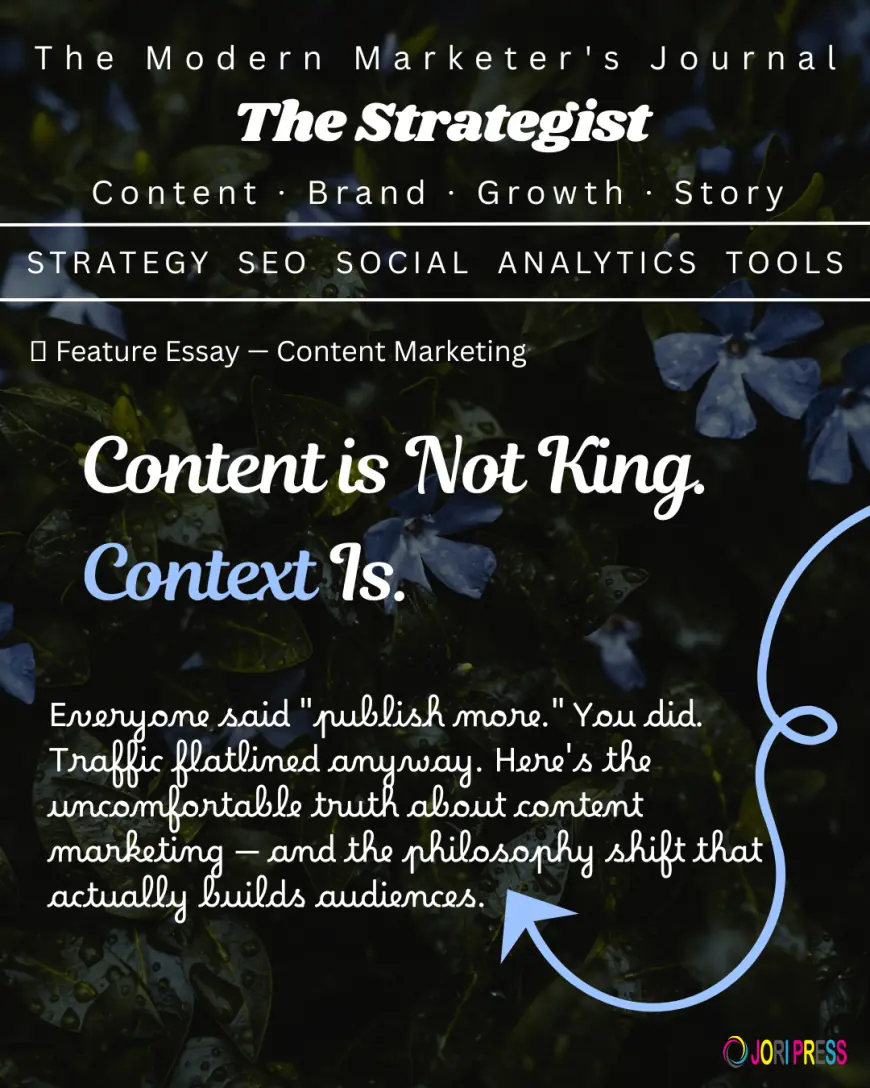
The irony of content marketing lies within an insidious falsehood: volume is strategy. Create content daily. Binge-produce content. Repurpose all content. Underneath this lie exists a truth of sorts: reaching an audience is all about numbers, and if you produce enough content, an audience will appear.
It won’t. Or it no longer does, at any rate — and perhaps never did. The only way content marketing has ever truly worked is by being specific, relevant, and earning trust. Done correctly, content marketing involves getting the exact attention of the audience you want to reach before they need you, so you can meet their needs easily.
Key Concepts
- Topical Authority
- Content Mission Statement
- Distribution-First Strategy
- Audience ICP Mapping
- Content Repurposing Engine
- Editorial Calendar
- Zero-Click Content
- TOFU / MOFU / BOFU
Editor’s Note
The single most actionable thing you can do today: write down exactly who your content is for, what problem it solves, and what action you want them to take after reading.
If that sentence takes longer than five minutes to write, you have a strategy problem — not a content problem.
What Content Marketing Actually Is
Content marketing involves creating or sharing compelling, valuable, or inspiring information, like blog posts, videos, or podcasts, in order to acquire and retain an established audience with the objective of promoting a profitable action.
Do you see something that’s not there? Your product or your offer, the thing that you’re trying to sell. That’s precisely the brilliance of content marketing. People aren’t visiting your website to find advertisements. People visit websites for answers, for entertainment, and for community. The company that offers all that will earn the relationship. And the relationship will eventually earn the sale.
The Four Pillars of Effective Content Strategy
1. Clear Target Audience
Before putting pen to paper or fingers to keyboard, you have to know exactly who you are writing for — not as a statistic, but as an individual. Know your audience’s profession, their fears, their language, and how they hang out. The more specific you make your target audience right at the start, the more focused your writing will be. “Entrepreneurs in small businesses” is not a clear target audience; “first-time SaaS business owners seeking guidance on their first marketing hire” is.
2. Your Content Mission
Steal a tactic from brand building and write a content mission statement. A good content mission statement mentions your target audience, what kind of content you’ll create for them, and what they get out of reading it. An example would be: “We enable small independent retailers to thrive in the new omnichannel landscape by equipping them to compete against large chain stores with superior customer experiences.”
3. The Distribution First Mentality
What’s the number one mistake people make in content marketing? Thinking that distribution is something that happens after you’ve done all the work. Most people spend 90% of their time on content creation and only 10% on distribution. Flip this ratio upside down. Good content with bad distribution always loses to poor content with fantastic distribution.
4. Meaningful Metrics
Page views, likes, or any other vanity metric may make you feel good about yourself, but they don’t tell you much. The metrics that matter are returning traffic (indicating trust), email subscribers (showing intent), pipeline influenced by content (measured in revenue), and time on page (engagement). Set up a metrics framework before doing anything else.
The Content Formats Worth Your Time in 2026
01. Long Form Editorials & Guides — Thoroughly researched pieces (2,000–5,000 words) that drive organic search traffic and backlinks. The backbone of any enduring content strategy.
02. Email Newsletters — The only owned content channel. You’re not at the mercy of any algorithm when it comes to distributing your content. A newsletter to 5,000 engaged subscribers beats 50,000 social followers in nearly every commercially relevant way.
03. Short Form Video — Reels, Shorts, and TikTok videos still boast the greatest potential for audience growth. Utilise video content to bring new folks to your orbit; nurture them with email & long-form content.
04. Original Research & Data Reports — Data is your moat. Survey your customers, analyse your data, and collaborate on research. Media will cover you, give you backlinks, and turn you into a category expert.
05. Podcasts & Audio — Deep, long-form audio establishes parasocial intimacy with listeners. People engage with your content for 20 to 40 minutes; that’s an attention span that no other medium can claim. Interviews will open doors, too.
The AI Question
It would be misleading to talk about content marketing in 2026 without talking about artificial intelligence. It can help speed up research, outline writing, draft writing, repurposing, and even SEO optimisation. If deployed effectively, it is a powerful lever multiplier for small content teams.
What the successful creators do, however, is combine speed using technology with hard work, where technology falls short — personal experience, honest opinions, unique reporting, storytelling, and the degree of specificity which comes only through knowing your audience. The web is already flooded with AI-written content, which is technically sound but thoroughly forgettable. The most limited resource when it comes to content is a unique perspective.
Building a System, Not Just a Calendar
The most sustainable content operations operate as editorial divisions, rather than marketing initiatives. They feature a beat, which is what the division covers, a voice guide, a calendar that ties into the audience’s time frames as opposed to those of the brand, and a repurposing machine for every single anchor post produced.
One in-depth article can be transformed into a whole newsletter, three social media posts, a presentation, a podcast episode, and even a video — all without duplicating the work that has already been done and without saying the same thing again in the process.
The Compounding Effect
Content marketing is a compounding asset. The content you write today could generate traffic for you over the course of five years. An email list you’ve built over the span of two years will always be worth more than the campaigns you spend money running over the next quarter. The reputation of being the most useful voice within your field is difficult to match overnight.
This compounding effect makes it challenging to keep up. The value will be impossible to measure when looking back on your first month, but the impact after three years will be undeniable. The companies that succeed by way of content marketing are those who see it as an infrastructure, something they invest in, grow, and maintain forever.
Start small. Pick just one medium. Pick just one group of people. Find just one pace at which you can create content. Then give them everything they want out of that form of content.
What's Your Reaction?
 Like
0
Like
0
 Dislike
0
Dislike
0
 Love
0
Love
0
 Funny
0
Funny
0
 Angry
0
Angry
0
 Sad
0
Sad
0
 Wow
0
Wow
0