







































The Rise of AI-Assisted Full Stack Developers and What It Means for Businesses
Software development is entering a new era—one where artificial intelligence is no longer just a feature inside applications but an active participant in the development process itself.
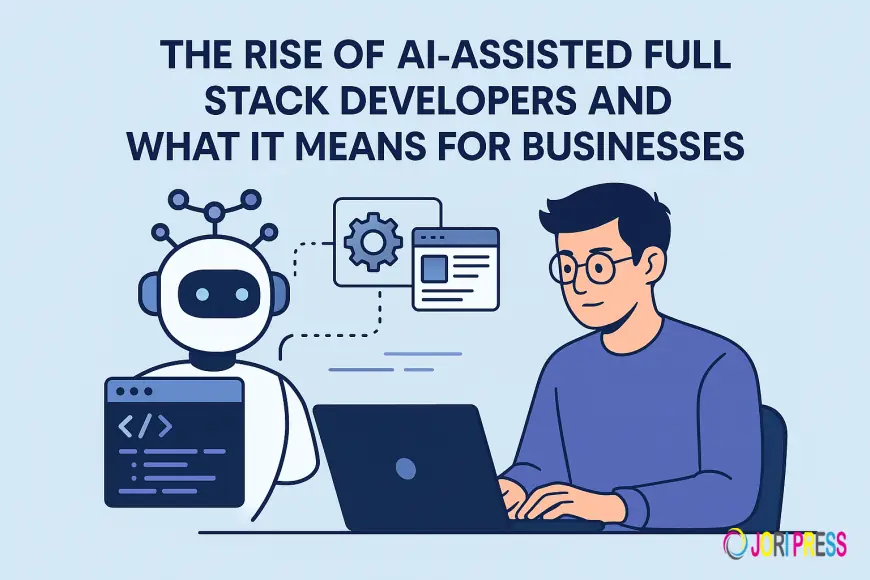
Across startups, enterprises, and product teams, AI-powered coding assistants are rapidly changing how applications are designed, built, tested, and deployed.
This shift has fueled the rise of the AI-assisted full stack developer: engineers who combine traditional frontend and backend expertise with AI-driven productivity tools to accelerate development and improve software quality. Technologies such as GitHub Copilot, ChatGPT, Amazon CodeWhisperer, and modern automation frameworks are helping developers move faster, reduce repetitive work, and focus more on solving business problems rather than writing boilerplate code.
At the same time, businesses are under increasing pressure to launch products faster, scale digital platforms efficiently, and stay competitive in rapidly evolving markets. As a result, organizations are rethinking how they build engineering teams and evaluating whether to hire a full stack developer with AI-enhanced capabilities.
This transformation is not simply about replacing developers with automation. Instead, it represents a major evolution in how software teams operate, collaborate, and innovate.
What Are AI-Assisted Full Stack Developers?
Traditionally, full stack developers are professionals who work across both frontend and backend systems. They manage user interfaces, APIs, databases, application logic, cloud infrastructure, and integrations. In many organizations, these developers already play a critical role because they bridge multiple layers of application architecture.
AI-assisted full stack developers take this role further by integrating AI-powered tools into their workflows.
Instead of manually writing every function, debugging every issue line by line, or creating repetitive code structures from scratch, developers now work alongside intelligent systems capable of generating suggestions, automating tasks, and accelerating development cycles.
Modern AI tools can:
-
Generate code snippets and application scaffolding
-
Suggest optimized functions and queries
-
Detect bugs and potential vulnerabilities
-
Automate testing and documentation
-
Assist with deployment pipelines and DevOps tasks
GitHub Copilot, for example, can recommend entire code blocks based on context, while ChatGPT helps developers troubleshoot issues, refactor code, and explain complex technical concepts quickly. AI-assisted development environments are becoming increasingly integrated into IDEs, CI/CD pipelines, and cloud-native workflows.
For businesses using full stack development services, this evolution means faster delivery timelines and more efficient engineering operations.
How AI Is Transforming Full Stack Development
AI is fundamentally reshaping the way modern applications are built. One of the most noticeable changes is the speed at which developers can now generate functional code.
In traditional development environments, building even basic functionality often involved repetitive setup tasks, configuration management, and extensive manual coding. AI tools significantly reduce this overhead by automating common development patterns and accelerating routine implementation work.
Frontend development, for example, has become more efficient through AI-generated UI components, responsive layouts, and styling recommendations. Backend workflows are also evolving, with AI assisting in API creation, database queries, authentication flows, and infrastructure automation.
This shift is especially impactful for organizations relying on full stack development company partnerships to deliver scalable products quickly.
AI is also improving collaboration between frontend and backend teams. In many development environments, coordination delays occur because developers work in isolated silos. AI-assisted workflows help unify development processes by generating consistent interfaces, API contracts, and shared architectural recommendations.
As applications grow more complex, AI tools increasingly serve as productivity multipliers rather than simple coding assistants.
Impact on Engineering Productivity
One of the biggest reasons businesses are investing in AI-assisted engineering is productivity.
Several industry studies and developer surveys suggest that AI coding assistants can reduce development time for repetitive tasks by a substantial margin. While exact gains vary depending on project complexity and developer expertise, many engineering teams report measurable improvements in velocity and efficiency.
However, the true value of AI-assisted development goes beyond writing code faster.
Developers are spending less time on repetitive implementation tasks and more time on:
-
System architecture
-
Product logic
-
User experience optimization
-
Scalability planning
-
Performance engineering
This marks an important transition in software engineering. Developers are shifting from being primarily “code writers” to becoming higher-level problem solvers and solution architects.
In real-world workflows, AI-human collaboration often looks like this:
A developer defines the architecture and business requirements, while AI assists in generating implementation patterns, testing strategies, and optimization suggestions. The developer then reviews, validates, and refines the output to ensure quality and alignment with business objectives.
For companies looking to hire full stack programmer talent, this means evaluating not only coding skills but also strategic thinking, adaptability, and the ability to work effectively with AI-enhanced workflows.
Business Benefits
The rise of AI-assisted development is creating significant advantages for businesses across industries.
One of the most immediate benefits is faster time-to-market. Product development cycles that once took months can now be compressed significantly through AI-assisted workflows. Faster development enables companies to launch features quickly, respond to customer feedback faster, and maintain competitive agility.
Cost efficiency is another major factor. AI-assisted developers can often accomplish more work within the same timeframe, reducing bottlenecks and improving team productivity. For startups and growing businesses, this efficiency can translate into lower operational costs and better resource allocation.
Organizations using full stack development services also benefit from greater scalability. AI-assisted workflows allow engineering teams to handle increasing workloads without proportionally increasing team size.
This scalability is especially valuable for:
-
SaaS platforms
-
E-commerce systems
-
Enterprise applications
-
AI-powered digital products
-
High-growth startups
Additionally, businesses that adopt AI-enhanced development strategies often gain a competitive edge through faster experimentation and innovation. Teams can prototype ideas rapidly, validate concepts earlier, and iterate more efficiently.
Challenges and Limitations
Despite its advantages, AI-assisted development is not without challenges.
One concern is over-reliance on AI-generated code. While modern tools are increasingly capable, they are not always accurate or context-aware. Developers still need to validate outputs carefully to avoid introducing security vulnerabilities, inefficient logic, or architectural inconsistencies.
Security remains a particularly important issue for enterprise applications. AI-generated code may inadvertently include insecure patterns or outdated practices if not properly reviewed.
Another challenge is the learning curve associated with AI tooling. Developers must learn how to interact effectively with AI systems, craft precise prompts, and integrate AI outputs into broader engineering workflows.
Importantly, AI does not eliminate the need for experienced engineers. Human oversight remains essential for:
-
Architecture decisions
-
Business logic validation
-
Security reviews
-
Performance optimization
-
Strategic product development
Businesses should view AI as an enhancement to engineering capabilities—not a replacement for skilled developers.
What Businesses Should Look for in AI-Assisted Full Stack Developers
As AI-assisted development becomes more mainstream, the expectations for developers are evolving.
Modern full stack developers increasingly need hybrid skill sets that combine traditional engineering expertise with AI fluency.
Businesses looking to hire a full stack developer should prioritize candidates who understand:
-
Frontend and backend architectures
-
Cloud-native development
-
API and integration workflows
-
AI-assisted coding tools
-
DevOps and automation pipelines
Equally important is adaptability. The AI ecosystem is evolving rapidly, and developers who continuously learn and experiment with new tools are more likely to deliver long-term value.
Prompt engineering is also emerging as an important skill. Developers who know how to interact effectively with AI systems can generate more accurate outputs, reduce errors, and optimize productivity gains.
For organizations working with a full stack development company, evaluating the provider’s AI capabilities is becoming increasingly relevant. Companies that successfully integrate AI into development workflows are often able to deliver faster and more scalable solutions.
Future Outlook
The next few years are likely to reshape software engineering even further.
As AI tools become more advanced, developers will increasingly operate as orchestrators of intelligent systems rather than manual coders for every implementation detail.
The rise of “AI-native engineers” is already beginning. These professionals are being trained in environments where AI assistance is a standard part of development workflows from day one.
Over the next three to five years, businesses can expect:
-
Greater automation across software lifecycles
-
Faster low-code and AI-assisted development frameworks
-
More intelligent debugging and testing systems
-
Enhanced AI-driven architecture recommendations
-
Deeper integration between AI and cloud-native platforms
However, the demand for experienced full stack engineers is unlikely to disappear. In fact, businesses may place even greater value on developers capable of combining technical expertise with AI-enhanced productivity.
Conclusion
AI-assisted development is not simply a temporary trend—it represents a major transformation in how modern software is created.
The emergence of AI-enhanced full stack developers is helping businesses accelerate engineering productivity, reduce development cycles, and build scalable digital products more efficiently than ever before.
At the same time, this shift is changing the role of developers themselves. Engineers are moving beyond repetitive coding tasks toward higher-value responsibilities such as architecture design, strategic problem-solving, and innovation leadership.
For businesses evaluating how to scale digital initiatives, the ability to hire full stack programmer talent with AI-assisted capabilities is becoming increasingly important. Whether working with internal teams or partnering with a full stack development company, organizations that embrace AI-enhanced development strategies will be better positioned to compete in a rapidly evolving technology landscape.
The future of software development will not be driven by AI alone. It will be driven by skilled developers who know how to use AI effectively to build smarter, faster, and more resilient systems.
What's Your Reaction?
 Like
0
Like
0
 Dislike
0
Dislike
0
 Love
0
Love
0
 Funny
0
Funny
0
 Angry
0
Angry
0
 Sad
0
Sad
0
 Wow
0
Wow
0