



































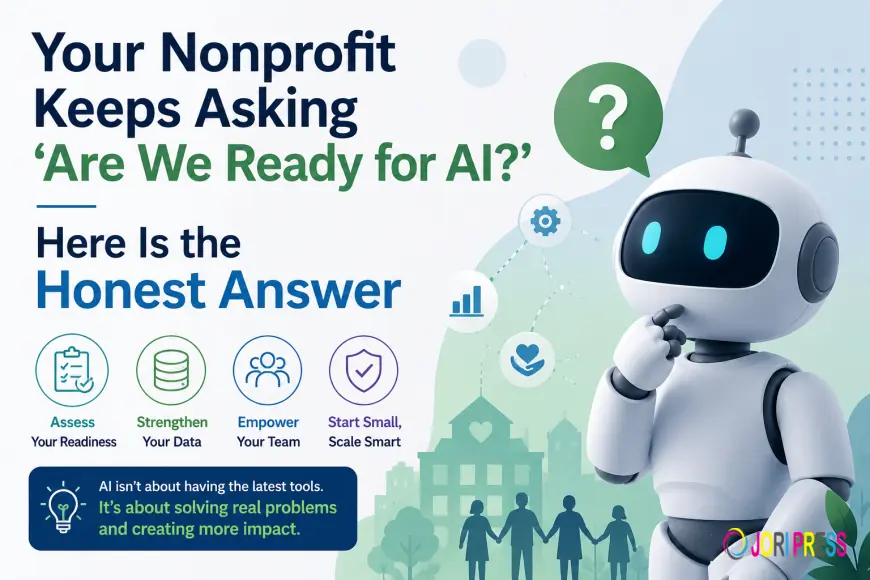
Your Nonprofit Keeps Asking 'Are We Ready for AI?' Here Is the Honest Answer
INTRODUCTION: THE CONVERSATION NONPROFITS ARE NOT HAVING
Let us start with something most AI companies will never say to you directly: buying an AI tool is the easy part. Knowing whether your organization is genuinely ready to get value from it — that is the hard part. And it is the part that most vendor conversations conveniently skip.
Across every industry in 2026, enterprises are waking up to the same uncomfortable reality. They ran the pilot. It looked incredible. The demo impressed the board. The vendor's case studies were compelling. And then, somewhere between the proof-of-concept and actual deployment, the initiative quietly stalled. Budget was spent. Enthusiasm faded. And the organization returned to doing things the way it always had, except now with a lingering distrust of AI that would make the next conversation even harder.
For nonprofits specifically, this pattern carries a weight that pure commercial enterprises do not feel in the same way. When a for-profit company wastes money on a failed technology initiative, the cost is absorbed by the business. When a nonprofit wastes money on a failed technology initiative, that cost comes directly from capacity that could have served the mission — from programs, from staff, from the communities depending on the organization to be financially disciplined.
This is why AI readiness is not a technical question for nonprofits. It is a leadership question. A values question. And getting it right before spending anything is the single most important investment a nonprofit technology leader can make in 2026.
"Most enterprises don’t have an AI problem. They have a readiness problem they misidentified as an AI problem. The investment in figuring out which one you have is the highest-ROI conversation in enterprise technology today." — Enterprise AI Consulting, Mirketa
PART ONE: WHY AI FAILS — AND WHY IT IS ALMOST NEVER THE AI'S FAULT
The Numbers Behind the Failure Rate Nobody Wants to Talk About
The statistics are striking once you look at them honestly. According to MIT Sloan research published in 2025, the overwhelming majority of enterprise AI pilots fail to scale to production. Gartner research from the same year found that poor data quality is cited as the single most common barrier to successful AI adoption. McKinsey analysis found that organizations that complete a structured readiness assessment before AI investment are significantly more likely to succeed. And IDC data suggests that nearly a third of enterprise AI budgets are directed at the wrong use cases entirely.
These are not startup failures or experiments gone wrong. These are real enterprises — with real resources, real technology teams, and real AI tools that worked exactly as advertised — failing at the more fundamental question of whether the organizational foundation was in place to make those tools useful.
For nonprofit organizations, the pattern looks like this:
The nonprofit AI failure pattern:
An organization identifies a compelling use case — donor engagement scoring, grant deadline monitoring, program outcome reporting — and selects an AI tool that genuinely addresses it. They deploy it. It works in the controlled environment where the data was clean and the workflow was simplified for the demo. And then it meets the actual organizational data — fragmented, inconsistently maintained, split across systems that were never designed to communicate — and begins producing unreliable outputs that staff cannot trust. The tool gets quietly shelved. The organization concludes that AI is not ready for nonprofits. The opposite is true: the nonprofit was not yet ready for AI.
The four barriers Mirketa's AI readiness framework identifies consistently across 150+ enterprise assessments are:
-
Data infrastructure that is fragmented, incomplete, or inconsistently maintained across multiple systems
-
Governance gaps — no clear policy for how AI systems make decisions, handle exceptions, or escalate to humans
-
Workforce readiness — staff who have not been prepared for the workflow changes AI deployment requires
-
Use case misalignment — AI targeted at the wrong problems, usually the most technically interesting ones rather than the highest-impact ones
None of these barriers are insurmountable. But none of them are visible without looking for them deliberately — which is exactly what a structured AI readiness assessment does.
PART TWO: WHAT AI READINESS ACTUALLY MEANS FOR A NONPROFIT
Beyond the Buzzword — What 'AI Readiness' Looks Like in Practice
The phrase 'AI readiness' has been used often enough that it has started to lose its specific meaning. So let us be concrete about what it means for a nonprofit organization navigating the AI investment conversation in 2026.
AI readiness is not a destination. It is a current state assessment — an honest snapshot of where your organization stands across four interconnected dimensions, and a prioritized roadmap for what to build before, during, and after any AI deployment.
Dimension 1: Data Readiness — The Foundation Everything Else Depends On
Ask yourself a simple question: if you needed to show an AI system a complete, accurate picture of a major donor's relationship with your organization — every gift, every event attended, every communication received, every program they have expressed interest in — could you pull that from a single source of truth? Or would it require reconciling information from your CRM, your email platform, your events database, and your program team's personal files?
For the majority of nonprofits, the honest answer to that question is the second one. And that is not a failure — it is simply the accumulated reality of growing organizations using tools that were selected for individual purposes rather than as part of a unified data architecture.
Data readiness means understanding precisely where your data lives, how complete it is, how consistently it is maintained, and what it would take to make it usable as the foundation for AI systems that need to act on it — not just store it.
Dimension 2: Systems Readiness — What Your Technology Can and Cannot Do Today
Your existing technology stack is not an obstacle to AI. It is the context in which AI has to operate. Systems readiness means understanding which of your existing platforms can expose their data to AI agents, which cannot, and what the realistic integration pathway looks like for each.
Most nonprofits operate on a combination of a donor management platform, a grant tracking system, a financial management tool, a program delivery database, and a communications platform. Very few of these were designed with AI integration in mind when they were selected. All of them can participate in an AI-powered operation — but understanding what that participation requires, and in what sequence, is the systems readiness question.
Dimension 3: Governance Readiness — The Question Every Compliance Team Will Ask
This is the dimension that surfaces the most anxiety in nonprofit leadership — and understandably so. Nonprofits operate in environments with real accountability to donors, funders, program participants, and regulators. The question of how an AI system makes decisions, who is responsible when it makes a wrong one, and how those decisions are audited and documented is not a theoretical governance exercise.
Governance readiness means having documented answers to these questions before deployment, not after a problem surfaces. It means establishing approval gates — specific decision types where human consent is required before an AI agent can act. It means defining escalation protocols — what happens when the AI encounters a situation outside its operating parameters. And it means building the institutional muscle to maintain these guardrails as the system evolves.
Dimension 4: Workforce Readiness — The Human Side of the AI Equation
Arguably the most underinvested dimension of nonprofit AI readiness is the human one. Organizations spend significant energy on data, systems, and governance. They spend comparatively little time preparing the actual people who will work alongside AI systems every day.
Workforce readiness means understanding which roles will change and how. Which decisions your staff will continue to make entirely on their own, which they will make with AI-generated context and recommendations, and which the system will handle autonomously. It means providing genuine preparation — not a one-hour training session at go-live — for the workflow changes that AI deployment requires.
Most importantly, workforce readiness means earning your staff's trust in the system. A major gifts officer who does not trust the AI's donor prioritization recommendations will ignore them. A grants manager who finds the AI's deadline alerts unreliable will maintain her own parallel system. Adoption is a human outcome, not a technical one.
PART THREE: THE AI MATURITY SCORE — WHERE DOES YOUR ORGANIZATION STAND?
From Assessment to Action: What a Structured AI Readiness Process Delivers
Mirketa's structured AI Readiness Assessment — which covers 150+ enterprises across 12 industries, with an average delivery timeline of four weeks — produces three specific outputs that organizations need before any AI investment decision.
Output 1: AI Maturity Score
A quantified, honest assessment of where your organization currently stands across the four readiness dimensions — data, systems, governance, and workforce. Not a grade to feel good or bad about, but a baseline that tells you specifically what to build before AI investment will deliver reliable returns.
Output 2: Prioritized Use Case Roadmap
The highest-value AI applications for your specific organization, sequenced in the order that maximizes impact and minimizes implementation risk. Not the most technically impressive use cases — the ones that will make a measurable difference to your mission, your team, and your financial sustainability within 12 months.
Output 3: Investment-Ready Architecture
A clear technical roadmap that tells you exactly what infrastructure to build before AI deployment, what your existing systems can contribute immediately, and what a realistic timeline and budget looks like for moving from readiness to production.
The entire assessment is completed in 0 to 5 weeks. Not a six-month consulting engagement. Not an open-ended discovery process. A structured, time-bounded exercise that produces specific, actionable outputs — and 100% client IP ownership of everything produced.
For nonprofits operating on constrained timelines and tighter budgets than their enterprise counterparts, this time-to-roadmap matters. Every week spent in AI ambiguity is a week during which donor relationships are drifting, grant deadlines are being tracked manually, and program outcome data is sitting in disconnected spreadsheets instead of informing better decisions.
PART FOUR: WHAT CHANGES WHEN NONPROFITS GET THIS RIGHT
The Practical Impact on Donor Management, Fundraising, and Mission Delivery
Abstract AI readiness conversations are easy to have. The question nonprofit leaders actually care about is more direct: what changes, concretely, when we get this right?
Let us be specific.
Donor Management Transforms From Reactive to Predictive
Most nonprofit donor management is reactive. Someone lapses. Someone notices eventually. Outreach happens, often too late, often with insufficient context to make it feel genuine rather than formulaic.
AI-ready donor management is predictive. A system that has clean, unified donor data — giving history, event attendance, communication engagement, volunteer involvement, capacity indicators — can identify lapse risk six to eight weeks before the lapse happens. It can surface the right person to make contact, with enough context to have a real conversation rather than a scripted one. It can identify mid-level donors whose giving significantly underrepresents their demonstrated capacity. It can tell a major gifts officer, on Monday morning, which three relationships in her portfolio need human attention this week and why.
This is not a futuristic scenario. It is the current capability of AI systems deployed on a foundation of data readiness. The technology is available. The readiness is what determines whether your organization can access it.
Grant Management Stops Being a Production and Becomes a Dashboard
The grant compliance cycle is one of the most labor-intensive operational realities in nonprofit management. Tracking deliverables across multiple funders, reconciling program outcomes with grant commitments, producing narrative reports that are simultaneously honest and compelling — these are tasks that currently consume enormous amounts of skilled staff time.
When the underlying data is AI-ready — when program outcome data, financial data, and funder relationship history all flow through a unified data layer — the grant report stops being a three-week production that involves reconciling spreadsheets from multiple departments. It becomes a dashboard pull. The data is already there, already reconciled, already connected to the commitments that were made at the time of the award.
The grants manager's job does not disappear. But the portion of it that was pure administrative production — and that was consuming 40 to 60 percent of her week — shrinks dramatically. What she does with that reclaimed time is the real impact: deeper funder relationships, more thoughtful program design, better positioned applications for the next funding cycle.
Leadership Has Real-Time Clarity Instead of Quarterly Anxiety
One of the most consistent pain points in nonprofit leadership is the reporting cycle. The board meeting is in three weeks. Someone needs to produce a meaningful picture of organizational health — donor pipeline, program outcomes, financial position, funder relationship status — from data that lives in multiple systems, maintained at different intervals, by different people, using different definitions for the same metrics.
AI-ready organizations do not have this problem. When data is unified, consistently maintained, and surfaced through an intelligent layer, the board report is not a production project. It is a current view of an always-current picture. The Executive Director walks into the board meeting with confidence in the numbers — not because someone worked through the weekend to reconcile them, but because the infrastructure was built to produce them reliably.
PART FIVE: THE MIRKETA AI CONSULTING JOURNEY — END TO END
From Readiness Assessment to Production: What the Path Actually Looks Like
Mirketa's AI consulting practice is built around a specific conviction: turning AI strategy into production-scale reality requires more than strategy. It requires rigorous assessment, honest architecture, and hands-on delivery that transforms your technology estate from the foundation up.
The journey is structured across four phases:
Phase 1 — AI Readiness Assessment (Weeks 0–5)
Evaluate data infrastructure, systems connectivity, governance frameworks, and workforce preparedness. Produce an AI Maturity Score and a prioritized roadmap. This phase produces specific, actionable outputs that your organization owns entirely — not vendor-retained strategy documents but working assets that inform every subsequent decision.
Phase 2 — AI Strategy and Architecture (Post-Assessment)
Define the right AI model, deployment architecture, and integration approach for your specific organizational reality. Not a generic framework applied to your logo — a strategy built around your actual data, your actual systems, and your actual operational workflows.
Phase 3 — AI Implementation and Deployment
Hands-on build and deployment of the AI systems defined in the strategy phase. Integration with existing platforms, configuration of governance guardrails, workflow redesign for the teams that will work alongside the AI, and adoption support that continues past go-live.
Phase 4 — Managed AI Operations
Ongoing optimization, monitoring, and evolution of deployed AI systems. AI is not a static deployment — it requires continuous calibration as organizational data evolves, as new use cases emerge, and as earned autonomy is extended to systems that have demonstrated reliable performance.
The metrics that come out of this journey — 40% faster time-to-value, 0% to 5-week time-to-roadmap, 98% client satisfaction — are not marketing approximations. They are the outcomes of a process specifically engineered to deliver what the AI consulting industry most frequently fails to deliver: AI that actually works in production, at your organization, on your data.
PART SIX: THE HONEST CONVERSATION ABOUT NONPROFIT AI INVESTMENT
What Leadership Needs to Hear Before the First Budget Line Is Written
There is a version of the AI consulting conversation that sounds like this: here are the tools, here is what they can do, here is what it costs, sign here. That conversation moves fast. It feels decisive. And it produces, in most cases, exactly the kind of stalled initiative we described at the beginning of this piece.
The honest version is slower at the start and faster at the end — because it begins by establishing what is real about your organization before it proposes what should be built.
That honesty looks like this:
-
Your donor data may be in better or worse shape than you think, and you need to know which before you build anything on top of it
-
Your highest-value AI use case may not be the one generating the most internal excitement — it is the one where the data is clean, the workflow is well-defined, and the ROI is measurable within twelve months
-
Your staff's readiness for AI-assisted workflows matters as much as your technical infrastructure — and it requires as much deliberate investment
-
The governance framework your compliance team will eventually demand is easier to build before deployment than to retrofit afterward
-
The AI consulting partner who tells you what you want to hear is not the partner who will get you to production
The organizations that get AI right in 2026 are not the boldest or the best-resourced. They are the most honest about where they are before they decide where they are going.
Mirketa has completed over 1,000 successful implementations across healthcare, nonprofit, manufacturing, technology, and education. A 9.26 out of 10 CSAT score. Over 80% repeat business. Those numbers reflect an approach that prioritizes what is actually true about your organization over what is most convenient to tell you.
FREQUENTLY ASKED QUESTIONS
Questions Nonprofit Leaders Ask About AI Readiness and AI Consulting
What is an AI Readiness Assessment and why do nonprofits need one?
An AI Readiness Assessment is a structured evaluation of an organization's data infrastructure, technology systems, governance frameworks, and workforce preparedness for AI deployment. Nonprofits need one because the most common reason nonprofit AI initiatives fail is not the AI technology itself — it is the organizational foundation that the AI needs to operate reliably. A readiness assessment tells you exactly where that foundation is solid and where it needs investment before any AI tool is deployed.
How long does an AI Readiness Assessment take?
Mirketa's structured AI Readiness Assessment takes 0 to 5 weeks from engagement to a completed AI Maturity Score and prioritized roadmap. This is deliberately time-bounded — nonprofits cannot afford open-ended consulting engagements, and the specific outputs required to make an informed AI investment decision do not require months to produce when the process is well-structured.
What is an AI Maturity Score?
An AI Maturity Score is a quantified assessment of where your organization currently stands across the four dimensions of AI readiness: data, systems, governance, and workforce. It provides a baseline that tells you specifically what to build before AI investment will deliver reliable returns — and a framework for measuring progress as readiness improves over time.
What does AI consulting mean for a nonprofit organization?
For a nonprofit, AI consulting means working with a partner who understands both enterprise AI architecture and the specific operational reality of mission-driven organizations — donor relationships, grant compliance, program outcome reporting, funder accountability. The best AI consulting for nonprofits starts with a rigorous assessment of organizational readiness, produces a prioritized use case roadmap built around the mission rather than the technology, and delivers hands-on implementation support through to production deployment.
Can AI improve donor management for nonprofits?
Yes — but only when built on a foundation of clean, unified donor data. AI-powered donor management can identify lapse risk before it becomes lapse, surface high-capacity donors who are giving significantly below their potential, prioritize major gifts officer portfolios by opportunity and relationship health, and automate the administrative coordination that currently consumes development staff time. The technology is available today. What determines whether a nonprofit can access it is the readiness of their data foundation.
What is the difference between AI consulting and AI implementation?
AI consulting is the strategic work that determines what to build, in what order, on what foundation, and with what governance model. AI implementation is the technical work of actually building it. Both are necessary. The most common failure pattern in nonprofit AI is organizations that proceed directly to implementation without the consulting work that would tell them whether the implementation will succeed — and the Mirketa AI consulting practice is specifically designed to prevent this sequence from happening.
How much does enterprise AI consulting cost for a nonprofit?
The investment varies based on organizational complexity, the number of systems being assessed, and the scope of the use case roadmap required. Mirketa works with nonprofits across a wide range of organizational sizes and budgets. The more useful starting point is the cost of not doing the assessment: what does a failed AI implementation cost your organization in staff time, vendor investment, and organizational trust? That calculation almost always justifies the readiness investment.
What is an AI strategy for a nonprofit organization?
A nonprofit AI strategy is a prioritized roadmap that defines the highest-value AI applications for the organization's specific mission, the data and infrastructure investments required to support them, the governance model that protects donor privacy and funder accountability, and the timeline for moving from current state to production deployment. It is built around what your organization is actually trying to accomplish — not around the features of any particular AI tool.
Which Mirketa services are most relevant for nonprofit AI adoption?
The starting point for most nonprofit organizations is Mirketa's AI Readiness Assessment (mirketa.com/ai-consulting/ai-readiness/), which produces an AI Maturity Score and prioritized use case roadmap. From there, the AI consulting practice (mirketa.com/ai-consulting/) covers strategy, architecture, implementation, and managed operations. For nonprofits already on Salesforce, Mirketa's Nonprofit Cloud consulting practice integrates directly with the AI implementation roadmap.
CONCLUSION: THE MOST IMPORTANT INVESTMENT BEFORE THE INVESTMENT
Readiness Is Not a Delay. It Is the Strategy.
There is a pressure in the current AI moment — driven by vendor timelines, board enthusiasm, and genuine competitive anxiety — to move fast. To skip the assessment, select a tool, and deploy something. To be an organization that has done AI rather than an organization that is still evaluating it.
That pressure is understandable. It is also, for nonprofit organizations, one of the most expensive mistakes available.
The AI initiatives that succeed in 2026 — that actually change how organizations operate, that free staff from administrative overhead, that make donor relationships more genuine and grant reporting less terrifying — are the ones that began with an honest assessment of where the organization was before deciding where to go.
The four to five weeks that a structured AI readiness assessment takes is not a delay in the AI journey. It is the first step of the only version of the AI journey that ends in production rather than in a drawer full of discontinued pilots.
Your mission is ready for AI. The question is whether the infrastructure is. And knowing the answer — specifically, honestly, with a prioritized roadmap for what to build next — is the most valuable thing your organization can do before the next AI budget conversation.
You do not need to move faster. You need to move right. And moving right starts with knowing exactly where you are.
MIRKETA AI CONSULTING — BY THE NUMBERS
|
150+ |
Enterprises Assessed |
AI Readiness Assessments completed across 12+ industries |
|
12+ |
Industries Served |
Including nonprofit, healthcare, education, manufacturing, and technology |
|
4 wks |
Avg. Time to Roadmap |
From engagement kick-off to AI Maturity Score and prioritized roadmap |
|
98% |
Client Satisfaction |
Across all AI readiness and consulting engagements |
|
0–5 |
Weeks to Assessment Complete |
Structured, time-bounded process with 100% client IP ownership |
|
40% |
Faster Time-to-Value |
Compared to organizations that skip the readiness assessment phase |
What's Your Reaction?
 Like
0
Like
0
 Dislike
0
Dislike
0
 Love
0
Love
0
 Funny
0
Funny
0
 Angry
0
Angry
0
 Sad
0
Sad
0
 Wow
0
Wow
0