









































Inside the Agentic AI Stack: The Future of Autonomous Revenue Intelligence
Discover how the agentic AI stack powers autonomous revenue intelligence. Learn how SalesPlay leverages predictive, action-driven AI for enterprise sales growth.
Artificial intelligence in sales has evolved rapidly over the past decade. Early tools automated repetitive tasks. Next came predictive analytics. Today, we are entering a new phase: agentic AI.
Agentic AI systems do not simply analyze data or generate dashboards. They observe patterns, reason across multiple signals, recommend decisions, and trigger actions with minimal human intervention. In enterprise revenue environments where deal complexity and decision velocity define competitive advantage, this shift represents a fundamental transformation.
Understanding the agentic AI stack is critical for organizations building next-generation revenue engines.
What Is Agentic AI in Sales?
Agentic AI refers to systems capable of autonomous reasoning and action. Unlike rule-based automation that follows predefined workflows, agentic systems continuously learn from data and adapt to changing conditions.
- In the context of sales, agentic AI can:
- Detect deal stagnation before it becomes visible in CRM
- Identify expansion signals across account portfolios
- Recommend next-best actions for reps
- Trigger alerts when competitive displacement risk increases
- Adjust forecast probabilities dynamically
If predictive modeling forms the foundation of AI sales analytics, agentic AI builds on that foundation by introducing initiative and contextual reasoning.
It moves sales intelligence from passive insight to active orchestration.
The Architecture of the Agentic AI Stack
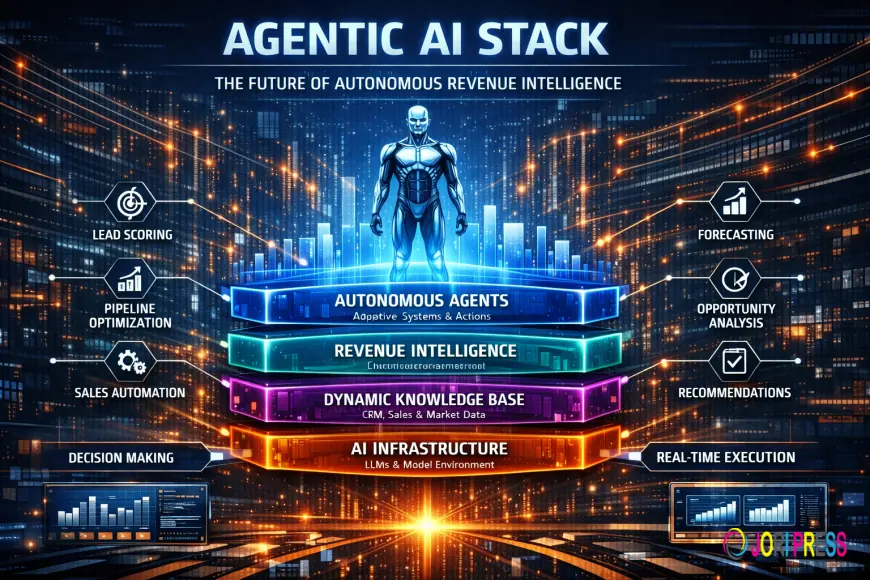
To understand how agentic systems function, it is useful to break the stack into layered components:
1. Data Ingestion Layer
This layer aggregates data from CRM systems, engagement platforms, call transcripts, marketing automation, and external intent sources. The broader and cleaner the dataset, the more powerful the reasoning engine becomes.
Organizations exploring integrating multiple sales AI tools often begin here — ensuring unified data pipelines before enabling autonomous intelligence.
2. Contextual Intelligence Layer
This is where predictive analytics models operate. Machine learning algorithms analyze historical patterns in deal progression, engagement velocity, stakeholder diversity, and win/loss ratios.
For deeper context on how predictive scoring works, revisit AI sales analytics, which explains the modeling backbone behind these systems.
3. Reasoning and Decision Engine
The defining characteristic of agentic AI lies here. Instead of merely assigning probabilities, the system evaluates multiple competing signals and determines the most impactful next action.
For example:
- If executive engagement declines but industry investment is accelerating, the system may recommend escalation rather than deprioritization.
- If multi-threading is weak in a late-stage deal, it may suggest adding stakeholders before forecast submission.
This decision layer transforms analytics into actionable intelligence.
4. Action and Workflow Automation Layer
Once a decision is formed, the system triggers alerts, task recommendations, pipeline re-prioritization, or automated workflows.
This aligns closely with broader revenue intelligence platform architectures, where unified data supports cross-functional coordination.
Why Agentic AI Matters for Enterprise Revenue Teams
Enterprise sales cycles are complex and dynamic. They involve long evaluation periods, multiple internal stakeholders, legal reviews, and procurement bottlenecks. Static dashboards cannot respond fast enough to this complexity.
Agentic AI provides:
- Continuous pipeline monitoring
- Autonomous risk detection
- Real-time expansion opportunity surfacing
- Intelligent forecast recalibration
For revenue leaders focused on understanding revenue intelligence holistically, agentic AI represents the operationalization of that strategy.
It reduces reliance on subjective rep updates and quarterly “deal inspection” rituals. Instead, it delivers always-on pipeline governance.
How SalesPlay Embeds Agentic Intelligence
SalesPlay by MarketsandMarkets integrates agentic AI principles within its broader revenue intelligence framework.
Unlike standalone automation tools, SalesPlay overlays internal deal signals with proprietary market intelligence data. This means the reasoning engine considers not only engagement patterns but also:
- Industry growth acceleration
- Technology adoption cycles
- Investment flow shifts
- Competitive saturation signals
For instance, if an account shows moderate engagement but operates in a rapidly expanding sector, SalesPlay may elevate its strategic priority. Conversely, a highly engaged account in a contracting market may be flagged for cautious forecasting.
This macro-micro alignment differentiates SalesPlay from conventional AI sales agents that operate in data silos.
For a broader strategic overview, the AI Sales Ultimate Guide explores how agentic intelligence integrates across the full revenue stack.
Agentic AI and Account-Centric Growth
One of the most powerful applications of agentic AI lies in account intelligence.
Instead of treating opportunities independently, the system evaluates account-level dynamics across all active deals, historical purchases, and industry indicators. This strengthens strategies outlined in Account Intelligence for Enterprise Sales Success.
The result is coordinated revenue orchestration:
- Expansion timing becomes data-driven
- Cross-sell campaigns align with industry demand cycles
- At-risk accounts are flagged before churn indicators appear
Agentic AI shifts account management from reactive support to proactive growth engineering.
Governance, Compliance, and Intelligent Autonomy
As autonomy increases, governance becomes essential. Enterprises must ensure AI-driven decisions remain compliant with data privacy and regulatory standards.
Best practices for AI governance and global compliance are explored in Compliance & Privacy in Global Sales Intelligence. Agentic systems must operate within transparent, auditable frameworks — especially when influencing revenue projections and customer engagement strategies.
SalesPlay’s architecture emphasizes explainability, ensuring leaders understand why specific recommendations are generated.
From Automation to Revenue Orchestration
The evolution from basic automation to predictive analytics to agentic AI marks a shift in how revenue organizations operate.
- Automation reduces manual effort.
- Predictive analytics improves decision accuracy.
- Agentic AI orchestrates revenue outcomes.
This progression supports scalability, particularly for organizations navigating growth phases described in Scalability Planning from Startup to Enterprise.
Agentic intelligence ensures that as complexity increases, clarity does not decline.
Frequently Asked Questions (FAQs)
What is agentic AI in sales?
Agentic AI refers to autonomous AI systems that analyze sales data, reason across multiple signals, and recommend or trigger actions without relying solely on predefined rules.
How is agentic AI different from sales automation?
Sales automation follows static workflows, while agentic AI dynamically learns from patterns and adapts recommendations based on contextual data.
Can agentic AI replace sales teams?
No. Agentic AI augments human decision-making by providing predictive insights and prioritized actions, enabling sellers to focus on strategic engagement.
How does SalesPlay implement agentic AI?
SalesPlay integrates predictive modeling with proprietary market intelligence from MarketsandMarkets, enabling autonomous deal risk detection and strategic account prioritization.
The future of enterprise sales is not just AI-assisted, it is AI-orchestrated. Organizations that embrace agentic intelligence gain continuous pipeline visibility, faster decision cycles, and measurable forecast confidence.
SalesPlay delivers the agentic AI stack required to move from reactive reporting to autonomous revenue growth.
What's Your Reaction?
 Like
0
Like
0
 Dislike
0
Dislike
0
 Love
0
Love
0
 Funny
0
Funny
0
 Angry
0
Angry
0
 Sad
0
Sad
0
 Wow
0
Wow
0