







































What Pakistani Shopify Merchants Should Look for Beyond Shopify Payments
Pakistani Shopify merchants should evaluate local payment methods, multi-gateway support, settlements, onboarding, and cross-border scalability.
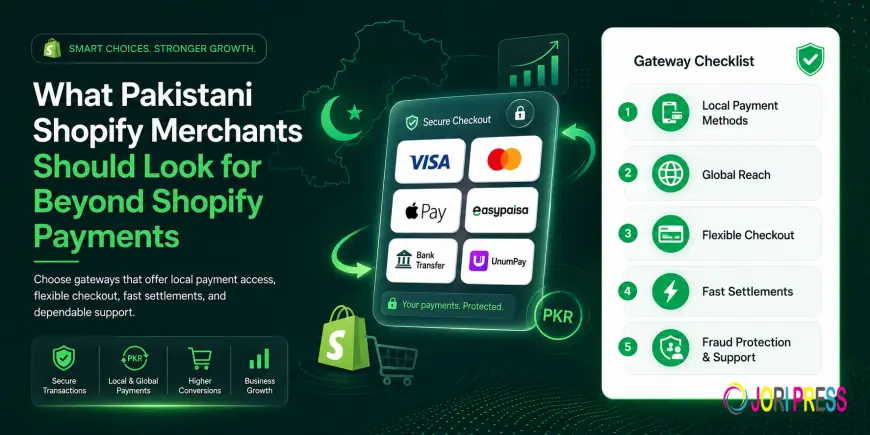
What Pakistani Shopify Merchants Should Look for Beyond Shopify Payments
For Pakistani merchants building a store on Shopify, the absence of Shopify Payments is one of the first realities to navigate. Shopify's built-in payment processor is unavailable in Pakistan, which means merchants cannot rely on the default setup that works in supported markets. Instead, they need to find, evaluate, and manage their own payment infrastructure.
This is not a disadvantage - it is an opportunity to build a payment setup that is genuinely suited to the Pakistani market rather than one designed for a different context entirely. But it does require knowing what to look for. This post outlines the key criteria Pakistani Shopify merchants should use when evaluating payment solutions beyond Shopify Payments.
Start With the Local Payment Landscape
The starting point for any Pakistani Shopify merchant evaluating payment solutions is understanding how Pakistani customers actually pay online. The answer is more varied than most merchants initially expect.
Card payments via Visa and Mastercard are the baseline for urban buyers. But a significant portion of Pakistani online shoppers rely on mobile wallets - JazzCash and Easypaisa in particular - as their primary or only digital payment method. Bank transfers matter for higher-value and business orders. Cash on Delivery remains relevant across most consumer product categories, especially for first-time buyers and customers in smaller cities.
Any payment solution worth considering for a Pakistani Shopify store needs to cover this full range. A setup that only handles card payments is not a complete setup - it is a partial one, and it will leave measurable revenue on the table from day one.

2. Look for Multi-Gateway Support From Day One
One of the most important things Pakistani merchants should look for beyond Shopify Payments is the ability to run multiple payment gateways simultaneously - not as a future upgrade, but as a foundational part of the initial setup.
A single gateway creates three problems:
● Limited buyer reach: Different customer segments prefer different payment methods. One gateway rarely covers all of them.
● Downtime risk: If the only active gateway goes down during a peak sales period, the store cannot accept any payments until it recovers.
● No optimisation room: With one provider, there is nothing to compare against - no way to evaluate success rates, fee structures, or regional performance across options.
Multi-gateway support from day one addresses all three. It gives buyers more payment options at checkout, provides a fallback if one provider experiences issues, and creates the data foundation for ongoing payment optimization as the store scales.
When evaluating any payment solution for a Shopify store in Pakistan, the first question should be: does this support multiple active gateways simultaneously, and how straightforward is the management?
3. Evaluate Settlement Visibility and Reporting
Settlement visibility is one of the most underestimated criteria when Pakistani merchants evaluate payment gateway options. It tends to become a priority only after it causes problems - usually when reconciliation becomes difficult or when finance teams struggle to piece together transaction data from multiple sources.
What to look for:
● Transaction-level visibility: Can you see each transaction, its status, and the associated order in one place?
● Settlement timelines: How quickly does each provider settle funds to your bank account, and is this clearly communicated?
● Reconciliation support: Is it easy to match payments received against orders placed without manual cross-referencing between platforms?
● Reporting flexibility: Can you generate reports by gateway, by date range, by payment method, or by market?
Merchants running multiple providers without unified reporting end up logging into separate dashboards, downloading separate reports, and manually combining data. This is manageable at low volumes but becomes a real operational burden as orders grow. A payment setup that centralises reporting from the start saves significant time and reduces the risk of reconciliation errors.
4. Check Merchant Onboarding Requirements Early
Every payment provider requires its own merchant account before it can go live on a Shopify store. This is one of the most practical - and most frequently underestimated - parts of building a payment setup in Pakistan.
Before committing to any provider, check:
● Document requirements: Most Pakistani payment providers require CNIC, business registration documents, and a local bank account. Some also require tax registration or additional compliance documentation.
● Approval timelines: Timelines vary significantly. Some providers approve accounts within 48 hours. Others take considerably longer, particularly for bank-based gateways.
● Ongoing compliance: Some providers have periodic review requirements or volume thresholds that affect account status.
For merchants planning to activate multiple gateways, running merchant onboarding applications in parallel - rather than sequentially - can reduce the overall setup time considerably. Building this into the project timeline from the start avoids delays that push back the store's payment go-live date.
5. Consider Checkout Reliability and Payment Operations
Checkout reliability directly affects conversion rates. A payment gateway that is slow to load, prone to errors, or unreliable under traffic spikes will cost sales regardless of how well the rest of the store is built.
When evaluating providers, look beyond marketing claims and assess:
● Transaction success rates: Ask providers directly about their average success rates for Pakistani transactions. Rates vary between providers based on their banking relationships and technical infrastructure.
● Hosted checkout quality: Many Pakistani bank gateways use hosted checkout pages. The quality of these pages - load speed, mobile optimisation, error handling - varies significantly and affects the buyer experience directly.
● Payment operations support: What happens when a transaction fails or a dispute arises? Does the provider have responsive local support, or are resolution timelines measured in days?
These factors are harder to evaluate from a spec sheet than transaction fees or supported payment methods - but they often have a bigger impact on actual store performance.
6. Think Beyond Pakistan From the Start
Pakistani Shopify merchants increasingly sell to customers in the UAE, Saudi Arabia, the UK, and other international markets. A payment setup built exclusively for local transactions will create friction as cross-border orders start coming in.
When evaluating payment solutions, check whether they support:
● International payment gateways alongside local Pakistani providers
● Multi-currency acceptance for buyers paying in AED, SAR, GBP, or other currencies
● Cross-border settlement without excessive conversion fees or delays
Building international capability into the payment setup from the start - even if cross-border orders are a small share of current volume - avoids having to rebuild the infrastructure later when that share grows.
7. The Case for a Unified Payment Platform
Managing multiple payment providers individually - separate integrations, separate merchant accounts, separate dashboards, separate reconciliation - is workable but increasingly inefficient as a store grows. Each provider adds operational overhead, and the cumulative effect is a payment operation that demands more time and attention than it should.
A unified payment platform addresses this by connecting multiple providers through a single integration and centralising all management in one place. Merchants activate gateways, monitor transactions, and reconcile payments from one dashboard rather than across several.
For Pakistani Shopify merchants specifically, this model suits the market well. The range of local payment methods required - wallets, bank gateways, fintech providers, and international processors - makes centralised management genuinely valuable. Platforms like Unumpay are built for exactly this setup, connecting Pakistani merchants to local and international payment providers through a single Shopify-approved integration with no coding required.
FAQs
What should Pakistani merchants prioritise when choosing a payment solution for Shopify?
Local payment method coverage first - JazzCash, Easypaisa, card acceptance, and COD - then multi-gateway support, settlement visibility, and scalability for international orders.
Why is multi-gateway support important for Pakistani Shopify stores?
It covers more buyer payment preferences, provides a fallback if one gateway goes down, and enables performance comparison across providers.
What documents are typically needed for merchant onboarding in Pakistan?
Most providers require CNIC, business registration documents, and a local bank account. Some also require tax registration.
How does a payment mediation platform differ from a single gateway?
A single gateway handles one provider. A mediation platform connects multiple providers through one integration, with unified reporting and management in one dashboard.
Can Pakistani Shopify merchants accept international payments?
Yes. By adding international gateways alongside local providers, merchants can accept payments in foreign currencies from buyers in the UAE, UK, and other markets.
What is the risk of relying on a single payment provider in Pakistan?
Downtime on that provider means no payments can be processed. It also limits buyer reach to customers who use that specific payment method.
Is it possible to manage multiple payment gateways without a developer?
Yes. Platforms like UnumPay connect multiple providers to Shopify without coding, with all management handled through one dashboard.
The Bottom Line
Moving beyond Shopify Payments in Pakistan is not just a matter of finding a substitute. It is an opportunity to build a payment setup that is better suited to the Pakistani market than Shopify Payments would have been anyway.
The merchants who do this well - covering local payment methods, running multiple providers, maintaining clear settlement visibility, and planning for cross-border growth - end up with a more resilient and more conversion-friendly payment operation than their counterparts in supported markets.
For Pakistani merchants evaluating their options, the criteria above provide a practical starting point. The goal is payment setup for shopify merchants in pakistan that works on day one and scales as the business grows.
What's Your Reaction?
 Like
0
Like
0
 Dislike
0
Dislike
0
 Love
0
Love
0
 Funny
0
Funny
0
 Angry
0
Angry
0
 Sad
0
Sad
0
 Wow
0
Wow
0