





































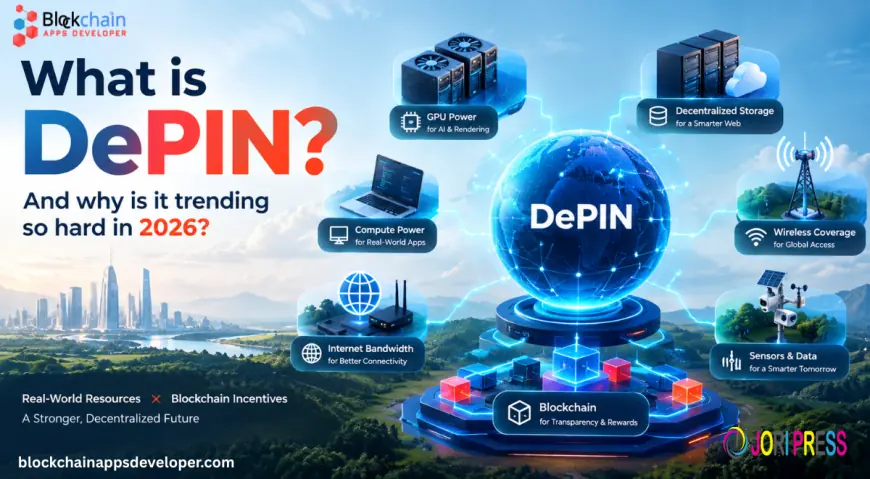
What is DePIN? And Why Is It Trending So Hard in 2026?
Explore DePIN in 2026, understand its growth, real-world use cases, and development potential. Read the key trends shaping Web3 infrastructure.
Introduction: The 2026 Tech Buzzword
DePIN, or Decentralized Physical Infrastructure Networks, has become one of the most discussed Web3 concepts in 2026 because it connects blockchain incentives with real-world infrastructure. From decentralized GPU networks to wireless connectivity and storage, DePIN lets people contribute physical resources and receive digital rewards, creating infrastructure networks without relying entirely on large centralized providers.
The idea is gaining attention alongside the rapid growth of AI, cloud computing, edge infrastructure, and decentralized networks. Projects such as Render Network, Helium, Bittensor, and Grass have helped push the concept beyond crypto-native communities.
Breaking It Down: What Exactly is DePIN?
DePIN (Decentralized Physical Infrastructure Networks) connects real-world infrastructure with blockchain incentives. People contribute resources such as GPUs, storage, bandwidth, or wireless coverage and earn tokens for verified contributions. This model forms the foundation of DePIN development, helping businesses build decentralized networks where infrastructure is distributed across many independent users instead of controlled by one central provider.
How It Works: The Invisible Web Built by Regular People
A DePIN network turns unused or underused physical resources into shared infrastructure. Users connect devices or resources to a protocol, the network measures their contribution, and blockchain-based mechanisms distribute rewards according to predefined rules.
For example, a participant might contribute:
-
Unused GPU capacity for AI or rendering workloads
-
Hard-drive storage for decentralized data networks
-
Internet bandwidth for decentralized connectivity
-
Wireless coverage through a compatible hotspot
-
Location or environmental data through connected sensors
The infrastructure can remain physically distributed while the blockchain provides a common coordination and incentive layer.
This model is particularly interesting for resources that are expensive when concentrated in a few data centers but are widely available across homes, businesses, and smaller operators.
The Passive Income Loop: What’s in It for the Users?
DePIN gives users an economic reason to contribute infrastructure by rewarding measurable network participation with cryptocurrency tokens. Instead of leaving computing power, storage, bandwidth, or other resources unused, participants can make those resources available to a network and potentially earn rewards.
The basic loop looks like this:
Provide Resource → Verify Contribution → Receive Tokens → Continue Supporting Network
The exact reward system differs between projects. Some networks may consider factors such as:
-
Amount of computing power supplied
-
Storage capacity and uptime
-
Network availability
-
Data contributed
-
Geographic coverage
-
Quality or reliability of service
-
Demand for the supplied resource
This makes DePIN different from simply holding cryptocurrency. The participant is contributing an actual resource to a functioning network.
However, rewards are not guaranteed income. Token prices, network demand, hardware costs, electricity, maintenance, and protocol economics can all affect profitability.
Why Is DePIN Trending So Hard in 2026?
DePIN is trending strongly in 2026 because the AI boom has increased demand for GPUs, computing capacity, data, and connectivity while companies and users are paying more attention to infrastructure costs, centralization, and data control. DePIN offers a model for distributing these resources across a larger contributor network.
Several trends are pushing the sector forward.
1. The AI Computing Boom
AI models require enormous amounts of computing power. GPUs have become valuable infrastructure for model training, inference, rendering, and other workloads.
DePIN networks can aggregate computing resources from multiple providers instead of depending exclusively on centralized cloud infrastructure.
Render Network is a well-known example of decentralized GPU infrastructure, particularly around distributed rendering and GPU computing.
2. GPU Capacity Has Become a Strategic Resource
The demand for advanced GPUs has created pressure around availability and infrastructure costs.
DePIN creates another possible supply layer by allowing independent GPU owners to contribute unused capacity.
This does not eliminate centralized cloud providers, but it creates an alternative model for sourcing computing resources.
3. Data Privacy and Centralization Concerns
Large technology platforms control significant amounts of computing infrastructure and user data.
DePIN can distribute parts of the infrastructure layer across independent participants. Depending on the architecture, this can reduce reliance on a single infrastructure operator and create more transparent mechanisms for resource coordination.
4. Real-World Utility
Earlier blockchain narratives often focused heavily on digital assets.
DePIN is different because its networks can provide physical-world services.
That makes the category interesting to developers, infrastructure providers, enterprises, investors, and Web3 users alike.
Real-World Impact: More Than Just Crypto Hype
DePIN networks are already being used to coordinate real-world resources such as wireless connectivity, GPU computing, decentralized storage, and data collection. Projects including Helium, Render Network, Bittensor, and Grass demonstrate how blockchain-based incentives can coordinate distributed contributors around useful digital or physical resources.
Examples include:
Helium
Helium uses decentralized infrastructure and community-operated hardware to build wireless networks. Participants can contribute network coverage through compatible devices while the protocol coordinates incentives.
Render Network
Render connects people needing GPU-based rendering and computing resources with contributors who provide GPU capacity.
Bittensor
Bittensor focuses on decentralized machine intelligence networks, using blockchain-based incentives to coordinate participants contributing AI-related computational or intelligence resources.
Grass
Grass is associated with a decentralized data network model where users contribute unused internet bandwidth and participate in a system designed around collecting and structuring web data.
These examples show why DePIN is attracting attention beyond traditional cryptocurrency discussions. The underlying question is practical:
Can millions of independent contributors collectively provide infrastructure that competes with or complements centralized systems?
That question will remain important as AI, edge computing, wireless networks, storage, and digital services continue expanding.
Why Choose BlockchainAppsDeveloper to Build Your Next DePIN Project?
BlockchainAppsDeveloper helps businesses build DePIN networks with practical Web3 expertise, secure smart contracts, and scalable infrastructure. As an experienced blockchain development company, we can support your project from network architecture and token mechanics to dApp development and deployment. The focus stays on building reliable technology that can handle real users, infrastructure providers, and growing network demand.
What's Your Reaction?
 Like
0
Like
0
 Dislike
0
Dislike
0
 Love
0
Love
0
 Funny
0
Funny
0
 Angry
0
Angry
0
 Sad
0
Sad
0
 Wow
0
Wow
0