









































SAP IS Oil & Gas Training: Build Expertise in Energy Operations
Learn SAP IS Oil & Gas Training to master industry-specific processes, procurement, logistics, inventory management, and SAP solutions through practical training.

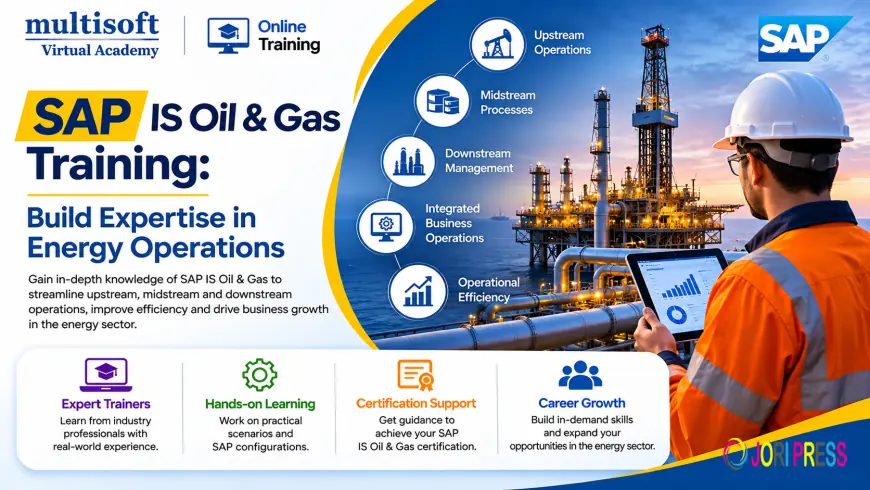
The oil and gas industry depends on complex business processes involving hydrocarbon management, product pricing, transportation, inventory, distribution, and financial operations. Managing these activities requires specialized enterprise systems that can connect operational workflows with business information. SAP Industry Solution for Oil & Gas (SAP IS-Oil) addresses industry-specific requirements through dedicated functionality and integrated business processes.
SAP IS Oil & Gas Training helps professionals understand how SAP supports the commercial and operational activities of petroleum and energy organizations. It introduces specialized areas such as Hydrocarbon Product Management, Marketing Accounting and Pricing, Marketing Contracts and Order Entry, Transportation and Distribution, and Traders and Schedulers Workbench.
For SAP consultants, oil and gas professionals, business analysts, and implementation specialists, this knowledge can provide a foundation for working with industry-specific SAP processes. It can also help professionals understand how traditional SAP IS-Oil functionality relates to modern SAP S/4HANA Oil, Gas and Energy solutions.
What Is SAP IS Oil & Gas?
SAP IS Oil & Gas is an industry-specific SAP solution designed to address business requirements across the petroleum and energy value chain. Unlike standard ERP processes, oil and gas operations involve specialized requirements related to hydrocarbon quantities, product movement, pricing formulas, transportation scheduling, exchange agreements, and regulatory duties.
The solution supports processes that connect different business functions, including procurement, sales, inventory, logistics, accounting, and distribution.
For example, an oil company may purchase crude oil, transport it to a refinery, process it into petroleum products, store those products, and distribute them to customers. Each activity involves business information that must be managed and coordinated.
SAP IS-Oil helps organizations manage relevant processes through industry-oriented functionality. Learning the solution requires an understanding of both SAP configuration concepts and the operational terminology used in the oil and gas industry.
Why Is SAP IS Oil & Gas Training Important?
Oil and gas organizations operate in an environment where product quantities, pricing conditions, transportation activities, and inventory movements require careful management. Professionals need to understand how these activities interact with enterprise systems.
A structured SAP IS Oil & Gas Course can help learners develop knowledge in the following areas:
- Industry-specific SAP business processes
- Hydrocarbon product management
- Quantity conversion and inventory management
- Oil industry pricing and accounting
- Marketing contracts and order processing
- Transportation and distribution
- Tariffs, duties, and permits
- Product exchanges and agreements
- Traders and Schedulers Workbench
- Integration with other SAP modules
- Implementation and configuration concepts
This specialized knowledge can be useful for professionals who already understand SAP ERP and want to develop expertise in the energy sector.
Key Functional Areas Covered in SAP IS Oil & Gas Training
A comprehensive SAP IS Oil & Gas Training Course should cover the functional areas that support the industry's commercial and operational activities. The following topics provide a useful learning structure.
1. Hydrocarbon Product Management (HPM)
Hydrocarbon Product Management is an important functional area for organizations handling petroleum products and related materials. Oil and gas businesses must maintain accurate product quantities and manage movements across storage locations and distribution points.
HPM introduces specialized processes for handling hydrocarbon quantities and product-related information.
Important learning topics include:
- Silo management
- Quantity conversion
- Material master configuration
- Product quantity management
- Unit-of-measure considerations
- Quantity conversion in the sales cycle
- Relevant configuration settings
Why it matters: Petroleum products may be measured using different units depending on operational and commercial requirements. Understanding quantity conversion helps professionals recognize how product quantities are represented and processed in SAP.
2. Marketing, Accounting and Pricing (MAP)
Pricing in the oil and gas industry can be more complicated than standard product pricing. Commercial agreements may involve formula-based pricing, average prices, time-dependent conditions, external pricing references, and adjustments.
The MAP functional area introduces learners to specialized pricing and accounting requirements.
Topics may include:
- Oil industry pricing scenarios
- Formula and average pricing
- Gross and net pricing
- Contract-based pricing
- Time-dependent pricing
- Differential invoicing
- Differential reference codes
- External agencies in pricing
- Pricing master data
- Customer master settings
- Related configuration activities
Why it matters: Understanding these processes helps consultants analyze pricing requirements and recognize how commercial agreements affect sales and billing transactions.
3. Marketing, Contracts and Order Entry (MCOE)
Oil and gas organizations frequently manage complex sales agreements and product supply arrangements. Marketing, Contracts and Order Entry supports business processes involving contracts, orders, and related commercial conditions.
Training can introduce the following concepts:
- Sales contract processing
- Sales order management
- Contract call-off restrictions
- Alternate plant determination
- Item category redetermination
- Order entry processes
- Customer and material master data
- Contract-related configuration
Why it matters: Professionals need to understand how customer agreements are translated into operational sales transactions. Knowledge of MCOE can help learners follow the relationship between contract conditions, order creation, and product delivery.
4. Transportation and Distribution (TD)
Transportation and Distribution is particularly relevant to petroleum companies because products may move through pipelines, tankers, trucks, terminals, and storage facilities.
The movement of bulk products requires coordination between transportation resources, scheduling activities, loading operations, and delivery confirmation.
Important topics include:
- Bulk transportation processes
- Transport units
- Vehicle and driver information
- Vehicle meters and rack meters
- Transportation scheduling
- Loading confirmation
- Delivery confirmation
- Terminal Automation System (TAS)
- Transportation Planning Interface (TPI)
- Transportation-related configuration
Why it matters: Understanding TD helps professionals see how transportation activities connect with sales, inventory, and logistics processes. It also introduces the operational information required to manage product movement.
5. Tariffs, Duties and Permits (TDP)
Oil and gas companies may need to manage duties, taxes, permits, and other regulatory requirements associated with product movement and commercial transactions.
The TDP area introduces industry-related concepts used to represent these requirements within SAP processes.
Key learning areas may include:
- Excise duty concepts
- Handling types
- Valuation types
- Excise duty groups
- Excise duty rates
- Duty claims and liabilities
- License management concepts
- Master data settings
- Sales processes involving duties
- Related configuration
Why it matters: A clear understanding of duties and permits helps consultants recognize the relationship between regulatory requirements, commercial transactions, and financial records.
6. Exchanges
Product exchanges are common in certain oil and gas business arrangements. Organizations may exchange products or quantities with business partners according to commercial agreements.
The Exchanges area introduces the concepts and processes associated with these transactions.
Topics may include:
- Exchange agreements
- Exchange partners
- Product exchange scenarios
- Sales processes based on exchange agreements
- Logical Inventory Adjustment (LIA)
- Netting concepts
- Related master data
- Configuration requirements
Why it matters: Exchange processes can involve multiple parties and inventory adjustments. Understanding these concepts helps professionals follow how contractual arrangements are reflected in operational records.
7. Traders and Schedulers Workbench (TSW)
Traders and Schedulers Workbench supports specialized oil and gas activities involving product movements, nominations, transportation systems, and scheduling.
It is particularly relevant to organizations that coordinate bulk commodity movements and transportation arrangements.
Training may cover:
- Locations and transport systems
- Business partner roles
- Nomination management
- Ticketing
- Sales-side TSW processes
- Junction functions
- Transportation scheduling
- Master data requirements
- Configuration concepts
- Integration with other SAP applications
Why it matters: TSW knowledge helps professionals understand how trading and scheduling activities relate to physical product movements and supply chain operations.
Other Important SAP IS-Oil Functional Areas
Beyond the major functional areas, a specialized course may introduce additional capabilities relevant to different oil and gas business models.
Marketing Retail Network (MRN)
MRN relates to retail network activities involving fuel distribution and service station operations. Learners can explore how retail-related business information connects with product supply and distribution processes.
Bulk Distribution Replenishment Planning (BDRP)
BDRP introduces concepts associated with replenishment planning for bulk product distribution. It can help learners understand how supply requirements and distribution activities are coordinated.
Service Station Retailing (SSR)
Service Station Retailing addresses processes related to retail fuel operations and service station business activities. The specific functionality covered depends on the implementation and course scope.
Revenue and Logistics Management (RLM)
RLM introduces additional industry-related process concepts. Learners should confirm the exact functionality and configuration topics included in their selected training program.
Production and Revenue Accounting (PRA) and Joint Venture Accounting (JVA)
PRA and JVA are relevant to certain upstream oil and gas business arrangements. These areas introduce accounting requirements associated with production, revenue distribution, and joint venture operations.
Understanding these concepts can help professionals recognize the relationship between operational activities and financial responsibilities.
SAP IS Oil & Gas Implementation: Important Concepts
Learning SAP IS-Oil becomes more valuable when professionals understand how its functionality is applied during implementation projects.
An SAP IS Oil & Gas Implementation project generally begins with an assessment of business requirements. The project team studies existing processes and determines how the SAP environment should support the organization's operational and commercial needs.
A typical implementation approach includes:
- Requirement gathering: Understand the organization's business model, processes, and operational challenges.
- Business process analysis: Study activities involving procurement, sales, pricing, inventory, transportation, and accounting.
- Solution design: Map business requirements to appropriate SAP functionality.
- Configuration: Set up relevant organizational structures, master data, and business process settings.
- Integration: Coordinate SAP IS-Oil processes with relevant SAP modules and external applications.
- Testing: Validate business scenarios, data accuracy, and process outcomes.
- Data migration: Prepare and validate required master and transactional data.
- User training: Help business users understand the configured processes.
- Go-live preparation: Complete deployment checks and operational readiness activities.
- Post-implementation support: Resolve issues and improve processes after deployment.
Implementation requirements differ between organizations. Professionals should therefore develop both functional knowledge and an understanding of the business environment in which the solution operates.
SAP IS Oil & Gas and SAP S/4HANA
SAP S/4HANA is an important part of the modern SAP enterprise landscape. SAP's Oil, Gas and Energy learning resources cover industry processes and solution capabilities connected with SAP S/4HANA and intelligent enterprise operations.
Professionals interested in modern energy-sector projects can benefit from understanding the relationship between traditional SAP IS-Oil processes and newer SAP technologies.
Related learning areas include:
- SAP S/4HANA fundamentals
- Oil, Gas and Energy business processes
- SAP Fiori applications
- SAP Finance integration
- Materials Management
- Sales and Distribution
- Supply chain management
- Business partner concepts
- Data migration
- Reporting and analytics
- System integration
It is important to distinguish between learning traditional SAP IS-Oil functionality and studying current SAP S/4HANA Oil, Gas and Energy capabilities. The relevant topics depend on the organization's SAP release, deployment model, and implementation scope.
Who Should Enroll in SAP IS Oil & Gas Training?
This training can be useful for professionals who want to combine SAP knowledge with oil and gas industry expertise.
SAP Functional Consultants: Professionals working with SAP MM, SD, FI, or logistics can expand their understanding of industry-specific processes.
Oil and Gas Professionals: Individuals working in petroleum operations, distribution, transportation, inventory, or commercial functions can learn how SAP supports business workflows.
SAP Implementation Consultants: Consultants can develop knowledge of specialized functionality, configuration concepts, and integration requirements.
Business Analysts: Analysts can improve their understanding of industry processes and participate more effectively in requirement-gathering activities.
Project Managers: Project professionals can gain a broader view of the functional areas involved in oil and gas SAP projects.
Fresh Graduates and Career Changers: Learners with relevant educational backgrounds can use introductory training to explore SAP and energy-sector business processes.
Basic SAP knowledge and familiarity with oil and gas terminology can make the learning process easier.
Career Opportunities After SAP IS Oil & Gas Training
Specialized SAP knowledge can complement several career paths in the energy and enterprise technology sectors.
Potential roles include:
- SAP IS-Oil Functional Consultant
- SAP Oil and Gas Consultant
- SAP MM Consultant
- SAP SD Consultant
- SAP Implementation Consultant
- SAP Business Analyst
- SAP Application Support Consultant
- SAP Logistics Consultant
- SAP Project Support Professional
Career opportunities depend on qualifications, practical skills, project exposure, and employer requirements. Training alone does not guarantee employment, but it can help professionals develop a foundation for relevant responsibilities.
How to Choose the Right SAP IS Oil & Gas Course
Before enrolling in an SAP IS Oil & Gas Online Training program, consider the following factors:
Check the curriculum: Look for coverage of HPM, MAP, MCOE, TD, TDP, Exchanges, and TSW if these areas match your learning objectives.
Evaluate practical exercises: Ask whether the course includes configuration demonstrations, master data activities, and business process scenarios.
Review trainer experience: An instructor with relevant SAP and oil and gas domain knowledge can explain how software functionality relates to actual industry operations.
Confirm software access: Understand which SAP environment and version will be used during training and whether practice access is included.
Understand certification details: Check whether the program provides a course-completion certificate or prepares learners for a separate SAP certification.
Explore implementation coverage: If your goal is consulting, choose a course that explains business requirements, configuration, integration, and testing rather than focusing only on basic navigation.
Frequently Asked Questions
What is SAP IS Oil & Gas Training?
SAP IS Oil & Gas Training introduces industry-specific SAP processes used in petroleum and energy businesses. It may cover hydrocarbon management, pricing, contracts, transportation, distribution, duties, exchanges, and scheduling.
What are the main modules of SAP IS-Oil?
Important functional areas include Hydrocarbon Product Management, Marketing Accounting and Pricing, Marketing Contracts and Order Entry, Transportation and Distribution, Tariffs Duties and Permits, Exchanges, and Traders and Schedulers Workbench.
Is SAP IS Oil & Gas suitable for beginners?
Beginners can start with an introductory course, particularly if it explains SAP fundamentals and oil industry business processes before moving into configuration and advanced functionality.
What is the difference between SAP IS-Oil and SAP S/4HANA Oil and Gas?
SAP IS-Oil refers to specialized industry functionality associated with SAP's traditional Oil and Gas industry solution. SAP S/4HANA Oil, Gas and Energy learning covers modern SAP capabilities and industry processes in the S/4HANA landscape. The relevant functionality depends on the specific release and implementation.
Does SAP IS Oil & Gas training include implementation?
Course coverage varies. Some programs introduce configuration, master data, integration, testing, and implementation concepts. Review the syllabus to confirm the depth of practical implementation coverage.
Conclusion
The oil and gas industry requires specialized enterprise processes to manage hydrocarbons, product pricing, commercial contracts, transportation, distribution, inventory, and financial activities. Developing knowledge of SAP IS-Oil can help professionals understand how these processes are represented and coordinated within an integrated SAP environment. Learning areas such as HPM, MAP, MCOE, TD, TDP, Exchanges, and TSW provide a strong foundation for understanding industry-specific requirements, while SAP S/4HANA knowledge can broaden awareness of modern energy-sector transformation. For professionals and organizations seeking structured, industry-focused learning, Multisoft Virtual Academy offers SAP IS Oil & Gas Training designed to build functional knowledge through instructor-led learning, practical concepts, and relevant business process coverage.
What's Your Reaction?
 Like
0
 Dislike
0
 Love
0
 Funny
0
 Angry
0
 Sad
0
 Wow
0