






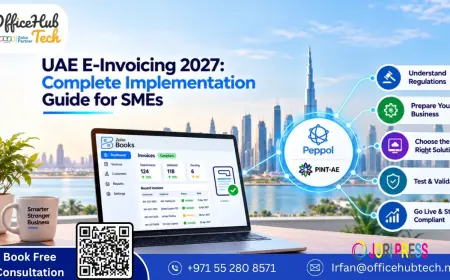
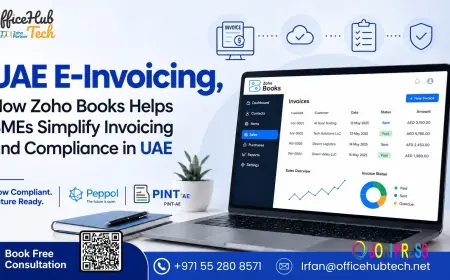





























UAE E-Invoicing Guide: How Zoho Books Helps SMEs with PINT-AE, Peppol & Compliance
Learn how UAE e-invoicing works, including PINT-AE, Peppol and ASP requirements, and how Zoho Books can help SMEs prepare for compliance.

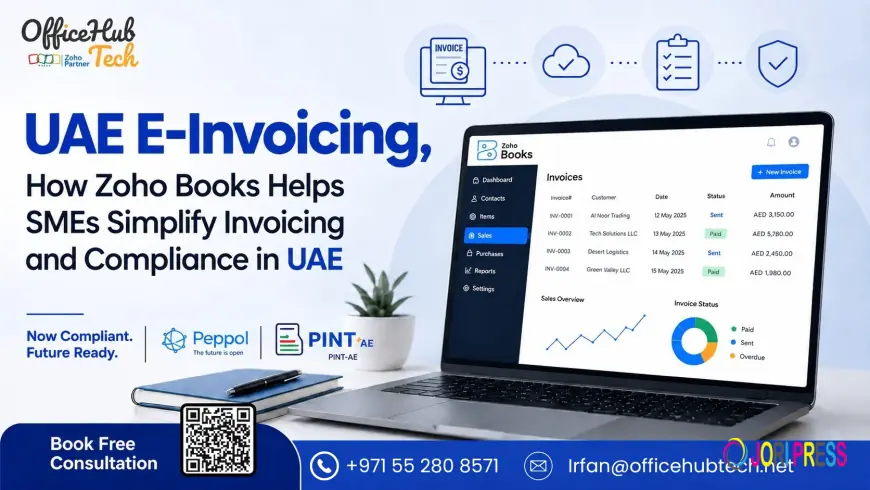
A Practical Guide to UAE E-Invoicing, PINT-AE, Peppol & Zoho Books
What Is E-Invoicing in the UAE?
UAE e-invoicing involves creating, exchanging, and processing invoice data in a structured, machine-readable format. Unlike a PDF sent by email, an e-invoice enables business systems to validate and process invoice information automatically.
The UAE framework uses PINT-AE, Peppol, and Accredited Service Providers (ASPs) to support electronic invoice exchange and tax reporting.
|
PDF/Digital Invoice |
UAE E-Invoice |
|
Designed primarily for human reading |
Designed for machine processing |
|
Usually shared through email |
Exchanged through the e-invoicing network |
|
May contain unstructured information |
Contains structured invoice data |
|
May require manual data entry |
Supports automated processing |
|
PDF, image, or scanned document |
Structured XML based on PINT-AE |
Businesses evaluating an e-invoicing software and solutions provider should verify support for structured data, XML generation, validation, and electronic exchange.
How Does E-Invoicing Work in the UAE?
The UAE e-invoicing framework follows a Decentralized Continuous Transaction Control and Exchange (DCTCE) 5-Corner Model.
- Corner 1 – Supplier: Creates the electronic invoice.
- Corner 2 – Supplier's ASP: Processes and transmits the invoice.
- Corner 3 – Buyer's ASP: Receives and processes the invoice.
- Corner 4 – Buyer: Receives the structured invoice.
- Corner 5 – FTA: Receives relevant tax data through the framework.
The exchange flow is:
Supplier → Supplier ASP → Buyer's ASP → Buyer
The FTA receives relevant tax information through the prescribed reporting framework.
This model enables businesses using different accounting systems to exchange invoices through a standardized infrastructure.
What Is Peppol and Why Does It Matter for UAE E-Invoicing?
Peppol is an interoperability framework that enables businesses using different software systems to exchange standardized electronic documents.
In the UAE e-invoicing ecosystem, Peppol supports electronic invoice exchange through the relevant ASP infrastructure. Suppliers and buyers do not necessarily need to use the same accounting platform.
The key components are:
- PINT-AE: Defines UAE-specific invoice requirements.
- Peppol: Provides the interoperability framework.
- ASP: Facilitates the required e-invoicing services and exchange.
- Zoho Books: Provides the accounting and invoicing environment.
What Is an Access Point?
An Access Point is a technical connection used to exchange electronic documents through Peppol. Within the UAE framework, ASPs perform the relevant connectivity and e-invoicing functions.
When evaluating Peppol e-invoicing compliance software, businesses should assess connectivity, XML validation, participant identification, invoice transmission, status tracking, credit-note handling, security, and error management.
What Is PINT-AE?
PINT-AE is the UAE-specific implementation of the Peppol International Invoice specification. It defines how invoice information must be structured, including mandatory fields, code lists, and validation rules.
In simple terms, Peppol provides the exchange framework, PINT-AE defines the invoice structure, and XML represents the invoice data in a machine-readable format.
What Information Does a PINT-AE E-Invoice Contain?
Depending on the transaction, invoice data may include:
- Supplier and buyer details
- Applicable tax identification
- Invoice number and date
- Product or service descriptions
- Quantities and unit prices
- Tax categories, rates, and amounts
- Invoice totals and payment information
- Relevant credit-note references
Incorrect customer details, tax classifications, pricing, or accounting mappings can cause validation failures. Businesses should therefore review data quality before implementation.
Why XML Matters in UAE E-Invoicing
XML (Extensible Markup Language) represents invoice information in structured fields that business systems can interpret automatically.
It enables systems to identify the supplier, buyer, products or services, quantities, prices, VAT treatment, totals, and payment information without manually reading a document.
For UAE e-invoicing, invoice data must follow the applicable PINT-AE XML requirements. Generating an XML file alone is not sufficient; the data must also satisfy the relevant validation rules.
What Is an Accredited Service Provider (ASP)?
An Accredited Service Provider is a provider accredited under the UAE Ministry of Finance's e-invoicing framework.
Depending on its services and the implementation, an ASP supports invoice validation, structured data processing, Peppol exchange, transaction status messages, and applicable reporting requirements.
Businesses within the scope of mandatory e-invoicing must plan their ASP arrangements according to the applicable implementation requirements. Provider accreditation and capabilities should be verified before selection.
How Does Zoho Books Support UAE E-Invoicing?
Zoho Books can serve as the accounting and invoicing layer for managing customer transactions, invoices, credit notes, payments, and financial records.
Its UAE e-invoicing offering includes capabilities such as PINT-AE XML generation, VAT accounting, credit-note management, and related invoice workflows.
A simplified process is:
Business Transaction → Zoho Books → Invoice Data → PINT-AE XML → ASP/Peppol → Buyer
This approach connects invoicing with the broader financial process rather than treating electronic invoicing as a separate document-generation task.
Is Zoho Books Enough for UAE E-Invoicing?
Zoho Books provides an important foundation, but successful implementation depends on the complete setup.
Businesses should review:
- UAE VAT and tax configuration
- Customer and supplier records
- Structured invoice data and PINT-AE requirements
- Credit-note workflows
- ASP connectivity and Peppol exchange
- Integration, validation, and transaction-status handling
The required configuration and capabilities should be confirmed for the specific organization and implementation.
Zoho Peppol Integration: How Does It Work?
Zoho Peppol integration connects financial information maintained in Zoho Books with the relevant e-invoicing exchange process.
The implementation typically involves:
- Invoice data extraction: Retrieve the required financial information.
- Data mapping: Map Zoho Books fields to applicable PINT-AE fields.
- Validation: Check mandatory details, tax information, line items, and totals.
- XML processing: Generate structured invoice data according to PINT-AE.
- ASP connectivity: Connect to the selected provider through the supported integration.
- Peppol transmission: Exchange invoices through the prescribed infrastructure.
- Status handling: Track accepted, rejected, and other transaction responses.
- Exception management: Identify errors and route transactions for correction.
- Credit-note processing: Handle adjustments using the applicable electronic credit-note process.
The integration architecture depends on the selected ASP, available interfaces, existing systems, and business requirements.
Why E-Invoicing Matters for SMEs
As SMEs grow, invoicing becomes connected to VAT, accounts receivable, reconciliation, reporting, and cash-flow management.
Manual processes can create duplicate entries, incorrect tax calculations, delayed processing, reconciliation difficulties, and limited visibility into invoice status.
E-invoicing standardizes invoice data and supports more automated financial operations. Beyond regulatory preparation, it can help businesses improve data consistency, reduce repetitive work, and establish processes that scale with growth.
UAE E-Invoicing Timeline: When Should SMEs Prepare?
The published UAE implementation schedule includes the following phases:
|
Phase |
Business Category |
Mandatory Implementation |
|
Pilot / voluntary |
Selected participants and early adopters |
From 1 July 2026 |
|
Phase 1 |
Businesses with annual revenue of AED 50 million or more |
1 January 2027 |
|
Phase 2 |
Businesses with annual revenue below AED 50 million |
1 July 2027 |
|
Phase 3 |
UAE government entities |
1 October 2027 |
For Phase 1 businesses, the ASP appointment deadline was extended to 30 October 2026, while the mandatory implementation date remains 1 January 2027.
Businesses should confirm the latest applicable requirements and begin reviewing data, accounting configuration, integrations, testing, and staff readiness well before their deadlines.
How SMEs Can Prepare for UAE E-Invoicing
1. Assess Your Existing Invoicing System
Document how invoices are created, approved, issued, corrected, and stored. Identify whether invoice information originates in accounting software or other business applications.
2. Check Your Financial Data
Review customer and supplier records, tax details, product information, pricing, invoice numbering, payment details, and credit-note relationships. Correct inconsistent or incomplete data before implementation.
3. Evaluate Your Accounting Platform
Your software for e invoicing should support the applicable structured-data requirements and required integration capabilities. Zoho Books users should review their current UAE configuration and e-invoicing setup.
4. Select an ASP
Evaluate accreditation, PINT-AE support, Peppol connectivity, integration options, security, pricing, reliability, and ongoing support.
5. Plan the Integration
Map how invoice information will move between the accounting platform and the ASP. Depending on the environment, this may require APIs, connectors, middleware, or custom development.
6. Test Before Going Live
Test invoice creation, mandatory fields, XML generation, validation, transmission, buyer receipt, status messages, rejected invoices, credit notes, error correction, and record retention.
7. Train Your Finance Team
Prepare employees to handle transaction statuses, rejected invoices, corrections, credit notes, exceptions, and system issues.
Choosing E-Invoicing Software for UAE Business: What Should You Look For?
Choosing an E-Invoicing Software For UAE Business requires more than comparing invoice templates.
Evaluate whether the solution supports:
- UAE e-invoicing requirements and PINT-AE
- Structured XML and invoice validation
- Peppol connectivity and ASP integration
- Credit-note processing and data mapping
- API integration with existing systems
- Transaction status tracking and error handling
- Audit trails, security, and scalability
For Zoho Books users, the priority is ensuring that accounting data, the selected ASP, and the e-invoicing exchange process work together within a reliable financial workflow.
Common E-Invoicing Challenges and How Zoho Can Help
Challenge 1: Your Existing Invoices Are Not Structured
PDF-based invoicing does not provide the structured data required by the UAE framework.
How Zoho helps: Zoho Books' UAE e-invoicing capabilities support structured invoice processing, including PINT-AE XML generation.
Challenge 2: Incomplete or Incorrect Financial Data
Missing customer details, tax information, or incorrect field mapping can cause validation failures.
How Zoho helps: Centralized financial records and appropriate configuration help improve data consistency before transmission.
Challenge 3: Peppol Integration Is Technically Complex
Connecting accounting software to an ASP requires appropriate data mapping, connectivity, and response handling.
How Zoho helps: Zoho Books provides the accounting layer, while the selected ASP and integration architecture support electronic exchange.
Challenge 4: Rejected E-Invoices
Rejected transactions require investigation and correction.
How Zoho helps: Defined exception workflows can help finance teams identify errors, correct data, and follow the applicable credit-note process where required.
Challenge 5: Legacy Financial Data
Historical accounting records may require cleanup and mapping before moving into a new environment.
How Zoho helps: Zoho Books can be configured as the target accounting platform, with relevant historical data assessed and migrated as part of implementation.
How OfficeHub Tech Can Help With UAE E-Invoicing
OfficeHub Tech supports businesses preparing their Zoho Books environment for UAE e-invoicing through:
- System Readiness Assessment: Identify gaps in existing invoicing and accounting processes.
- Zoho Books Configuration: Review tax settings and financial workflows.
- PINT-AE Readiness: Assess invoice data and required fields.
- ASP and Peppol Integration: Support the required technical connectivity.
- Financial Data Migration: Clean, map, and migrate relevant records.
- API and Third-Party Integration: Connect other business applications where required.
- Testing and Validation: Test invoice processing, transmission, and exception scenarios.
- Custom E-Invoicing Workflows: Develop additional workflows or portals where necessary.
- User Training: Prepare finance and operational teams for the new processes.
The objective is to help businesses establish a structured, connected invoicing process aligned with their operational and technical requirements.
UAE eInvoicing: Zoho Becomes an Accredited Service Provider
Zoho Software Trading LLC is included in the UAE Ministry of Finance's list of Accredited Service Providers, with accreditation number 121988. This provides businesses evaluating Zoho with an additional option for their e-invoicing implementation.
For Zoho Books users, this development is relevant because the accounting platform and the e-invoicing service can form part of a connected financial process.
However, ASP accreditation alone does not guarantee that a business is compliant. Organizations must still review their financial data, configure the required settings, validate PINT-AE fields, establish the appropriate exchange process, and test transaction handling.
Why Businesses Should Start Preparing Now
E-invoicing can affect customer records, tax information, accounting systems, integrations, credit notes, reporting, audit trails, and employee responsibilities.
Businesses with legacy systems, customized billing processes, multiple transaction sources, or complex approval workflows may need additional preparation.
Starting early allows teams to identify gaps, clean data, plan integrations, test transactions, and address operational issues before their applicable deadlines.
Businesses seeking a Zoho implementation and integration Partner in UAE can work with OfficeHub Tech to assess their existing environment and develop an implementation roadmap.
Conclusion
UAE e-invoicing introduces a structured approach to creating, validating, exchanging, and reporting invoice information through PINT-AE, XML, Peppol, and Accredited Service Providers.
Zoho Books can support the accounting and invoicing process, but successful implementation also requires accurate financial data, appropriate configuration, ASP arrangements, integration, testing, and exception management.
By reviewing these requirements early, SMEs can prepare their systems and teams for the transition while building more consistent and scalable financial operations. OfficeHub Tech can help assess existing systems and plan the Zoho Books configuration and integration work required for the business's e-invoicing needs.
What's Your Reaction?
 Like
0
 Dislike
0
 Love
0
 Funny
0
 Angry
0
 Sad
0
 Wow
0