









































A Practical Guide to Selecting Sociology Study Material for UPSC Optional

Preparing for UPSC Sociology Optional can become challenging when aspirants have access to too many books and study resources. The main difficulty is not finding material but identifying what is relevant and learning how to use it effectively. A well-planned reading strategy helps students save time, understand important concepts and prepare more confidently for the examination.
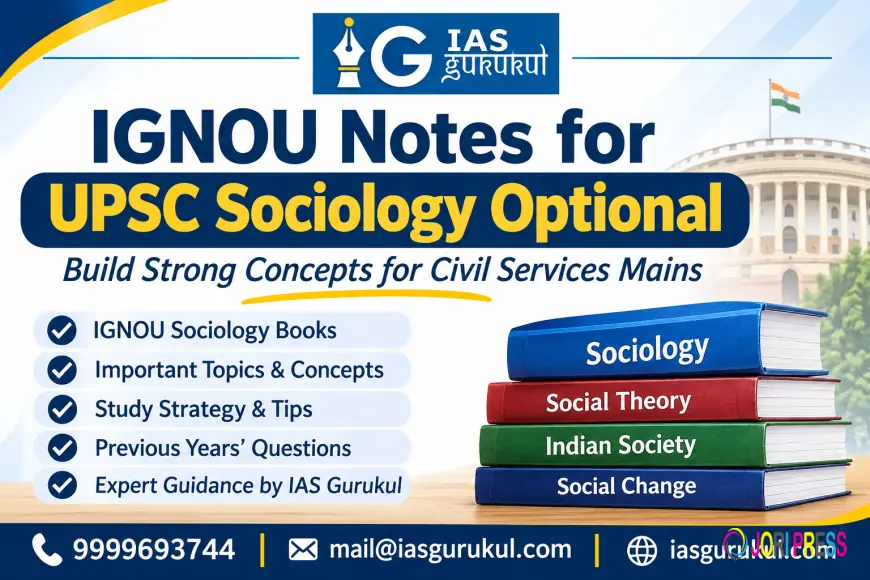
For aspirants looking to strengthen their subject knowledge, IGNOU Sociology Books can be a useful supplementary resource. Students can also explore the IAS Gurukul Books and Notes section, NCERT Sociology Books and NIOS Sociology Books to find additional reading material. The key is to select resources according to the syllabus rather than trying to study everything available.
For a better understanding of answer presentation and examination requirements, Sociology Toppers' Notes and Sociology Optional Previous Year Question Papers can also be useful. Aspirants interested in structured guidance may explore UPSC Sociology Courses, the Sociology Optional Classroom Course, the 70-Day Sociology Optional Test Series and the 35-Day Sociology Optional Test Series.
Start with the Syllabus, Not the Number of Books
Before beginning any book, aspirants should understand the complete Sociology Optional syllabus. It provides a clear direction and helps identify which chapters deserve attention.
Paper I introduces the fundamental aspects of Sociology, including sociological thinkers, research methods, social institutions and theoretical approaches. Paper II focuses on Indian society, its structures, challenges and transformations.
A simple method is to divide the syllabus into smaller topics and prepare a reading plan for each section. This makes it easier to track progress and avoid unnecessary repetition.
Develop a Clear Understanding of Sociological Concepts
Sociology involves understanding relationships between individuals, groups and institutions. Topics such as socialisation, stratification, social change, religion, family and education should be studied with attention to their meaning and practical relevance.
IGNOU material can support this learning process by providing explanations of different subjects. While reading, aspirants should focus on understanding the central argument rather than memorising every sentence.
For example, while studying social change, students can explore how industrialisation, urbanisation, education and technology influence traditional social structures. Such connections help develop a broader understanding of the subject.
Prepare Short and Organised Notes
Note-making is an important part of long-term preparation. However, notes should not become another version of the textbook. They should contain the information that is useful for revision and answer writing.
Aspirants can organise their notes under the following headings:
-
Important definitions and sociological terms.
-
Key thinkers and their contributions.
-
Major theories and perspectives.
-
Relevant examples from Indian society.
-
Important arguments and criticisms.
This structure makes it easier to revise topics and include relevant information in answers.
Connect Theory with Contemporary Society
A strong Sociology answer often demonstrates how theoretical knowledge can explain real social developments. Aspirants should regularly observe issues related to caste, gender, migration, urbanisation, education, inequality and changing family patterns.
For instance, the study of gender can be connected with employment opportunities, education and changing household responsibilities. Similarly, urbanisation can be examined through migration, housing, employment and changing community relationships.
These connections help students move beyond basic definitions and develop analytical answers.
Practise Previous Year Questions Regularly
Reading without practice can make preparation incomplete. Previous year questions help aspirants understand the examination pattern and identify the type of analysis expected.
After completing a topic, try writing answers within the prescribed word limit. Focus on presenting a clear argument, using appropriate concepts and supporting the discussion with relevant examples.
It is also important to review answers. Check whether the response addresses the question directly, follows a logical structure and uses sociological perspectives appropriately.
Maintain Consistency in Revision and Testing
Regular revision helps retain concepts and makes it easier to connect different areas of the syllabus. Aspirants should set aside time every week to revisit completed topics and practise questions.
Mock tests can further help assess preparation, improve time management and identify weak areas. Instead of treating tests only as an assessment, use them as an opportunity to improve answer quality.
Final Thoughts
Selecting the right Sociology study material is an important step, but using it with a clear strategy matters even more. IGNOU Sociology books can support conceptual learning when combined with syllabus-based reading, relevant examples, previous year questions and regular revision.
Aspirants should focus on understanding the subject rather than collecting multiple resources. Consistent reading and answer-writing practice can help build a stronger foundation for UPSC Sociology Optional.
What's Your Reaction?
 Like
0
 Dislike
0
 Love
0
 Funny
0
 Angry
0
 Sad
0
 Wow
0