









































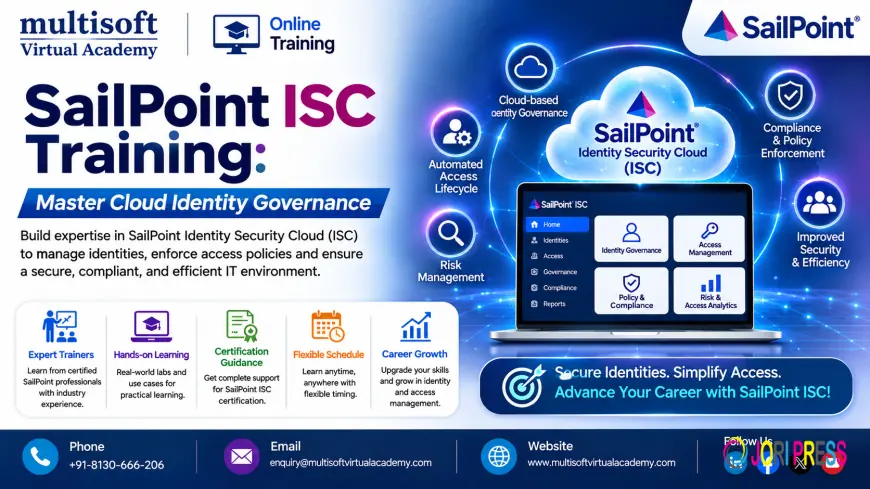
SailPoint ISC Training: Master Cloud Identity Governance
Learn SailPoint ISC Training to master Identity Security Cloud, identity governance, access management, and hands-on skills through expert-led online training.

As businesses expand their digital operations, managing employee identities and controlling access to enterprise applications have become major security responsibilities. Organizations now work with cloud platforms, hybrid environments, third-party applications, and distributed teams. This creates a growing need for reliable identity governance solutions that can protect business information while allowing authorized users to perform their responsibilities.
SailPoint Identity Security Cloud (ISC) provides capabilities that help organizations manage identities, govern application access, automate identity-related processes, and maintain better visibility into user permissions. It supports businesses in establishing structured access management practices across complex technology environments.
SailPoint ISC Training provides professionals with an opportunity to understand these capabilities and develop practical knowledge of modern identity governance. From identity lifecycle management and access provisioning to application integration and compliance reviews, the training introduces important concepts used in enterprise identity security projects.
For IT professionals, IAM consultants, security administrators, and implementation specialists, learning SailPoint ISC can help build a stronger technical foundation for working with cloud-based identity governance platforms.
Understanding SailPoint Identity Security Cloud
SailPoint Identity Security Cloud is a cloud-based identity security platform that helps organizations manage digital identities and govern access to business resources. It supports identity governance processes that determine who should have access to particular applications, systems, and information.
The platform provides capabilities for managing identity data, automating access requests, provisioning accounts, reviewing permissions, and supporting compliance activities.
Consider an organization with thousands of employees using different business applications. Each employee requires specific permissions based on their department, position, and responsibilities. When someone joins the organization, changes roles, or leaves, their access must be updated accordingly.
Managing these activities manually can create delays and security gaps. Identity Security Cloud helps organizations establish automated and controlled processes for managing access throughout the employee lifecycle.
Why Are Organizations Investing in Identity Security Skills?
Digital transformation has increased the number of identities and applications that organizations need to manage. Traditional access management approaches may struggle to provide sufficient visibility when users work across cloud services, enterprise systems, and external applications.
SailPoint ISC knowledge is relevant because it helps professionals understand how identity governance can support business security requirements.
Centralized Identity Visibility
Organizations need to understand which identities exist across their technology environments and what resources those identities can access.
Identity governance capabilities help security teams maintain visibility into user accounts, application permissions, and entitlement relationships.
Reduced Manual Access Management
Manual account creation, permission changes, and access removal can consume considerable administrative time.
Automated identity processes help organizations manage these activities more consistently while reducing repetitive operational work.
Better Access Control
Users should receive permissions according to their actual responsibilities. Granting unnecessary access can increase the risk of unauthorized activity.
Learning SailPoint ISC helps professionals understand access policies, approval mechanisms, role-based access, and governance controls.
Support for Compliance Requirements
Organizations must demonstrate that access to sensitive resources is reviewed and managed appropriately.
Access certification and governance processes can support internal controls, audit preparation, and regulatory compliance activities.
Essential Skills Covered in SailPoint ISC Training
A well-planned SailPoint Identity Security Cloud Training program should combine platform knowledge with practical identity governance scenarios.
1. Platform Fundamentals and Tenant Administration
The learning process generally begins with an introduction to Identity Security Cloud and its administrative environment.
Participants explore the platform interface, architecture, configuration concepts, identity security terminology, and administrative responsibilities.
Important areas may include:
- Identity Security Cloud overview
- Platform navigation
- Tenant administration
- Identity data concepts
- Administrative configuration
- Access model fundamentals
- Platform security principles
These fundamentals provide the foundation for understanding more advanced identity management activities.
2. Identity Sources and Profile Configuration
Identity sources provide information about employees, contractors, and other users. Common sources include HR applications, directories, and enterprise systems.
Identity profiles define how identity information is represented and processed within the platform.
Training may introduce identity source configuration, attribute mapping, identity profile management, identity correlation, and identity refresh operations.
These concepts are essential because accurate identity information influences provisioning decisions and governance processes.
3. Account Aggregation and Identity Correlation
Account aggregation involves collecting account information from connected applications. Identity correlation associates those accounts with the appropriate identities.
For example, an employee may have separate accounts in an email platform, an HR system, and a financial application. Identity correlation helps connect these accounts to the correct individual.
Important learning areas include:
- Application account aggregation
- Full and delta aggregation
- Account correlation
- Entitlement aggregation
- Identity refresh
- Duplicate account identification
- Aggregation troubleshooting
Understanding these activities helps administrators investigate identity data inconsistencies and maintain reliable account information.
4. Identity Lifecycle Management
Identity lifecycle management covers the processes involved in creating, modifying, and removing user access.
The Joiner-Mover-Leaver model is a common way to understand these activities.
Joiner management: When a new employee joins, an identity record is established and relevant access may be assigned according to organizational policies.
Mover management: When an employee changes departments or job responsibilities, existing permissions may need to be modified.
Leaver management: When an employee leaves, unnecessary accounts and permissions must be removed or disabled according to organizational procedures.
SailPoint ISC training explains how identity attributes, lifecycle events, and automated processes can support these activities.
5. Access Requests and Provisioning
Access requests allow users or authorized stakeholders to request access to business applications and resources.
Provisioning involves granting, changing, or removing permissions based on configured policies and approval requirements.
A practical training program may cover request submission, approval workflows, access profiles, provisioning policies, account updates, and access removal.
These processes help organizations maintain structured control over application access.
6. Role Management and Entitlement Governance
Role management helps organizations organize access according to job responsibilities and business requirements.
Roles can simplify access assignment by grouping permissions that are commonly required for particular functions.
Learners may explore:
- Business roles
- IT roles
- Access profiles
- Entitlements
- Role assignments
- Role discovery
- Birthright access
- Segregation of Duties principles
- Least-privilege access
Understanding these concepts helps professionals recognize how organizations can reduce excessive permissions and improve access consistency.
7. Access Certification and Review Campaigns
Access certification is an important identity governance activity. It allows designated reviewers to evaluate whether users should continue to retain their existing permissions.
For example, an application owner may review employee access to a sensitive financial application and approve or revoke permissions according to business requirements.
Training may cover certification campaign creation, reviewer assignments, access decisions, remediation activities, and reporting.
These processes support governance accountability and help organizations identify inappropriate access.
8. Workflow Automation and Advanced Configuration
Workflow automation allows organizations to define processes that respond to identity-related events.
For example, a workflow can initiate an approval process when an employee requests access to a restricted application. Another workflow may trigger an action when an identity attribute changes.
Advanced training may introduce workflow triggers, conditions, actions, notifications, automation logic, and troubleshooting.
Depending on the course level, learners may also explore transforms, REST APIs, JSON, and platform extensibility.
SailPoint ISC Implementation: From Planning to Deployment
SailPoint ISC Implementation requires a structured approach because identity governance affects multiple business applications, departments, and security processes.
An implementation project usually begins by understanding the organization's existing identity environment and defining its governance objectives.
Business and Technical Assessment
The implementation team identifies identity sources, target applications, user populations, existing access policies, and business requirements.
This assessment helps determine which identity processes should be automated and which applications require integration.
Identity Source Onboarding
Relevant identity sources are connected to the platform. Identity attributes and mappings are reviewed to ensure that information is collected and processed correctly.
Application Integration
Target applications are onboarded according to their connectivity and provisioning requirements.
The implementation team evaluates how accounts and entitlements will be aggregated and whether automated provisioning is supported.
Governance Configuration
Access request processes, approval mechanisms, roles, access profiles, and certification requirements are configured according to organizational policies.
Workflow Development
Workflows can automate selected identity-related processes and support business-specific requirements.
The design should consider exception handling, approvals, notifications, and operational responsibilities.
Testing and Deployment
Implementation teams validate identity aggregation, account correlation, provisioning, access removal, certification campaigns, and integrations.
After successful testing, the solution can move toward production deployment and ongoing operational monitoring.
The exact implementation methodology depends on the organization's environment, platform capabilities, security policies, and integration requirements.
Industries Where SailPoint ISC Skills Are Relevant
Identity governance is important in industries that manage sensitive information, complex application environments, and large user populations.
Banking and financial services: Financial institutions must control access to customer information, payment applications, financial systems, and internal business resources.
Healthcare: Hospitals and healthcare organizations need structured access controls for patient records, clinical systems, and administrative applications.
Information technology: Technology businesses manage identities across cloud infrastructure, development environments, SaaS platforms, and enterprise applications.
Manufacturing: Manufacturing organizations require controlled access to production systems, operational applications, and business information.
Telecommunications: Telecom providers manage extensive user populations and complex application environments that require consistent identity governance.
Retail and e-commerce: Retail companies manage access for employees, suppliers, contractors, and business partners across different applications.
These industries may benefit from identity governance solutions, although individual organizations have different security requirements and technology environments.
Who Can Benefit from SailPoint ISC Training?
SailPoint ISC training can support professionals who want to develop skills in identity security and enterprise access governance.
- IAM consultants: Professionals seeking to expand their knowledge of cloud-based identity governance.
- SailPoint IdentityIQ administrators: Existing professionals interested in developing knowledge of Identity Security Cloud.
- Cybersecurity professionals: Security specialists looking to understand identity-related risks and access governance.
- System administrators: IT professionals responsible for directories, accounts, and application access.
- IAM engineers: Technical specialists involved in identity integration, provisioning, and automation.
- Business analysts: Professionals responsible for documenting access requirements and governance workflows.
- Compliance specialists: Individuals involved in access reviews, audit requirements, and security controls.
- Solution architects: Professionals who plan identity security architecture and enterprise implementation strategies.
A basic understanding of identity management, user accounts, authentication, and authorization is useful. Knowledge of APIs and scripting can be valuable for advanced technical topics.
Career Scope After Learning SailPoint ISC
As organizations continue strengthening their identity security programs, professionals with relevant IAM and governance skills may find opportunities in consulting, administration, implementation, and engineering.
Potential career roles include:
- SailPoint ISC Consultant
- SailPoint Identity Security Engineer
- SailPoint ISC Administrator
- IAM Technical Consultant
- Identity Governance Analyst
- IAM Implementation Engineer
- SailPoint Integration Specialist
- Identity Security Architect
- Identity Governance Administrator
- IAM Application Support Specialist
Career opportunities depend on professional experience, practical platform knowledge, technical capabilities, and employer requirements.
Training can provide a foundation, but candidates should also develop hands-on skills and understand how identity governance works in real enterprise environments.
How to Select the Best SailPoint ISC Online Training
Choosing the right SailPoint ISC Online Training program can make a significant difference to the learning experience.
Before enrolling, consider these important factors.
Comprehensive curriculum: Ensure the syllabus covers identity sources, identity profiles, aggregation, lifecycle management, provisioning, access certifications, and workflow automation.
Practical assignments: Look for guided exercises involving application onboarding, access requests, identity configuration, and governance activities.
Experienced trainers: Choose instructors who can explain platform concepts using practical business scenarios and implementation examples.
Training environment: Confirm whether a suitable Identity Security Cloud practice environment is available for learning.
Flexible learning options: Compare live online classes, individual sessions, and recorded learning resources according to your schedule.
Certification guidance: Check whether the course prepares learners for an official SailPoint certification assessment or provides a separate training completion certificate.
A good training program should focus on understanding the technology rather than simply memorizing platform terminology.
Frequently Asked Questions About SailPoint ISC Training
What is SailPoint ISC Training?
SailPoint ISC Training introduces learners to Identity Security Cloud and its identity governance capabilities, including identity lifecycle management, provisioning, access reviews, application integration, and workflow automation.
Is SailPoint ISC different from SailPoint IdentityIQ?
Yes. Identity Security Cloud is a cloud-based identity security platform, whereas IdentityIQ is a separate identity governance solution. They have different architecture and administration approaches.
Do I need programming knowledge to learn SailPoint ISC?
Programming knowledge is not essential for every introductory administration topic. However, REST APIs, JSON, transforms, and scripting concepts can help professionals working on advanced integrations and automation.
What is the Joiner-Mover-Leaver process?
The Joiner-Mover-Leaver process describes identity changes when an individual joins an organization, changes roles, or leaves. It helps organizations manage access throughout the employment lifecycle.
Does SailPoint ISC training cover implementation?
Implementation-focused training may include tenant configuration, identity source onboarding, application integration, provisioning, workflows, access governance, testing, and troubleshooting.
Can beginners enroll in SailPoint ISC training?
Yes. Beginners can start with foundational IAM concepts and platform administration before progressing to advanced configuration and implementation topics.
Conclusion
Identity security has become an essential part of enterprise cybersecurity as businesses manage increasing numbers of digital identities, cloud applications, and access permissions. Learning SailPoint Identity Security Cloud can help professionals understand identity lifecycle management, access provisioning, application integration, certification campaigns, and automated governance processes. Developing these capabilities can provide a valuable foundation for working on modern IAM and cloud identity security projects. Multisoft Virtual Academy offers SailPoint ISC Training designed to help learners develop practical knowledge of Identity Security Cloud and strengthen their understanding of enterprise identity governance and administration.
What's Your Reaction?
 Like
0
 Dislike
0
 Love
0
 Funny
0
 Angry
0
 Sad
0
 Wow
0