



































The Immigration Story Children Actually Need Right Now

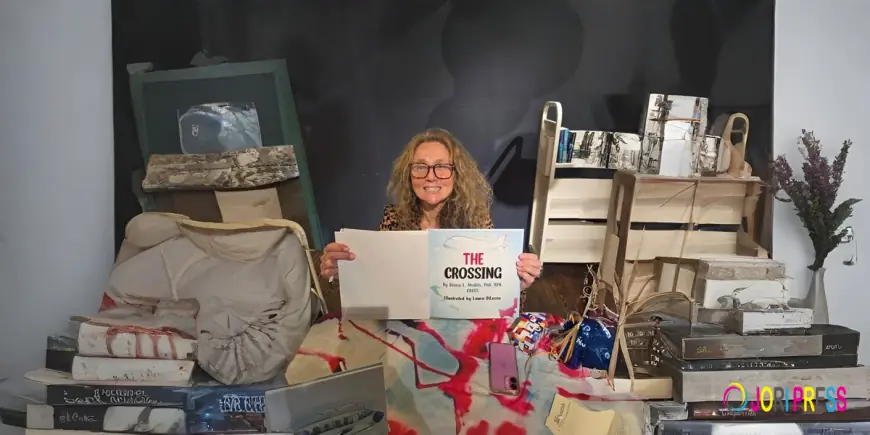
Diana L. Malkin’s “The Crossing” avoids slogans and offers something more durable, a humane education in why people leave home.
The difficulty with writing for children about immigration is not that the subject is too complicated. It is that adults tend to simplify it so badly before children ever encounter it.
In public life, migration is flattened into argument, fear, policy language, or sentimental affirmation. Rarely is it restored to its actual emotional scale, the private reasoning, the bodily stress, the confusion of arrival, the many motives that can coexist within one journey.
Diana L. Malkin’s The Crossing stands out because it begins where human experience begins, not in ideology, but in fatigue.
The book opens with four animals from four countries waiting in an immigration line at an airport. They are tired, hungry, and uncertain, which is to say they are in a state a child can understand instantly, even if they have never crossed an international border. This is one of Malkin’s smartest moves. She does not begin with a lesson on what immigration means. She begins with the sensory facts that make the subject emotionally legible. The children who read this book are invited first into feeling, then into thought.
From there, The Crossing unfolds with calm assurance. The characters begin talking, slowly and somewhat cautiously. They reveal why they left home. One seeks family. One hopes to marry his girlfriend. One is looking for work to support loved ones. One longs to find another like herself. All of them are also living with diabetes, which adds another layer of urgency and realism to their travel. The point of this range is not simply to create variety. It is to rehumanize migration. People move for mixed reasons. Desire and necessity often travel together. Love, loneliness, health, money, and hope do not arrive as separate categories.
This is the book’s quiet political intelligence. It never announces itself as corrective, but it absolutely is one. In a culture that encourages children to inherit adult simplifications, The Crossing offers a more truthful picture. It says, in effect, that the people who cross borders are not generic “others.” They are individuals carrying stories, obligations, illnesses, family ties, and unfulfilled futures. That may sound obvious, but in the current public climate, it feels almost radical.
Malkin’s background in public health sharpens the realism further. Diabetes is not incidental here. It reveals how health and migration can be bound together. One character worries about expensive supplies.
Another hopes for better conditions. The book never becomes a tract about healthcare inequity, yet the implication is unmistakable. Movement through the world is shaped not only by politics or economics, but by what one’s body requires and where those needs can be met with dignity.
The use of animals gives the book accessibility without draining its seriousness. A giraffe, a jaguar, a rhino, and a shoebill stork offer children an immediate imaginative entry point, but Malkin wisely avoids making them generic stand-ins. Their species-specific traits enrich the emotional field.
The prose is intentionally plain, but the plainness is a strength. When one character says, “I feel so lost here,” the line carries enormous freight in very little language. Lost in transit. Lost in a crowd. Lost in the instability of becoming new. Children do not need the vocabulary of policy analysis to understand dislocation. They need a sentence that names it clearly and allows them to feel its shape.
What the book ultimately offers is not an easy moral, but a better way of seeing. By the time the characters find shelter and companionship, the reader has been gently guided toward an understanding that welcome is not just a feeling. It is a practice. It requires listening, practical help, and the willingness to imagine that every traveler has arrived with more than anyone can see at first glance.
Buy The Crossing for a child who deserves a humane introduction to immigration, and for a family or classroom that wants a story capable of replacing abstraction with understanding.
What's Your Reaction?
 Like
0
Like
0
 Dislike
0
Dislike
0
 Love
0
Love
0
 Funny
0
Funny
0
 Angry
0
Angry
0
 Sad
0
Sad
0
 Wow
0
Wow
0