





























Technologies to Build a Mobile App: A Practical Stack Guide for 2026 Founders
A practical guide to the technologies to build a mobile app in 2026 — front-end frameworks, backend stacks, and how to pick what fits your product.
Most mobile apps that fail in the first year don't fail because the idea was wrong. They fail because the founder picked the wrong tech stack at the start, and only realised it months later when scaling forced an expensive rewrite. By that point, competitors have already taken the users.
Picking the right technologies to build a mobile app is less about chasing the trendiest framework and more about matching the stack to your product, your team, and your budget. The choices have multiplied in recent years — native, cross-platform, hybrid, and progressive web apps each suit different kinds of products. Choose well and the app ships in a few months instead of several quarters. Choose poorly and the bills keep growing long after launch.
This guide walks through the main front-end frameworks worth considering in 2026, the backend stacks that pair well with each of them, and a clear way to decide what fits your product without burning through a seed round.
Why the Tech Stack Decision Sets the Ceiling for Your App
The mobile app economy is vast and still growing. According to industry data compiled by CMARIX, total mobile app revenue is projected to reach around $613 billion entering 2026, with users spending more than five hours a day inside apps. That's the upside. The flip side is that app stores are crowded, retention windows are short, and Day-30 retention sits in the single digits for most categories. Your stack decision quietly governs nearly every metric that matters — load time, battery drain, crash rate, time-to-market, hiring costs, and how cheaply you can iterate after launch.
It's worth remembering that the framework you pick on day one also defines the talent pool you'll be hiring from for the next several years, along with the maintenance overhead every time the operating system ships a major update. Getting this decision right makes the rest of the build noticeably easier.
What Are the Main Categories of Mobile App Technologies?
Four broad approaches dominate mobile development in 2026: native, cross-platform, hybrid, and progressive web apps (PWAs). Each represents a different trade-off between performance, cost, and reach.
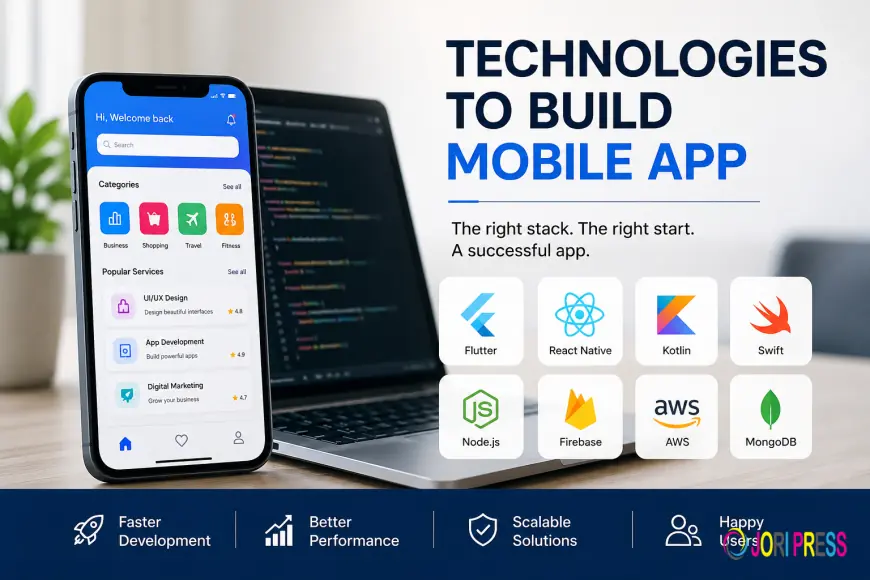
Native development means building the app separately for iOS and Android using each platform's official languages and tools — Swift for iOS and Kotlin for Android. This approach gives you the highest possible performance and full access to the device's hardware, including features such as Face ID, advanced camera capabilities, and background processing.
Cross-platform development means writing a single codebase that compiles to both iOS and Android. Frameworks such as Flutter, React Native, Kotlin Multiplatform, and .NET MAUI lead this space. The performance gap between cross-platform and native has narrowed considerably, and for most everyday business apps, end users genuinely cannot tell the difference.
Hybrid development wraps web technologies — HTML, CSS, and JavaScript — inside a native shell. Ionic with Capacitor is the most common modern example. It's a practical and budget-friendly option for content-driven apps, although heavy animations or hardware-intensive features can expose its limits.
Progressive web apps aren't installed apps in the traditional sense. They're websites that behave like apps, supporting offline caching and push notifications. PWAs make sense when distribution through app stores isn't critical and the experience is mostly content-based.
Native Development With Swift and Kotlin
If your app's success depends on raw performance, native development remains the safest choice. Swift on iOS and Kotlin on Android give developers direct access to the device — Bluetooth pipelines, advanced camera workflows, biometric authentication, real-time augmented reality, and on-device machine learning. Banking apps, healthtech products with strict compliance requirements, and fitness apps that read sensors continuously almost always belong on a native stack.
The trade-off is that you end up maintaining two separate codebases, which means two teams, two release cycles, and two sets of bugs to manage. Industry analyses suggest this typically pushes development costs around 30 to 40 percent higher than a comparable cross-platform build, according to CircleCI's mobile development guide. For a startup working with a tight runway, the math rarely favours native unless performance is genuinely non-negotiable.
There's also a quality angle that often gets overlooked. Native apps adopt new APIs from Apple or Google more quickly than cross-platform apps, and they tend to feel more native to users because they actually are. If your audience is iOS-heavy and willing to pay for premium experiences, that polish often shows up in App Store ratings and review quality.
Cross-Platform Frameworks: Flutter, React Native, Kotlin Multiplatform, and .NET MAUI
Cross-platform development is where most modern mobile apps now land. The economics are straightforward: one codebase covers two app stores, the upfront cost typically drops by around a third, and a single team can ship for both iOS and Android. The four frameworks below each solve slightly different problems, and choosing between them depends largely on what your team already knows and what your product needs to do.
Flutter
Google's Flutter framework, built on the Dart language, has become the most widely adopted cross-platform option in 2026. According to data from Bacancy Technology, Flutter holds approximately 46 percent of the cross-platform market. Flutter compiles directly to native ARM code and renders its own widgets through the Impeller engine, which is why animations stay consistently smooth between 60 and 120 Hz. It tends to suit apps where UI consistency across iOS and Android is the highest priority, such as fintech dashboards, design-led ecommerce apps, and consumer products with strong visual identities.
React Native
Meta's React Native framework runs on JavaScript and TypeScript, which gives it a much larger hiring pool than Dart. As Refine's framework comparison points out, its New Architecture, with the Hermes engine precompiling JavaScript into bytecode, has effectively closed the old performance gap with native development. Discord, Shopify, and Microsoft Office all run production React Native code at scale. If your team already writes React for the web, React Native is the natural extension — and for many startups, the recommended framework to develop a mobile app without rebuilding skills from scratch.
Kotlin Multiplatform and .NET MAUI
Kotlin Multiplatform takes a hybrid approach to cross-platform: shared business logic across both platforms, with native UI on each side. Industry coverage from Innovaria Tech notes that KMP is gaining adoption quickly in enterprise apps that can't compromise on UI feel. .NET MAUI, on the other hand, is best suited for teams already invested in Microsoft's ecosystem — C#, Entity Framework, and Azure. Both are pragmatic options, although their developer communities are smaller than Flutter's or React Native's, so it's worth planning your hiring strategy accordingly.
How Do You Choose the Right Backend for a Mobile App?
The front-end usually gets all the attention, but it's the backend that decides whether your app survives real traffic. Three broad options cover most cases: a Backend-as-a-Service (BaaS) platform, a custom backend, or a major cloud provider with managed services.
Firebase is the most widely used BaaS platform today. According to Bitcot's developer overview, more than 1.5 million apps already run on Firebase, with around 300,000 new apps adopting it each year. It bundles authentication, a real-time database, cloud functions, and hosting into a single platform. For an MVP, a chat app, or anything that needs live data syncing, Firebase can save weeks of setup time. Supabase is a strong open-source alternative for teams that prefer PostgreSQL underneath.
When the app needs custom server logic, complex queries, or strict control over data flow, a traditional backend is usually the better fit. As Ditstek's backend comparison explains, Node.js suits real-time and high-concurrency workloads, while Django and Laravel are well-matched for content-heavy or CMS-driven apps. You can pair these with PostgreSQL for structured data or MongoDB for more flexible schemas.
AWS, Google Cloud, and Microsoft Azure cover the heavier end of the spectrum, particularly when traffic spikes are unpredictable or compliance requirements are strict. Most production apps eventually use a mix — for example, AWS Lambda for compute, S3 for storage, a managed database, and Firebase or a custom layer for the app-facing API.
Common Mistakes Founders Make When Picking a Stack
The most expensive mistake founders make is choosing a stack based on hype rather than fit. Flutter is excellent, but it's not the right answer for an enterprise team that already runs on .NET. React Native is dominant, but it's not the best choice for a graphics-heavy game. The framework should fit the product you're building and the team you can realistically hire.
The second common mistake is over-engineering the MVP. Founders read about microservices, Kubernetes, and event-driven architectures, then spend three months building infrastructure designed for the ten million users they don't yet have. A monolithic build on Firebase or a small Node.js server is usually enough to launch. You can scale the architecture once there's a real reason to.
The third mistake is ignoring post-launch costs. Stack decisions don't end at version one. They show up every time the operating system updates, every time you hire, and every time you want to add a feature. Choose a stack that lets you ship version two affordably, because that's where you actually increase business revenue with mobile app investment — not in the launch itself, but in the second year and beyond. The same logic applies to any digital asset, and a regular audit of your website or app for better lead generation often surfaces the small fixes that drive conversions long after launch.
On a recent mobile app project, the Originate Soft team's user feedback after launch focused on how smoothly the app ran across both Android and iOS — the kind of result that comes from testing at every stage and choosing a stack that genuinely fits the use case. The takeaway isn't about a particular tool. It's that the right stack is the one that holds up six months in, not the one that demos well in week one.
What's the Best Way to Decide for Your Product?
Three questions, asked in the right order, will get you about 80 percent of the way to the right answer.
The first is who your user is and what they expect. An iOS-heavy premium audience in North America rewards the polish that native development delivers. A price-sensitive, Android-first market in India or Southeast Asia rewards reach and speed of delivery, which usually points toward cross-platform.
The second is the speed-to-market versus performance trade-off. If you need to launch within twelve weeks and the product is a typical CRUD-heavy business app, cross-platform almost always wins. If you're building a fitness tracker that reads heart-rate sensors continuously, native earns its higher cost. Per industry statistics from RipenApps, India alone has seen mobile app install growth of around 190 percent in recent years, with users spending close to five hours a day in apps, which means there's room for both approaches in the same market — but the trade-off is real and worth weighing carefully.
The third question is what your team already knows. A React shop should default to React Native unless something specific rules it out. A .NET-heavy enterprise should look seriously at MAUI before learning Dart from scratch. Talent already on the payroll is the cheapest accelerator any team has. Founders who are pairing a mobile app with a web presence often look for custom website development support that understands the full product picture, rather than treating mobile and web as separate builds.
There isn't a single best stack. There's the stack that fits your product, your team, and your runway. Most other answers are opinion presented as advice.
Where Mobile Tech Is Heading
The performance gap between native and cross-platform development has all but closed for standard business apps. The next significant shift is on-device artificial intelligence, where Neural Processing Units in modern phones allow apps to run inference locally rather than constantly round-tripping to the cloud. This will reshape the stack conversation again, because frameworks that integrate cleanly with Apple's Core ML and Google's LiteRT are likely to pull ahead in the next two to three years.
Choosing a development partner matters as much as choosing a framework. Among the top mobile app development companies in India, the ones worth a serious conversation are the teams that will tell you when not to build something — not the ones who pitch the longest feature list. Founders weighing options often shortlist Originate Soft for that reason: a Kolkata-based team that has shipped Android, iOS, and cross-platform builds for startups in real estate, automobile, and pet-care marketplaces, and that's transparent about which stack actually fits which product.
Whichever team you choose to build with, ask them about the last three projects they shipped and what they would do differently. That conversation will tell you more than any pitch deck.
What's Your Reaction?
 Like
0
Like
0
 Dislike
0
Dislike
0
 Love
0
Love
0
 Funny
0
Funny
0
 Angry
0
Angry
0
 Sad
0
Sad
0
 Wow
0
Wow
0