








































The Silent Cost of Slow Decisions: Why Speed Is a Growth Strategy, Not Just a Mindset
Most companies don't lose growth because of bad ideas — they lose it to slow decisions. Here's how building faster decision-making systems became one of my core growth strategies across marketing and EdTech admissions.
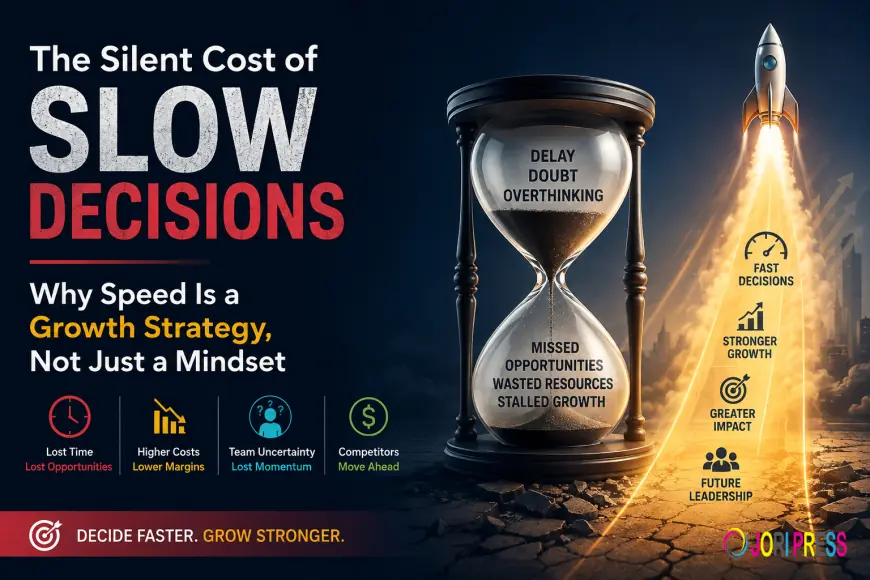
Seventeen years in marketing has taught me one uncomfortable truth: most companies don't lose growth because of bad ideas. They lose it because of slow decisions.
I've sat in rooms where a campaign that could have launched in a week took six weeks to get approved. By the time it went live, the market had moved, the competitor had already captured the attention, and the "perfect" version we waited for performed worse than the "good enough" version we could have shipped earlier. That's when I started treating speed itself as part of my growth strategy — not a side effect of having a good one, but a deliberate lever I pull on purpose.
Why Slowness Feels Safe (But Isn't)
Every organization has a version of the same story. A decision needs five approvals instead of one. A simple creative tweak gets stuck because nobody wants to be the person who said yes without "checking with everyone." Over-analysis gets dressed up as due diligence, when really it's fear wearing a business-casual outfit.
The irony is that this caution rarely reduces risk. It just delays the moment you find out whether something works. And in growth roles, delayed feedback is expensive — you're not just losing time, you're losing the compounding effect of early learning. A campaign that launches late doesn't just start late; it starts behind, informed by stale data instead of fresh signals.
What I've Learned About Building Fast, Not Reckless, Teams
None of this means throwing caution out the window. Fast doesn't mean careless. It means building systems where good decisions can be made quickly, by the right people, without fifteen layers of sign-off.
A few things that have consistently worked for me:
1. Push decision rights down, not up. The person closest to the customer or the campaign data usually has better real-time judgment than someone three levels removed reading a summary slide. Whenever I've restructured a team so that frontline marketers could approve small experiments themselves, our iteration speed doubled — and mistakes actually got smaller, not bigger, because they were caught early.
2. Separate reversible decisions from irreversible ones. Not every choice deserves the same scrutiny. Choosing a subject line for an email test is reversible — you'll know in 48 hours if it worked. Signing a year-long vendor contract is not. Business growth strategies that scale well are the ones that apply heavy deliberation only where it's actually warranted, and move fast everywhere else.
3. Make "good enough to learn from" an acceptable standard. Perfectionism is often just procrastination with better PR. I've pushed teams to ship the 80% version of a landing page or funnel step, watch how real users respond, and improve from there — instead of polishing a 100% version that never sees daylight until it's too late to matter.
The EdTech Lesson: Speed in Admissions Funnels
This lesson hit home hardest when I worked on admissions funnels in EdTech. Prospective students don't wait around for a university to perfect its outreach sequence. If a lead's questions go unanswered for three days because the response had to go through four internal reviewers, that lead is already talking to a competing institution. Every growth strategy I've built since then treats response time as a core KPI, not an afterthought.
I've also seen how the inclusive growth strategy was adopted in one organization I worked with, specifically to close this gap — decision-making authority was intentionally distributed across regional teams instead of centralized at headquarters, so that student queries in different markets could be answered in hours, not days. The result wasn't just faster admissions cycles; it was a measurable lift in conversion, because families felt heard when it mattered.
Speed as a Marketing Growth Strategy, Not Just an Operational Fix
It's tempting to file "move faster" under operations or process improvement. I'd argue it belongs squarely inside marketing growth strategy conversations too. The market doesn't wait for your internal calendar. Trends shift, algorithms change, and customer attention windows shrink faster every year. A brilliant campaign delivered two months late is often worse than an average one delivered on time — because timing itself is part of what makes a message land.
The teams and leaders who win aren't always the ones with the smartest ideas in the room. Often, they're the ones who built a culture where a decent idea can go from whiteboard to market before the moment passes.
The Real Question to Ask Your Team
Next time a decision is sitting in your inbox, unapproved, ask yourself honestly: is this delay protecting the business, or is it just protecting someone's comfort? Most of the time, it's the latter — and recognizing that difference might be the single highest-leverage growth strategy you're not using yet.
What's Your Reaction?
 Like
0
Like
0
 Dislike
0
Dislike
0
 Love
0
Love
0
 Funny
0
Funny
0
 Angry
0
Angry
0
 Sad
0
Sad
0
 Wow
0
Wow
0