

































What Should You Ask a Matrimonial Software Vendor Before Paying?
Before paying a matrimonial software vendor, evaluate the features, business requirements, total costs, source-code ownership, privacy, security, and ongoing support. Request a live demo using real workflows and clarify which features require extra payment or custom development. Review licensing terms, payment integrations, mobile apps, maintenance, and data-export options. Get every commitment documented in writing to avoid hidden costs, protect member information, and ensure long-term business flexibility.
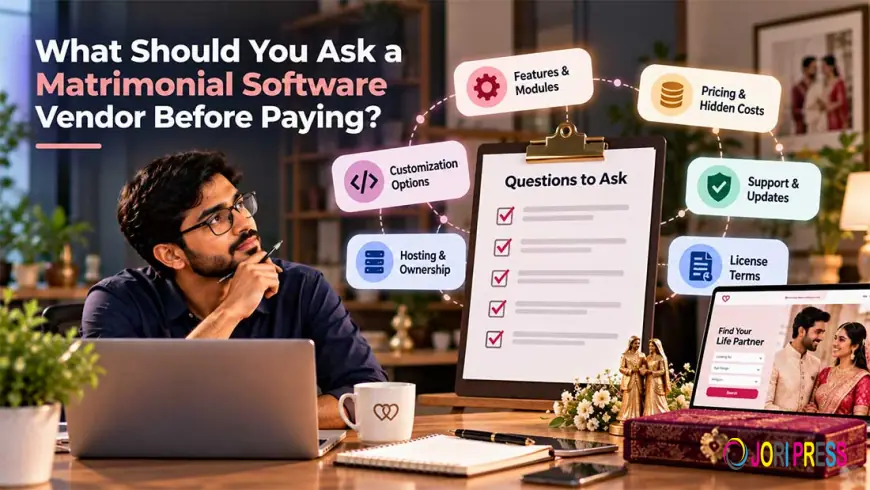
Picture a founder at the end of a good demo. Profiles load fast, the search filters look sharp and chat works. She is ready to pay. What she hasn't asked yet is who owns the code, what hosting costs, and whether the mobile apps are in the price.
A demo shows what the software can do. It doesn't show what you own, what you'll pay next year or who fixes things at midnight.
So here is the short answer. Before you pay any matrimonial software vendor, check five things: what is actually included, the total cost, your rights over the code, how member data is protected, and what support looks like after launch. Get each answer in writing. The sections below give you the questions, and the proof to ask for.
Does a Matrimonial Software Vendor Support Your Business Model?
Start with your own plan, not the vendor's feature list. A public matrimony site, a marriage bureau moving online and a managed matchmaking service all need different things. A bureau may want staff to handle profiles and introductions. A paid membership site cares more about plans and renewals.
Write your model down in a few lines. Then ask three things. Which of my needs work out of the box? Which need configuration? Which need custom development? Get that split in writing, because the third group is where budgets stretch.
Feature lists need the same treatment. Ask whether each feature sits in your quoted package, and whether anything in the demo is a separate module or a third-party service. Ask about limits on members, admins or profiles too.
Then test the real workflow instead of watching it. Software Advice suggests giving the vendor your own use cases and asking to see the actual mobile interface, not screenshots. For matrimony, that means: register a member, fill a profile, search, send an interest request, buy a plan, change privacy settings, then run it all from the admin panel. A free demo is a good place to practise this routine.
What Does Matrimonial Software Really Cost After the Quote?
The quote is rarely the whole bill. Ask whether the price is one-time, recurring or a mix. Then go line by line: installation, branding, hosting, domain and SSL, payment gateway fees, email or SMS services, app store accounts, updates and custom work after launch. Not every vendor charges for all of these, and that is the point of asking. For a rough sense of the numbers, this matrimony website development cost guide is a useful starting point. Capterra also advises asking which functions sit in which pricing tier and whether training and support cost extra.
Support is the line people misread most. "Free support" can mean bug fixes only, or it can include new features. Ask what counts as a bug and what counts as a paid change. Ask how long support lasts and what happens when it ends.
Here is an illustrative example, not a real client. A small marriage bureau picks the cheapest quote. Three weeks in, it realises it needs paid plans for premium members, a mobile app and a Hindi interface. None were in the price. A one-page cost sheet would have caught this. The bureau would have listed those three items before signing and asked, line by line, whether each was included.
Ask for a written cost breakdown and compare every vendor on the same sheet. A lower number means little if it covers less.
Who Owns the Matrimonial Software Source Code?
Three things get mixed up here: a licence, source-code access and ownership. A licence says what you may do with the software. Source access means you can read and change the code. Owning the intellectual property is a separate matter. You can hold the code and still not own it.
So ask plainly. Will I receive the full source code? Can I modify it? Can another developer maintain it? Can I move to a different host? Are there limits on resale or on running more than one site? Who owns any custom code built for me?
Then ask what happens if the vendor stops selling the product. A buyer with code and documentation can hire someone else. A buyer without them can't.
Customisation belongs in the same conversation. Ask which changes are settings and which need programming, and whether custom work survives future updates. This post on customising a matrimony script after buying it goes deeper. None of these answers should live only on a phone call. Read the licence agreement before you pay and ask for the deliverables list in writing.
How Does the Vendor Handle Privacy, Security and Payments?
Matrimonial profiles carry family details, photos, income and phone numbers. Members treat this as sensitive, so you should too.
Start with access. OWASP's 2025 Top 10 still puts broken access control first, as The Register reported. In plain terms: can the wrong person see the wrong data? Ask which admin roles can view personal details, whether you can create limited roles for staff, and how members control who sees their photos and contact numbers.
Then ask how fixes reach you. Request the release notes. A product that publishes its version history shows what was patched and when. Ask about backups, recovery, and what member data can be exported or deleted.
India's data protection rules were notified in November 2025 and are being phased in, with core duties expected around May 2027, according to SCC Online. They also cover retention and deletion. What applies to you depends on where you operate and who your members are, so speak to a lawyer. Ask the vendor which parts the software supports and which stay your job.
Payments need their own test. Ask which gateways work, whether plans can have different prices and durations, and what happens when a renewal fails. Razorpay's documentation explains that recurring card payments in India need extra authentication and carry a mandate limit, so ask whether auto-renewal is actually built and tested, not assumed. Ask about refunds, payment records and who pays the gateway fees.
What Happens After Launch: Apps, Support and Exit Terms?
A mobile-friendly website and a mobile app are different products, so ask which one you are getting. If apps are included, ask whether you receive the source code, who submits them to the stores and who updates them later. Apple's App Review Guidelines generally require in-app purchase for digital subscriptions (section 3.1.1), so ask how membership payments will work inside the app. No vendor can promise store approval. Be wary of one who does.
Support deserves numbers. How long is it included? What are the response times for urgent problems? Is there documentation your own developer can use? Do updates keep your custom changes?
Last, ask how you could leave. Can you export member data, and in what format? Is anything tied to the vendor's own services? Check this now. Nobody plans to leave, which is exactly why exit terms get skipped.
A Matrimonial Software Vendor Checklist You Can Print
Take this table to your next vendor call. Fill the last column with documents, not promises.
| Area | Question to verify | Evidence to request |
| Business fit | Does it support our model without custom work? | Requirements list marked supported or custom |
| Features | Is every listed feature in my package and working? | Feature list plus a live demo |
| Total cost | What will I pay in year one and year two? | Itemised written quote |
| Source code and licence | What rights do I get over the code? | Licence agreement and deliverables list |
| Customisation | What needs programming, and who owns that code? | Written scope and sample documentation |
| Privacy & Security | How is member data protected and access controlled? | Security policy and privacy settings demo |
| Payments | Do renewals, failed payments and refunds work? | A test purchase in the demo |
| Mobile apps | Included, optional or extra? | Quote line and an app demo on a real phone |
| Support and Exit | What support is included, and can I export my data if I switch vendors? | Support policy and sample data export |
Sort the answers by urgency. Settle cost, licence, privacy and your core workflow before you pay. Confirm payments, apps and support details before launch. Design polish and nice-to-have filters can wait.
Final Thoughts: Ready-Made or Custom?
Ready-made software suits you when its features match your plan and it can be configured to fit. You launch sooner and maintain less. Custom development suits unusual workflows that no existing product handles, but it takes longer, costs more to maintain and ties you to whoever built it. Neither is always cheaper or safer.
If ready-made looks right, put the matrimonial script from Best Dating Scripts through this same checklist. Ask what is in the package, what the licence says and what support covers, and get the answers in writing.
The best purchase is not the cheapest one or the one with the longest feature list. It is the one that fits your business, has clear terms and covers the workflows you depend on.
Ready to compare? Ask for pricing and a live walkthrough, and bring this checklist with you.
What would you check first before buying matrimonial software: total cost, source-code access, privacy, customisation, or vendor support?
What's Your Reaction?
 Like
0
Like
0
 Dislike
0
Dislike
0
 Love
0
Love
0
 Funny
0
Funny
0
 Angry
0
Angry
0
 Sad
0
Sad
0
 Wow
0
Wow
0