





































SAP IBP Training: Master Intelligent Supply Chain Planning for a Smarter Business Future
Join SAP IBP Training to master demand planning, supply planning, inventory optimization, and earn certification with expert-led online sessions.

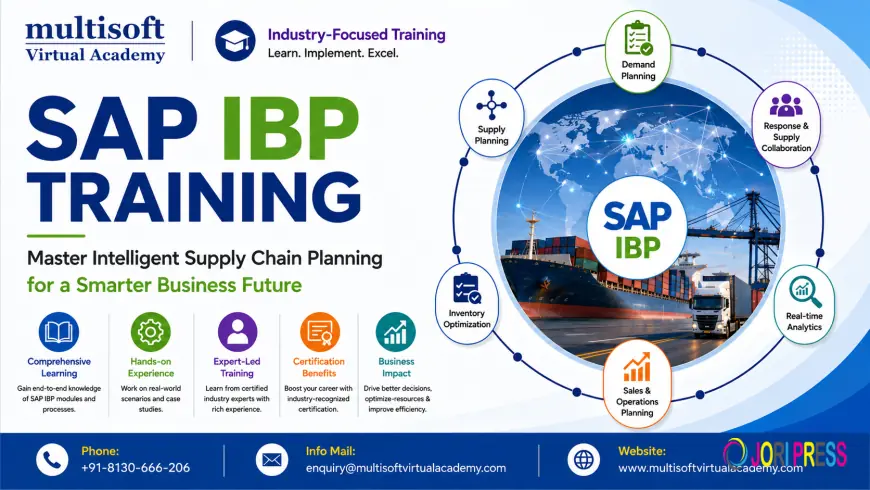
Modern supply chains are more dynamic than ever before. Businesses must respond quickly to changing customer demands, global disruptions, inventory challenges and increasing competition while maintaining operational efficiency. Traditional planning methods that rely heavily on spreadsheets and disconnected systems are no longer sufficient to support complex supply chain operations. Organizations now require intelligent planning solutions that provide real-time visibility, predictive insights and collaborative decision-making across every stage of the supply chain.
This is where SAP Integrated Business Planning (SAP IBP) has emerged as one of the most powerful cloud-based supply chain planning solutions available today. Designed on the SAP HANA platform, SAP IBP helps organizations improve demand forecasting, optimize inventory, streamline production planning and enhance collaboration between sales, finance, procurement and operations teams. By combining Artificial Intelligence (AI), Machine Learning (ML), predictive analytics and cloud technology, SAP IBP enables businesses to make faster and more informed decisions.
As organizations continue their digital transformation journey, the demand for professionals with expertise in SAP IBP Training is growing rapidly across industries. Companies are actively seeking skilled consultants, planners and analysts who can implement and manage intelligent business planning solutions. Whether you are an SAP consultant, supply chain professional, business analyst or a graduate looking to enter the ERP domain, learning SAP IBP can significantly enhance your career prospects.
This comprehensive guide explains everything you need to know about SAP IBP Training, including its features, modules, benefits, career opportunities, implementation process and future scope.
What is SAP IBP?
SAP Integrated Business Planning (SAP IBP) is SAP's next-generation cloud-based solution for supply chain planning. It integrates multiple planning functions, including demand planning, inventory optimization, supply planning, sales and operations planning (S&OP), response management and control tower capabilities into a single unified platform.
Unlike traditional planning systems, SAP IBP enables businesses to access real-time information, perform advanced forecasting, analyze multiple planning scenarios and collaborate across departments. The platform leverages the high-speed processing power of SAP HANA, allowing organizations to analyze massive volumes of business data within seconds and make data-driven decisions with greater confidence.
SAP IBP supports end-to-end supply chain planning by providing a centralized environment where all stakeholders work with the same data, reducing inconsistencies and improving overall operational efficiency.
Why SAP IBP is Important in Modern Supply Chains
Global supply chains face numerous challenges such as fluctuating customer demand, supplier uncertainties, transportation delays and changing market conditions. Businesses need planning systems that are agile, intelligent and capable of responding to disruptions in real time.
SAP IBP addresses these challenges by offering advanced planning capabilities that help organizations:
- Improve demand forecast accuracy
- Optimize inventory levels
- Reduce supply chain costs
- Increase operational efficiency
- Improve customer satisfaction
- Enhance collaboration across departments
- Respond quickly to unexpected disruptions
- Support strategic business planning
By integrating advanced analytics with intelligent automation, SAP IBP enables organizations to shift from reactive planning to proactive decision-making.
Key Components of SAP IBP Training
A well-structured SAP IBP Training program introduces learners to the complete functionality of the platform while providing practical exposure to real-world business scenarios.
SAP IBP Architecture
Understanding the architecture is the foundation of learning SAP IBP. The platform is built on SAP HANA and operates entirely in the cloud, providing high performance, scalability and seamless integration with other SAP solutions.
Learners understand how planning areas, planning levels, master data, key figures and time profiles work together to create an efficient planning environment.
Demand Planning
Demand planning is one of the most important modules in SAP IBP. It helps businesses predict future customer demand using historical sales data, statistical forecasting techniques and machine learning algorithms.
The module allows organizations to create accurate forecasts, monitor forecast accuracy and adjust demand plans based on market trends, promotional activities and seasonal variations.
Inventory Optimization
Inventory optimization helps organizations maintain the right inventory at the right location while minimizing carrying costs. SAP IBP supports multi-echelon inventory optimization, enabling businesses to balance customer service levels with inventory investment.
Professionals learn how to calculate safety stock, optimize inventory policies and reduce excess stock across the supply chain.
Supply Planning
Supply planning ensures that customer demand is fulfilled efficiently by balancing production capacity, procurement and inventory availability.
This module enables organizations to:
- Plan production schedules
- Allocate resources efficiently
- Optimize manufacturing capacity
- Manage supply constraints
- Improve production efficiency
Supply planning also helps businesses identify bottlenecks before they affect operations.
Sales and Operations Planning (S&OP)
Sales and Operations Planning is a collaborative process that aligns demand forecasts with production capacity and financial objectives.
SAP IBP enables different business departments to work together using shared planning information, improving decision-making and ensuring organizational alignment.
The module supports executive reviews, financial planning, demand reviews and supply reviews, creating a unified planning process.
Response and Supply
Unexpected disruptions are common in today's supply chains. The Response and Supply module enables organizations to react quickly by analyzing supply shortages, prioritizing customer orders and evaluating alternative planning scenarios.
Businesses can simulate different supply chain situations before making operational decisions, reducing business risks and improving responsiveness.
Control Tower
The SAP IBP Control Tower provides real-time visibility into supply chain performance through dashboards, alerts and key performance indicators (KPIs).
Decision-makers can monitor business performance, identify potential risks and take corrective actions before problems escalate.
Features of SAP IBP
SAP IBP offers a wide range of intelligent features that distinguish it from traditional planning systems.
Cloud-Based Platform
Being a cloud-native solution, SAP IBP eliminates the need for complex on-premises infrastructure while ensuring continuous updates and scalability.
Real-Time Analytics
Users gain instant access to planning information, enabling faster and more accurate decision-making.
Artificial Intelligence and Machine Learning
Advanced algorithms continuously improve forecasting accuracy by identifying hidden demand patterns and market trends.
Scenario Planning
Organizations can compare multiple planning scenarios and evaluate their business impact before implementation.
Excel Integration
SAP IBP integrates seamlessly with Microsoft Excel, allowing planners to work within a familiar interface while accessing real-time enterprise data.
Collaboration
The platform improves communication between sales, finance, procurement, manufacturing and logistics teams by providing a centralized planning environment.
Predictive Analytics
SAP IBP uses predictive models to anticipate future demand, supply shortages and inventory requirements, enabling proactive business planning.
Industries Using SAP IBP
SAP IBP has become an essential solution across various industries due to its flexibility and intelligent planning capabilities.
Major industries include:
- Manufacturing
- Automotive
- Retail
- Consumer Goods
- Pharmaceuticals
- Healthcare
- Food and Beverage
- Oil and Gas
- Chemicals
- Electronics
- Logistics
- Wholesale Distribution
- Fashion
- Aerospace
- Industrial Equipment
Organizations in these sectors rely on SAP IBP to improve supply chain efficiency, reduce operational costs and enhance customer satisfaction.
Benefits of SAP IBP Training
Learning SAP IBP provides both technical expertise and strategic business knowledge. Professionals who complete SAP IBP Training gain the ability to manage complex supply chain planning processes while contributing to organizational growth.
Some of the major benefits include:
- Strong understanding of digital supply chain management
- Improved analytical and planning skills
- Hands-on experience with SAP cloud technologies
- Better understanding of demand forecasting
- Knowledge of inventory optimization techniques
- Enhanced career opportunities in SAP consulting
- Global job prospects across multiple industries
- Competitive salary packages
- Expertise in AI-driven planning solutions
SAP IBP Implementation Process
Implementing SAP Integrated Business Planning is a structured process that requires careful planning, collaboration and continuous optimization. A successful implementation ensures that the solution aligns with business objectives while delivering measurable improvements in supply chain performance.
The implementation journey generally begins with understanding the organization's existing planning processes, identifying business challenges and defining project goals. Consultants work closely with business stakeholders to gather requirements and determine how SAP IBP can address current inefficiencies.
The next step involves designing the planning model, including planning areas, planning levels, key figures, master data and time profiles. Accurate master data is critical because it forms the foundation of every planning activity within SAP IBP.
SAP IBP Integration with SAP Solutions
One of the greatest strengths of SAP IBP is its ability to integrate with various SAP applications and third-party systems.
It integrates seamlessly with:
- SAP S/4HANA
- SAP ERP ECC
- SAP HANA Database
- SAP Analytics Cloud
- SAP Business Technology Platform (BTP)
- SAP Ariba
- SAP Transportation Management
- SAP Extended Warehouse Management (EWM)
- Third-party ERP systems
- External data sources
This integration enables organizations to create a connected digital ecosystem where planning, procurement, manufacturing, warehousing and logistics operate together using consistent business data.
SAP APO to SAP IBP Migration
Many organizations that previously relied on SAP Advanced Planning and Optimization (SAP APO) are now migrating to SAP IBP to take advantage of cloud technology and intelligent planning capabilities.
Compared to SAP APO, SAP IBP offers several advantages:
- Cloud-native architecture
- Faster implementation
- Artificial Intelligence and Machine Learning capabilities
- Improved user experience
- Better scalability
- Lower infrastructure costs
- Real-time analytics
- Continuous product innovations
- Simplified system maintenance
- Enhanced collaboration
As SAP continues to invest in cloud-based supply chain solutions, SAP IBP has become the preferred platform for organizations planning long-term digital transformation initiatives.
Best Practices for Learning SAP IBP
To become proficient in SAP IBP, learners should follow a structured learning approach.
Begin by understanding the fundamentals of supply chain management, including demand planning, inventory management and production planning. A strong business foundation makes it easier to understand SAP planning processes.
Gain hands-on experience by working with real-world scenarios instead of relying solely on theoretical concepts. Practice creating planning areas, configuring key figures, developing forecasting models and analyzing planning results.
Stay updated with SAP's latest releases, as the platform receives regular enhancements that introduce new planning features and AI capabilities.
Learning related technologies such as SAP S/4HANA, SAP Analytics Cloud and SAP Business Technology Platform can further strengthen your expertise and improve career opportunities.
Career Opportunities After SAP IBP Training
The rapid adoption of intelligent supply chain planning has created significant demand for SAP IBP professionals across the globe.
Organizations are hiring experienced professionals for roles such as:
- SAP IBP Consultant
- SAP Supply Chain Consultant
- SAP SCM Functional Consultant
- Demand Planning Consultant
- Inventory Planning Specialist
- Supply Planning Consultant
- SAP Implementation Consultant
- SAP Business Analyst
- Supply Chain Analyst
- SAP Solution Architect
- Digital Supply Chain Consultant
- ERP Functional Consultant
- Planning Manager
- Supply Chain Transformation Consultant
These professionals work on implementation projects, business process optimization, system configuration, consulting and digital transformation initiatives.
Skills You Will Gain
After completing SAP IBP Training, learners develop both functional and technical expertise.
Key skills include:
- Demand Forecasting
- Inventory Optimization
- Supply Planning
- Sales and Operations Planning (S&OP)
- Response and Supply Planning
- Supply Chain Analytics
- Business Process Mapping
- SAP HANA Fundamentals
- Planning Area Configuration
- Key Figure Modeling
- Data Integration
- Business Reporting
- Supply Chain Collaboration
- Predictive Analytics
- Scenario Planning
These skills are highly valued by multinational organizations implementing intelligent supply chain solutions.
Future Scope of SAP IBP
The future of SAP IBP is closely connected with advancements in Artificial Intelligence, Machine Learning, cloud computing and digital supply chain transformation.
Businesses are increasingly adopting intelligent planning solutions that provide predictive insights and automate routine decision-making processes. SAP continues to enhance IBP by introducing AI-assisted forecasting, advanced analytics, sustainability planning and improved collaboration capabilities.
Emerging technologies expected to influence SAP IBP include:
- Generative AI
- Autonomous Supply Chains
- Digital Twins
- Hyperautomation
- Predictive Risk Management
- Advanced Machine Learning
- Intelligent Automation
- Sustainability Analytics
- Cloud-Native Planning
- Real-Time Decision Intelligence
As these innovations become mainstream, professionals with SAP IBP expertise will remain in high demand across industries.
Frequently Asked Questions
Is SAP IBP difficult to learn?
SAP IBP is easier to understand for professionals with basic knowledge of supply chain management and SAP ERP concepts. With structured training and practical exercises, learners can develop confidence in using the platform effectively.
Who should enroll in SAP IBP Training?
SAP IBP Training is suitable for supply chain professionals, SAP consultants, business analysts, ERP consultants, inventory managers, production planners, logistics professionals, operations managers and fresh graduates interested in SAP careers.
Does SAP IBP require programming knowledge?
No. Most functional consultants work with business configuration, planning models and process optimization. However, understanding data integration concepts and SAP technologies can be beneficial.
What industries use SAP IBP?
Manufacturing, automotive, pharmaceuticals, healthcare, retail, consumer goods, food and beverage, logistics, chemicals, oil and gas, electronics and many other industries use SAP IBP to optimize their supply chain operations.
Is SAP IBP a good career choice?
Yes. As organizations continue investing in digital supply chains and cloud-based ERP solutions, SAP IBP remains one of the fastest-growing career domains in enterprise technology. Skilled professionals benefit from global job opportunities, challenging projects and competitive salaries.
Final Thought
In today's competitive business environment, intelligent supply chain planning has become a strategic necessity rather than an operational advantage. SAP IBP Training equips professionals with the knowledge and practical skills required to manage demand planning, inventory optimization, supply planning, sales and operations planning and real-time business collaboration using one of the world's leading cloud-based planning platforms. As organizations continue embracing digital transformation, Artificial Intelligence and data-driven decision-making, the demand for SAP IBP professionals will continue to grow across global industries.
For professionals seeking comprehensive learning, expert guidance and hands-on practical exposure, Multisoft Virtual Academy offers industry-focused SAP IBP Training designed to help learners master real-world business planning concepts and stay ahead in today's rapidly evolving supply chain landscape. With experienced trainers, flexible online learning, practical projects and career-oriented training methodology, Multisoft Virtual Academy empowers individuals to build successful careers in SAP Integrated Business Planning and modern supply chain management.
What's Your Reaction?
 Like
0
Like
0
 Dislike
0
Dislike
0
 Love
0
Love
0
 Funny
0
Funny
0
 Angry
0
Angry
0
 Sad
0
Sad
0
 Wow
0
Wow
0