









































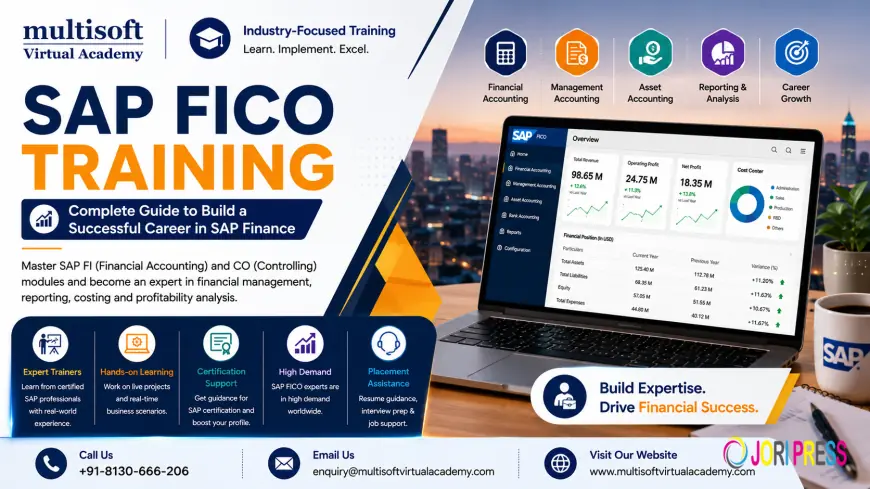
SAP FICO Training Complete Guide to Build a Successful Career in SAP Finance
Master SAP FICO Training with expert-led online sessions, hands-on projects, and certification support to build practical finance and accounting skills.

In today's rapidly evolving digital economy, organizations depend on intelligent ERP systems to manage financial operations efficiently. Among these enterprise solutions, SAP FICO has emerged as one of the most trusted and widely implemented financial management modules. Businesses across manufacturing, healthcare, banking, retail, logistics, telecommunications, and government sectors rely on SAP FICO to streamline accounting, financial reporting, budgeting, cost control, and compliance.
As organizations continue their digital transformation journeys, the demand for skilled SAP FICO professionals is increasing worldwide. Whether you are a recent graduate, finance professional, accountant, auditor, or ERP consultant, enrolling in SAP FICO Training can significantly improve your career prospects and help you secure high-paying roles in leading organizations.
This comprehensive guide explains everything you need to know about SAP FICO, its features, career opportunities, certification benefits, learning roadmap, and why learning SAP FICO remains one of the smartest career investments in today's competitive job market.
What is SAP FICO?
SAP FICO stands for Financial Accounting (FI) and Controlling (CO). It is one of the most important modules in SAP ERP that helps organizations manage their financial transactions, accounting records, cost management, profitability analysis, budgeting, and financial reporting.
The SAP FI module focuses on external financial reporting, while the SAP CO module supports internal management reporting and cost analysis. Together, these modules provide organizations with complete financial visibility and enable better strategic decision-making.
Today, SAP FICO is widely integrated with SAP S/4HANA, enabling organizations to leverage real-time financial analytics, automation, artificial intelligence, and intelligent reporting capabilities.
Why is SAP FICO So Popular?
SAP FICO remains one of the most sought-after ERP solutions because it simplifies complex financial operations while ensuring regulatory compliance and business transparency.
Some major reasons for its popularity include:
- Real-time financial reporting
- Automated accounting processes
- Faster month-end closing
- Better budgeting and forecasting
- Improved audit compliance
- Cost optimization
- Integration with other SAP modules
- Enhanced financial planning
- Global accounting standards support
- Intelligent business insights
Organizations implementing SAP ERP almost always require SAP FICO consultants, making this module one of the highest-demand ERP specializations.
Understanding SAP FI and SAP CO
SAP FI (Financial Accounting)
SAP Financial Accounting manages all external financial activities of an organization.
Major functions include:
- General Ledger Accounting
- Accounts Payable
- Accounts Receivable
- Asset Accounting
- Bank Accounting
- Financial Statements
- Tax Accounting
- Financial Closing
- Electronic Payments
- Financial Reporting
SAP FI ensures that every financial transaction is accurately recorded while complying with international accounting standards.
SAP CO (Controlling)
SAP Controlling focuses on internal financial planning and management.
Major activities include:
- Cost Center Accounting
- Profit Center Accounting
- Internal Orders
- Cost Element Accounting
- Product Costing
- Profitability Analysis
- Budget Monitoring
- Cost Allocation
- Variance Analysis
- Management Reporting
The CO module helps organizations control expenses and improve profitability through better financial planning.
Major Components of SAP FICO
SAP FICO includes several integrated components designed to support every aspect of enterprise finance.
General Ledger Accounting
The General Ledger serves as the foundation of an organization's accounting system by recording all financial transactions.
Accounts Payable
This component manages vendor payments, purchase invoices, payment processing, credit notes, and supplier balances.
Accounts Receivable
It handles customer invoices, collections, incoming payments, customer balances, and credit management.
Asset Accounting
Organizations can efficiently manage fixed assets, depreciation calculations, acquisitions, transfers, retirements, and asset reporting.
Bank Accounting
Bank transactions, reconciliations, cash management, and payment processing become easier using SAP FICO.
Cost Center Accounting
This module monitors departmental expenses and helps organizations optimize operational costs.
Profit Center Accounting
Businesses can evaluate profitability across different business units, divisions, products, or geographical locations.
Internal Orders
Internal Orders help organizations track temporary costs related to projects, events, maintenance, and marketing activities.
Product Costing
Manufacturing companies use this functionality to calculate production costs accurately.
Profitability Analysis (CO-PA)
CO-PA enables businesses to evaluate profitability based on products, customers, markets, and sales channels.
Key Features of SAP FICO Training
Professional SAP FICO Training provides practical knowledge of enterprise financial processes while preparing learners for real-world implementation projects.
Training generally covers:
- Enterprise Structure Configuration
- Financial Accounting Configuration
- Company Code Setup
- Fiscal Year Configuration
- Chart of Accounts
- Posting Period Management
- Document Control
- Tax Configuration
- Vendor Management
- Customer Management
- Asset Accounting
- Cost Center Accounting
- Internal Orders
- Profit Centers
- Product Costing
- Financial Closing
- Reporting
- Integration with MM
- Integration with SD
- Integration with PP
- SAP S/4HANA Finance
Hands-on project practice enables learners to understand how SAP FICO works in real business environments.
Benefits of SAP FICO Training
Learning SAP FICO provides numerous professional advantages.
High Industry Demand
Thousands of organizations continue migrating to SAP S/4HANA, increasing the need for certified SAP finance professionals.
Excellent Salary Opportunities
SAP consultants often receive attractive salary packages because of their specialized ERP expertise and practical implementation skills.
Global Career Opportunities
SAP FICO professionals are employed across North America, Europe, the Middle East, Asia-Pacific, and many other international markets.
Better Career Growth
Professionals with SAP FICO expertise frequently advance into roles such as Financial Analyst, ERP Consultant, SAP Functional Consultant, Solution Architect, Finance Manager, and Project Lead.
Cross-Industry Applications
SAP FICO skills are valuable in:
- Banking
- Manufacturing
- Retail
- Healthcare
- Pharmaceuticals
- Energy
- Telecommunications
- Automotive
- Government
- Aviation
- Oil & Gas
- Information Technology
Improved Business Understanding
SAP FICO Training enhances knowledge of finance, accounting, taxation, cost management, auditing, budgeting, and enterprise business processes.
Who Should Learn SAP FICO?
SAP FICO Training is suitable for a wide range of professionals.
Ideal candidates include:
- Commerce graduates
- MBA Finance students
- Chartered Accountants
- Cost Accountants
- Financial Analysts
- Accountants
- ERP Consultants
- SAP End Users
- Auditors
- Business Analysts
- Finance Managers
- Working professionals seeking career growth
Even beginners without prior SAP experience can start learning SAP FICO with proper guidance.
Essential Skills Required for SAP FICO
Although beginners can start learning SAP FICO, having a basic understanding of finance and accounting concepts makes the learning process easier. A successful SAP FICO consultant combines financial expertise with technical knowledge to solve business challenges efficiently.
Some useful skills include:
- Basic accounting principles
- Financial statement analysis
- Cost accounting
- Taxation fundamentals
- ERP business processes
- Analytical thinking
- Problem-solving skills
- Microsoft Excel proficiency
- Communication and presentation skills
- Business process understanding
You do not need programming knowledge to become an SAP FICO Functional Consultant. Most implementation activities involve business process configuration, testing, documentation, and client interaction.
SAP FICO Course Modules
A comprehensive SAP FICO Training program generally includes the following modules:
Financial Accounting (FI)
- Enterprise Structure
- Company Code Configuration
- Chart of Accounts
- General Ledger Accounting
- Accounts Payable
- Accounts Receivable
- Bank Accounting
- Asset Accounting
- Financial Document Posting
- Tax Configuration
- Financial Closing Process
- Financial Reporting
Controlling (CO)
- Cost Element Accounting
- Cost Center Accounting
- Internal Orders
- Profit Center Accounting
- Product Costing
- Profitability Analysis (CO-PA)
- Cost Allocation
- Budget Planning
- Variance Analysis
- Management Reporting
SAP S/4HANA Finance
Modern organizations are rapidly adopting SAP S/4HANA Finance due to its intelligent capabilities. Training also introduces learners to:
- Universal Journal
- Real-Time Reporting
- SAP Fiori Applications
- Embedded Analytics
- Intelligent Financial Processes
- Machine Learning Integration
- Automation Features
Hands-on assignments, case studies, and implementation scenarios help learners understand practical business applications.
Industries That Use SAP FICO
SAP FICO is one of the most versatile ERP modules and is used across industries worldwide.
Major industries include:
- Manufacturing
- Information Technology
- Banking and Financial Services
- Healthcare
- Pharmaceuticals
- Retail and E-commerce
- Automobile
- Oil and Gas
- Energy and Utilities
- Construction
- Telecommunications
- Aviation
- Logistics and Supply Chain
- Government Organizations
- Education
Since finance is a core business function, almost every large enterprise implementing SAP requires SAP FICO professionals.
Career Opportunities After SAP FICO Training
Completing SAP FICO Training opens doors to a variety of rewarding career paths.
Popular job roles include:
SAP FICO Consultant
Responsible for configuring SAP systems according to business requirements and supporting implementation projects.
SAP Functional Consultant
Works closely with clients to analyze financial processes and customize SAP solutions.
Financial Analyst
Uses SAP reports to evaluate financial performance and support strategic decision-making.
ERP Consultant
Implements ERP systems, conducts user training, and ensures seamless business operations.
SAP Business Analyst
Bridges the gap between business stakeholders and technical teams by gathering requirements and improving financial workflows.
Finance Manager
Leverages SAP FICO for budgeting, forecasting, financial reporting, and compliance management.
SAP Support Consultant
Provides post-implementation support, resolves issues, performs system enhancements, and assists end users.
SAP Project Lead
Oversees SAP implementation projects, coordinates teams, manages timelines, and ensures successful delivery.
Benefits of SAP FICO Certification
A recognized SAP FICO certification validates your expertise and enhances your professional credibility.
Some major benefits include:
- Increased employability
- Better salary packages
- Global career opportunities
- Recognition by multinational companies
- Strong understanding of SAP financial processes
- Higher chances of promotion
- Improved confidence during interviews
- Better consulting opportunities
- Enhanced professional reputation
Certification also demonstrates your commitment to continuous learning and staying updated with the latest ERP technologies.
Future Scope of SAP FICO
The future of SAP FICO is promising as organizations continue investing in digital transformation and intelligent enterprise solutions.
Emerging trends include:
- SAP S/4HANA Finance
- Cloud ERP Adoption
- Artificial Intelligence in Finance
- Robotic Process Automation (RPA)
- Predictive Financial Analytics
- Real-Time Financial Reporting
- Intelligent Process Automation
- Embedded Analytics
- SAP Fiori User Experience
- Digital Compliance Solutions
Professionals with expertise in SAP FICO and SAP S/4HANA are expected to remain in high demand for years to come.
Tips to Succeed in SAP FICO
To build a successful career, consider the following recommendations:
- Learn accounting fundamentals thoroughly.
- Practice SAP configurations regularly.
- Work on real-world business scenarios.
- Understand integration with SAP MM, SD, and PP modules.
- Stay updated with SAP S/4HANA innovations.
- Prepare for SAP certification exams.
- Develop strong communication and consulting skills.
- Participate in implementation projects whenever possible.
- Continue learning advanced SAP financial features.
- Build a professional portfolio showcasing your SAP expertise.
Frequently Asked Questions (FAQs)
Is SAP FICO difficult to learn?
No. With consistent practice and a clear understanding of accounting principles, beginners can learn SAP FICO effectively.
Who can join SAP FICO Training?
Commerce graduates, MBA Finance students, Chartered Accountants, Cost Accountants, financial professionals, ERP consultants, business analysts, and working professionals can all benefit from SAP FICO Training.
Does SAP FICO require coding?
No. SAP FICO is primarily a functional module focused on finance and business process configuration. Coding knowledge is generally not required for functional consulting roles.
Is SAP FICO a good career choice?
Yes. SAP FICO continues to be one of the most in-demand ERP specializations, offering excellent career growth, competitive salaries, and opportunities across multiple industries.
What is the difference between SAP FI and SAP CO?
SAP FI manages external financial accounting, including general ledger, accounts payable, and accounts receivable. SAP CO focuses on internal management accounting, such as cost centers, profitability analysis, budgeting, and cost control.
Can freshers learn SAP FICO?
Absolutely. Fresh graduates with an interest in finance and accounting can start learning SAP FICO and gradually build practical skills through projects and certification.
Final Thought
Investing in SAP FICO Training is a strategic step toward building a successful career in enterprise finance and ERP consulting. As businesses increasingly adopt SAP S/4HANA and intelligent financial solutions, professionals with SAP FICO expertise are becoming invaluable assets across industries. By mastering financial accounting, controlling processes, and real-world SAP implementations, learners can unlock rewarding career opportunities, strengthen their technical and business knowledge, and stay competitive in the evolving digital economy.
If you are looking for comprehensive, industry-focused SAP FICO learning with expert guidance, practical projects, and career-oriented training, Multisoft Virtual Academy is a trusted destination. With experienced trainers, hands-on learning methodologies, flexible online sessions, and a commitment to quality education, Multisoft Virtual Academy helps aspiring professionals develop the skills needed to succeed in today's competitive SAP ecosystem and confidently pursue a rewarding career in SAP Finance and Controlling.
What's Your Reaction?
 Like
0
Like
0
 Dislike
0
Dislike
0
 Love
0
Love
0
 Funny
0
Funny
0
 Angry
0
Angry
0
 Sad
0
Sad
0
 Wow
0
Wow
0