







































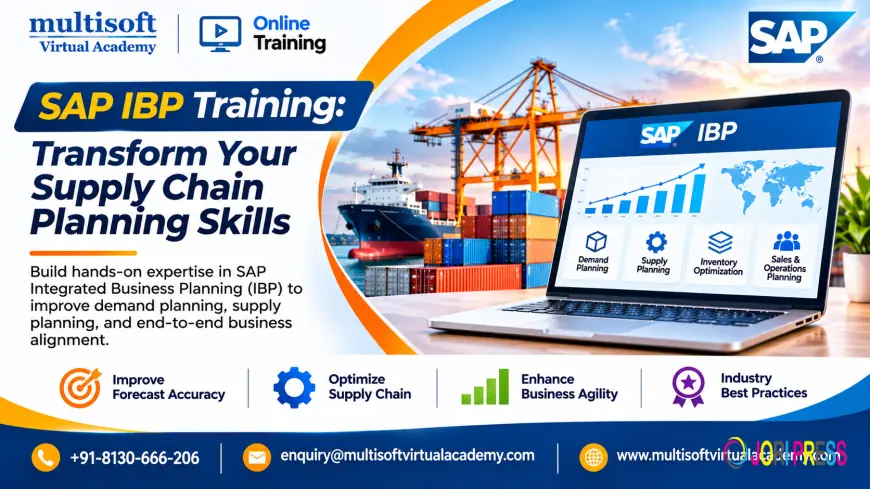
SAP IBP Training: Transform Your Supply Chain Planning Skills
Join SAP IBP Training to master demand planning, supply chain management, and forecasting with expert guidance and practical learning for career growth.

Businesses today operate in supply chain environments where customer expectations, product demand, material availability, and delivery schedules can change rapidly. Managing these variables requires more than traditional spreadsheets and disconnected planning systems. Organizations need a coordinated approach that connects business forecasts with procurement, manufacturing, inventory, and distribution activities.
SAP Integrated Business Planning (SAP IBP) helps organizations address these challenges through connected planning capabilities. It brings different supply chain functions into a common planning environment, allowing teams to evaluate business requirements, analyze potential disruptions, and make informed decisions.
SAP IBP Training provides professionals with an opportunity to understand these capabilities and develop practical knowledge of modern supply chain planning. From demand forecasting and inventory management to supply optimization and sales and operations planning, the platform covers important activities that influence business performance.
For individuals interested in SAP consulting, supply chain analytics, and digital transformation, learning SAP IBP can be a valuable addition to their professional skill set.
Understanding SAP Integrated Business Planning
SAP IBP is a cloud-based solution designed to help businesses coordinate supply chain planning activities. It supports planning processes that connect demand expectations with available resources and operational requirements.
The platform provides capabilities for demand planning, response and supply planning, inventory optimization, and sales and operations planning. It also supports scenario analysis and collaborative planning to help organizations evaluate alternative business situations.
Consider a manufacturing organization producing electronic components. The company needs to estimate customer demand, maintain sufficient raw materials, plan production capacity, and coordinate deliveries. If demand increases unexpectedly or a supplier experiences a delay, planners must understand the potential impact across the supply chain.
SAP IBP provides planning capabilities that help businesses evaluate such situations and develop suitable responses.
How SAP IBP Supports Modern Supply Chain Management
An effective supply chain depends on accurate information and coordination between departments. SAP IBP supports this objective by connecting different planning activities and providing tools for analyzing business information.
Connecting Demand and Supply
One of the major challenges in supply chain management is balancing customer requirements with available resources. Demand planning estimates what customers may need, while supply planning evaluates how those requirements can be fulfilled.
SAP IBP helps organizations connect these planning activities and identify potential gaps between expected demand and available supply.
Improving Planning Visibility
Disconnected planning processes can make it difficult for managers to understand the overall business situation. Integrated planning provides a more coordinated view of important information such as demand, inventory, capacity, and supply availability.
This visibility can help teams recognize exceptions and review planning priorities.
Supporting Business Scenario Analysis
Business conditions do not always develop according to initial forecasts. Organizations may need to evaluate the impact of increased demand, reduced production capacity, supplier delays, or changing material costs.
Scenario analysis allows planners to examine alternative situations and understand their possible operational consequences before selecting an appropriate response.
Encouraging Cross-Functional Collaboration
Supply chain planning involves sales, finance, procurement, manufacturing, and logistics teams. SAP IBP supports collaborative planning by helping stakeholders work with shared planning information and aligned business objectives.
Major Learning Areas in SAP IBP Training
A comprehensive SAP IBP Training Course should explain the platform's major capabilities through business-oriented examples and practical exercises.
1. SAP IBP Architecture and Fundamentals
The introductory section explains the platform's purpose, architecture, planning concepts, and user environment.
Participants may learn about:
- SAP IBP architecture and solution overview
- Planning areas and planning levels
- Master data types and attributes
- Key figures and calculations
- Time profiles and planning horizons
- Planning views
- SAP IBP Excel Add-In
- Planner Workspaces
- Basic application navigation
These concepts provide the foundation required to understand more advanced planning activities.
2. Demand Planning and Forecasting
Demand planning helps businesses estimate future customer requirements. Forecast quality can influence inventory availability, procurement activities, and production schedules.
SAP IBP provides forecasting capabilities that help planners analyze historical information and prepare demand projections.
Important topics include:
- Historical demand analysis
- Statistical forecasting
- Forecast models
- Demand sensing
- Forecast error measurement
- Forecast adjustments
- Demand segmentation
- Product lifecycle considerations
- Promotion planning
- Collaborative demand reviews
For example, a retail business may analyze seasonal sales patterns to estimate product requirements for an upcoming shopping period. Planners can review statistical forecasts and incorporate relevant business information before finalizing the demand plan.
3. Sales and Operations Planning
Sales and operations planning connects commercial expectations with operational capabilities. It helps organizations align demand, supply, inventory, and financial objectives.
Training may cover:
- S&OP fundamentals
- Demand and supply reconciliation
- Planning scenarios
- Capacity considerations
- Financial integration concepts
- Cross-functional planning
- Management reviews
- Performance indicators
Professionals learn how organizations use planning information to evaluate business priorities and coordinate decisions between departments.
4. Inventory Planning and Optimization
Inventory management directly influences customer service and operational costs. Businesses must maintain appropriate stock levels while avoiding unnecessary inventory investment.
SAP IBP inventory optimization capabilities help organizations evaluate inventory targets and understand the relationship between demand variability, lead times, and service requirements.
Key learning topics may include:
- Inventory planning concepts
- Safety stock calculations
- Service level targets
- Demand variability
- Lead time considerations
- Inventory policies
- Multistage inventory optimization
- Inventory performance analysis
These topics are relevant to inventory managers, supply chain consultants, and professionals responsible for stock planning.
5. Response and Supply Planning
Response and supply planning helps organizations determine how demand can be fulfilled using available materials, resources, and production capacity.
A practical training program may include:
- Supply planning fundamentals
- Time-series-based planning
- Order-based planning
- Planning heuristics
- Supply optimization
- Capacity constraints
- Production planning
- Procurement planning
- Deployment strategies
- Product allocation
Understanding these concepts helps learners analyze supply requirements and identify potential constraints within a business planning environment.
6. SAP Supply Chain Control Tower
Supply chain monitoring is important for identifying exceptions and responding to operational changes.
SAP Supply Chain Control Tower capabilities support supply chain visibility, analytics, and exception management.
Training may introduce:
- Supply chain performance monitoring
- Planning alerts
- Exception analysis
- Key performance indicators
- Supply chain analytics
- Operational visibility
- Risk identification
- Scenario evaluation
This learning area is useful for professionals who need to monitor supply chain performance and communicate important planning information to decision-makers.
SAP IBP Implementation: From Business Requirements to Planning Solutions
Learning SAP IBP functionality is important, but implementation projects also require an understanding of business processes and solution design.
SAP IBP Implementation Training should help participants understand how an organization's planning requirements are translated into application configurations and working processes.
Requirement Gathering and Process Analysis
Implementation professionals begin by understanding existing supply chain operations. They identify planning challenges, business objectives, data requirements, and expected outcomes.
A clear understanding of demand, supply, inventory, and production processes helps define the solution scope.
Master Data Preparation
Planning accuracy depends on reliable master data. Information about products, locations, customers, suppliers, resources, and other business entities must be organized appropriately.
Learners should understand how master data supports planning processes and why data quality is essential.
Planning Area and Key Figure Design
Planning areas organize planning information within SAP IBP. Key figures represent measurable business values such as demand quantities, inventory levels, and supply requirements.
Understanding planning levels, attributes, key figures, and calculations helps professionals develop a stronger foundation in solution configuration.
System Integration
SAP IBP can exchange information with SAP S/4HANA, SAP ERP, and other enterprise applications. Integration supports the movement of master data, transactional information, and planning results.
The specific integration approach depends on the organization's system landscape and implementation requirements.
Testing and Deployment
Before a solution goes live, implementation teams must validate planning processes and system behavior.
Testing activities may include forecast validation, inventory calculations, supply planning scenarios, data integration, and user acceptance testing.
Deployment planning and post-implementation support are also important for maintaining business continuity.
Industries That Use SAP IBP
SAP IBP can support organizations across industries that need coordinated planning and improved supply chain visibility.
Manufacturing: Manufacturers can coordinate demand forecasts, material requirements, production capacity, and inventory targets.
Retail and consumer goods: Retail organizations can analyze seasonal demand, product availability, and replenishment requirements.
Automotive: Automotive businesses manage complex supplier networks, production schedules, material availability, and changing customer requirements.
Pharmaceuticals: Pharmaceutical organizations may use integrated planning to coordinate product demand, manufacturing, inventory, and distribution activities.
Electronics: Electronics companies need to manage product demand, component availability, procurement lead times, and production constraints.
Food and beverage: Businesses in this sector may use demand planning and inventory management to coordinate product availability and changing consumption patterns.
The specific SAP IBP capabilities adopted by an organization depend on its operational requirements, industry processes, and technical environment.
Who Can Benefit from SAP IBP Training?
SAP IBP training is relevant to professionals working in supply chain management, enterprise applications, and business planning.
- Supply Chain Managers: Individuals who want to improve their understanding of integrated planning processes.
- Demand Planning Professionals: Specialists involved in forecasting and demand analysis.
- Inventory Planners: Professionals responsible for stock availability, inventory targets, and service levels.
- SAP Functional Consultants: Consultants looking to develop expertise in SAP supply chain planning.
- Production Planners: Individuals who coordinate manufacturing requirements with material availability.
- Procurement Professionals: Specialists interested in connecting purchasing activities with supply planning.
- Business Analysts: Professionals who translate business requirements into planning solutions.
- Fresh Graduates: Candidates interested in building a foundation in SAP and supply chain technology.
Previous knowledge of supply chain management, production planning, inventory, or SAP business processes can make the learning process easier.
Career Opportunities After SAP IBP Training
The increasing importance of digital supply chain management has created opportunities for professionals with relevant planning and technology knowledge.
After developing practical SAP IBP skills, learners may explore roles such as:
- SAP IBP Consultant
- SAP IBP Demand Planning Specialist
- SAP IBP Supply Planning Consultant
- SAP IBP Inventory Optimization Consultant
- SAP Supply Chain Business Analyst
- SAP IBP Functional Consultant
- SAP Planning Application Support Specialist
- SAP IBP Solution Consultant
- Supply Chain Transformation Consultant
The responsibilities associated with these positions vary across organizations. Employers may expect practical SAP experience, business process knowledge, communication skills, and an understanding of implementation methodologies.
Training can help build foundational knowledge, while project experience and continuous learning contribute to long-term professional development.
How to Select the Right SAP IBP Online Training Program
Choosing an appropriate course can make a significant difference to your learning experience. Before enrolling in SAP IBP Online Training, consider the following points.
Evaluate the course curriculum: Make sure the syllabus covers the planning areas relevant to your professional goals, including demand planning, supply planning, S&OP, and inventory optimization.
Prioritize practical learning: Look for exercises involving master data, key figures, forecasting, planning views, and business scenarios.
Check trainer qualifications: An experienced instructor should understand both SAP IBP functionality and the supply chain processes behind it.
Confirm system availability: Ask whether participants receive access to a training environment and which SAP IBP version or release is covered.
Understand the training schedule: Compare instructor-led, one-to-one, and self-paced learning options according to your availability.
Review certification information: Confirm whether the course includes a training completion certificate or prepares participants for an official SAP certification assessment.
A course that combines business concepts with practical application can help learners develop a more complete understanding of the platform.
Frequently Asked Questions About SAP IBP Training
What is the purpose of SAP IBP Training?
SAP IBP training helps professionals understand integrated supply chain planning using SAP. It covers demand forecasting, inventory optimization, supply planning, S&OP, and related business processes.
Is SAP IBP difficult to learn?
The learning experience depends on your background. Professionals familiar with supply chain operations or SAP applications may find the concepts easier to understand. Beginners can start with the fundamentals and progress toward advanced planning topics.
What are the main SAP IBP modules?
Major capability areas include demand planning, sales and operations planning, inventory optimization, and response and supply planning. Supply chain visibility and analytics are also important learning areas.
Does SAP IBP support demand forecasting?
Yes. SAP IBP includes forecasting capabilities that help businesses analyze historical demand, generate forecasts, and evaluate demand changes.
Can SAP IBP integrate with SAP S/4HANA?
Yes. SAP IBP supports integration with SAP S/4HANA and other enterprise applications. The integration design depends on the organization's system architecture and business requirements.
What career options are available after SAP IBP training?
Professionals may pursue opportunities in SAP consulting, demand planning, supply planning, inventory optimization, business analysis, and application support. Job requirements vary by employer and experience level.
Conclusion
SAP Integrated Business Planning provides organizations with capabilities to connect forecasting, inventory management, supply planning, and business collaboration. As supply chains become more interconnected, professionals with knowledge of integrated planning solutions can contribute to better operational visibility and informed decision-making. Learning demand planning, S&OP, inventory optimization, and SAP IBP implementation concepts can establish a useful foundation for working with modern supply chain technologies. Multisoft Virtual Academy offers SAP IBP Training for professionals who want to strengthen their understanding of integrated business planning, explore practical supply chain scenarios, and develop skills relevant to SAP consulting and planning-related roles.
What's Your Reaction?
 Like
0
 Dislike
0
 Love
0
 Funny
0
 Angry
0
 Sad
0
 Wow
0