


































Supervision to Graduation: Building a Strong PhD Relationship

By Dr Giju Paul PhD, ISBAT University
Yesterday was one of those moments that reminded me why doctoral supervision is much more than an academic responsibility.
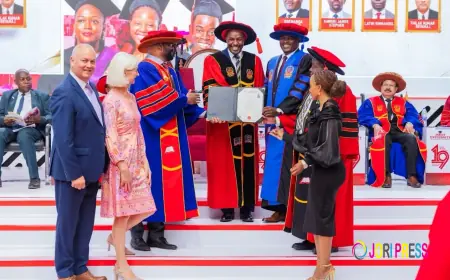
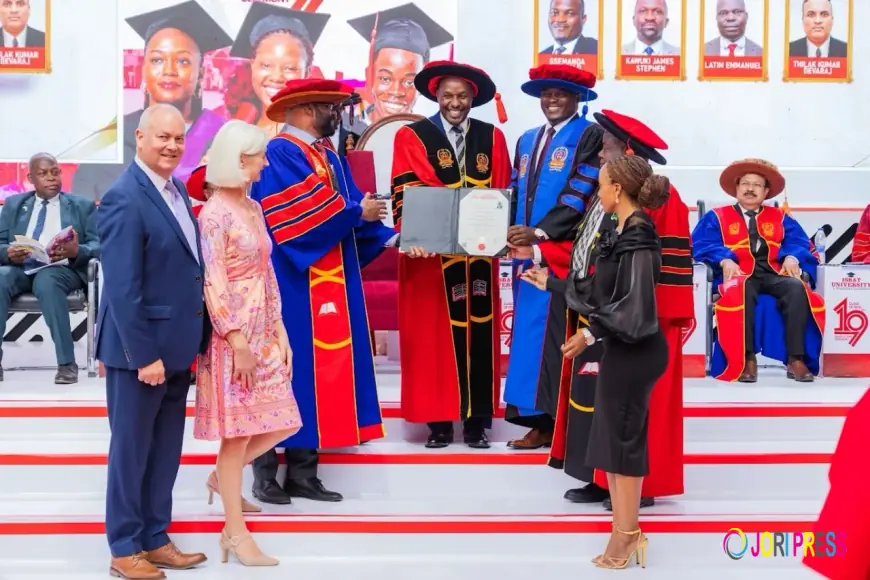
I had the privilege of accompanying my scholar, Mr Ssemand Ronald, together with my main supervisor, Dr Peter Mbabzi, towards the Chancellor’s dais during graduation. It was a proud moment, but behind that short walk was a much longer journey of research discussions, corrections, rewriting, encouragement, discipline, uncertainty, patience, and continuous learning.
Graduation photographs capture the final moment. They do not capture the hundreds of small interactions that make the PhD possible.
That is why I believe one of the most important factors in successful doctoral research is the relationship between the PhD scholar and the supervisor.
A PhD is not completed by the scholar alone, and it is not completed by the supervisor alone. It is completed through a professional relationship built on trust, respect, openness, academic discipline, and gradual intellectual independence.
A PhD Scholar Must Remain Teachable
One of the biggest mistakes a doctoral scholar can make is to assume that because they have completed a Master's degree, gained professional experience, or reached a senior position, they no longer need to be taught.
A PhD demands humility.
The supervisor may question the title, challenge the research problem, ask for more literature, reject an argument, or request that a section be rewritten. These are not signs that the scholar is weak. They are part of doctoral formation.
A scholar should therefore approach supervision with the openness of a learner while gradually developing the confidence to make and defend independent research decisions.
A healthy doctoral journey moves from:
Guidance → Practice → Confidence → Independence
Learn to Receive Correction
Research supervision inevitably involves correction.
A supervisor may return a chapter full of comments or ask the scholar to rethink an approach that took days or weeks to develop. These moments can be frustrating, but academic correction should not be interpreted as personal rejection.
There is a major difference between saying:
“My supervisor rejected me.” and “My supervisor challenged my argument.”
The first creates emotional resistance. The second creates academic growth.
A scholar who learns to receive correction constructively often progresses faster and produces stronger research.
Take Ownership of the PhD
The supervisor is not a thesis editor and should not be expected to rewrite the scholar’s work.
The scholar owns the PhD.
The supervisor guides the direction, questions assumptions, identifies weaknesses, protects academic standards, and helps improve the study. But the scholar must do the reading, thinking, writing, analysis, interpretation, and revision.
A healthy supervision relationship is based on a simple principle:
The supervisor guides. The scholar executes.
The more ownership the scholar takes, the stronger the doctoral journey becomes.
Communicate Early and Regularly
Many PhD problems grow during periods of silence.
A scholar may encounter difficulty with data collection, methodology, analysis, or writing but wait too long before discussing it. By the time the issue reaches the supervisor, weeks or months may have been lost.
Research should be communicated progressively.
A short discussion at the right time can prevent a great deal of unnecessary work.
A good supervision relationship should allow the scholar to say:
“I am stuck here.”
“I do not understand this.”
“This approach is not working.”
“I have found something that may change the direction.”
Honesty and timely communication save time and strengthen trust.
Submit Work Early
One practical habit can dramatically improve supervision:
Submit early.
If a scholar sends a chapter just before a university deadline, the supervisor has little opportunity to provide meaningful guidance. If the corrections are substantial, there may not be enough time to implement them.
Early submission creates space for review, correction, discussion, revision, and improvement.
A PhD should not be managed as a deadline-only project. It should be managed as an iterative learning process.
Ask Better Questions as You Grow
At the beginning of the PhD, scholars often ask:
“Is this correct?”
As they develop, their questions should become more analytical:
“Which theoretical position better explains this finding?”
“Does this result challenge existing literature?”
“Would another analytical method be more appropriate?”
“How does this finding contribute to the research problem?”
This change is important because the quality of a scholar’s questions often reflects the quality of their intellectual growth.
A good supervisor does not simply provide answers. A good supervisor helps the scholar learn how to ask better questions.
Trust and Professional Respect Matter
Supervision becomes difficult when there is no trust.
The scholar must trust that criticism is intended to improve the work. The supervisor must trust that the scholar is conducting the research honestly, taking responsibility, and reporting evidence accurately.
Trust is built through consistent work, academic integrity, respect for deadlines, and honest communication.
Professional respect also includes recognising the supervisor’s time. Supervisors usually manage teaching, administration, research, meetings, publications, and other scholars. Sending documents in advance, clearly identifying areas requiring feedback, and respecting agreed meeting times make the supervision process more productive.
Good Supervision Must Also Understand the Scholar
The relationship is not one-sided.
Supervisors must recognise that scholars come with different backgrounds, professional experiences, family responsibilities, financial pressures, confidence levels, and learning styles.
Some scholars need frequent guidance. Others work more independently. Some communicate easily; others hesitate to admit that they are struggling.
Good supervision therefore requires academic judgement together with human understanding.
The aim is not to make the PhD easy. The aim is to make the PhD achievable without compromising academic standards.
The Goal Is Independence
A successful supervision relationship should gradually reduce dependence.
At the beginning, the supervisor may guide many important decisions. Later, the scholar should increasingly be able to justify choices independently.
The final objective of a PhD is not to produce someone who always asks:
“What should I do next?”
It is to produce someone who can say:
“Based on the evidence, theory, and methodology, this is the decision I propose, and this is why.”
That is when the student begins to become the researcher.
The Relationship Can Continue Beyond Graduation
A good doctoral relationship does not necessarily end when the thesis is submitted.
The supervisor may later become a mentor, collaborator, referee, co-author, or academic adviser.
The degree may be awarded on one day, but a strong academic relationship can continue for many years.
That long-term connection can become one of the most valuable outcomes of the doctoral journey.
What Yesterday’s Graduation Reminded Me
Walking with my scholar towards the Chancellor’s dais reminded me that graduation is only the visible end of a long invisible process.
The scholar walks forward carrying the result of years of work.
The supervisors walk beside the scholar carrying memories of discussions, revisions, difficult decisions, progress, and growth.
There is pride in that moment because supervision has achieved its purpose.
The scholar is no longer simply receiving direction.
The scholar is now expected to contribute knowledge independently.
That transformation is what makes doctoral supervision meaningful.
A Relationship Similar to a Teacher and Student — But with a Different Goal
I often think about the simplicity of the relationship between a good teacher and a young student.
The student trusts the teacher. The student asks questions without embarrassment. The teacher corrects without giving up. The student tries again. There is patience, repetition, and progress.
Doctoral supervision needs some of that same spirit.
But there is one important difference.
In primary education, the teacher continues to remain the teacher.
In doctoral education, the supervisor’s greatest success is when the scholar grows to a point where they can stand intellectually on their own.
The scholar begins by being guided.
The scholar finishes by becoming a colleague in research.
My Advice to PhD Scholars
If I could give a few simple suggestions to every PhD scholar, they would be these: remain teachable, communicate early, submit work before deadlines, accept correction without ego, take ownership of the thesis, respect your supervisor’s time, and gradually learn to defend your own academic decisions.
Above all, do not approach your supervisor merely as the person who must approve your thesis.
Approach supervision as an opportunity to learn how to become a researcher.
Final Thought
A PhD is not only a research project.
It is also a human and intellectual relationship.
The strongest supervision relationships are built on:
Trust + Respect + Discipline + Communication + Humility + Independence
A good supervisor does more than help a scholar complete a thesis.
A good supervisor helps shape a researcher.
And a good scholar does more than follow instructions.
A good scholar learns, questions, improves, takes responsibility, and eventually becomes independent.
Yesterday, as I walked beside my scholar towards the Chancellor’s dais, that was the thought that remained with me:
The true success of supervision is not merely seeing a student graduate. It is seeing a learner become a researcher.
Make my personal voice more prominentReduce repetition and tighten the ending
What's Your Reaction?
 Like
0
 Dislike
0
 Love
0
 Funny
0
 Angry
0
 Sad
0
 Wow
0