








































How Much Does It Cost to Remove an Oak Tree?
Oak tree removal costs $350–$10,000+. Learn what drives the price, permit rules by state, insurance coverage, and how to hire safely in the USA.

How Much Does It Cost to Remove an Oak Tree?
If you have a mature oak on your property that's diseased, dying, dangerously close to your home, or damaged in a storm, one question rises above all others: what is this going to cost me?
Oak tree removal is one of the most expensive tree removal jobs a homeowner can face — and for good reason. Oaks are among the largest, densest, and heaviest trees in North America.
Removing one safely requires specialized equipment, an experienced crew, and careful planning that goes far beyond a simple chainsaw job.
This guide breaks down every cost factor, gives you realistic price ranges by tree size and scenario, explains what insurance covers, and helps you avoid the most common (and costly) mistakes homeowners make.
Check out a tree removal cost calculator for getting an estimate for oak tree removal cost. https://treeremovalcostestimator.org/
Oak Tree Removal Cost: National Price Ranges
The average cost of oak tree removal is $1,600, with prices ranging from $350 on the low end to $4,500 for very large and difficult specimens. However, for truly oversized oaks in challenging locations, costs can exceed $5,000 to $10,000 when cranes and complex rigging are required.
Here is a breakdown by tree size:
| Tree Size | Height | Trunk Diameter (DBH) | Estimated Cost |
|---|---|---|---|
| Small | 12 – 20 ft | 6" – 8" | $275 – $700 |
| Medium | 20 – 35 ft | 8" – 12" | $700 – $1,900 |
| Large | 45 – 70 ft | 12" – 18" | $1,500 – $3,500 |
| Very Large | 70 – 100 ft+ | 18"+ | $3,500 – $10,000+ |
A small oak (20–30 feet) might cost $900–$1,500. Medium ones can hit $2,000–$3,000. Large oaks, especially ones close to structures, can cost $3,500 to $5,000 or more.
Why do oak trees cost more than other species? Oak is one of the densest hardwoods in North America. Its wood is significantly heavier than pine, poplar, or other common yard trees. That extra mass means more time to cut, more effort to lower safely, more trips to haul it away, and more wear on equipment — all of which is reflected in the final price.
The 7 Key Factors That Affect Oak Tree Removal Cost
1. Tree Height and Trunk Diameter
Size is the single biggest driver of cost. Some species like oak have incredibly dense and heavy wood, making them much harder to cut, handle, and haul away. A sprawling oak with several massive trunks is a far more involved project than a straight, single-trunk pine of the exact same height.
Many arborists price by the foot, typically ranging from $10 to $14 per foot under standard conditions, rising to $25 per foot or more for hazardous or difficult jobs. Trunk diameter (measured as DBH — diameter at breast height) matters just as much as height, since a wider trunk means denser wood volume and a longer cutting and hauling job.
2. Location and Accessibility
Where the oak sits on your property can make or break the price. The two biggest things that add to the cost are access and obstacles around the tree. If these were not a problem, you would save hundreds and in some cases thousands of dollars.
Difficult access scenarios that raise costs significantly include:
- Backyard with no rear vehicle access — equipment must be broken down and carried through gates or side yards, adding significant time and labor
- Proximity to a structure — when the oak overhangs a house, garage, or outbuilding, every limb must be roped and lowered precisely rather than dropped freely
- Steep slopes or soft/wet ground — limits where equipment can be positioned safely
- Tight suburban lots — no room to safely fell the tree in one piece
A tricky location can add 25% to 50% to the price tag. Trees near structures or power lines require special equipment and precautions.
3. Tree Health and Structural Condition
The health of your oak has a nuanced effect on price. A dead or hollow tree is not necessarily cheaper to remove — it can actually be more expensive because unpredictable wood behavior makes it more dangerous to work with.
If a tree is rotted, leaning, or neglected, your team may need to rig extra supports before they start cutting. Factors affecting the condition include: construction or landscaping near the roots affecting stability; a significant trunk lean indicating serious stability problems; multiple trunks that can crack and fall; tight V-shaped branch connections that increase breakage risk; and cavities and rot that compromise structural integrity.
A visibly declining oak may require an arborist's inspection before removal can begin. Expect to pay around $860 for an arborist's visit. That assessment is often worth the investment both for safety planning and for insurance documentation purposes.
4. Number of Trunks and Canopy Spread
A single-trunk oak is a very different job from a multi-trunk or "co-dominant" oak. Multiple trunks mean multiple cut points, multiple rigging setups, and far more complex sequencing to prevent uncontrolled falls. A triple-trunked large oak in a backyard — even with great access — presents an amazing landscape job below the tree which is going to slow down the removal dramatically. Each branch will need to be roped up and lowered very slowly, or a crane would need to be used.
Wide canopy spread is another factor. Oaks are known for growing outward as much as upward. A wide, sprawling canopy means more branch volume to cut, lower, chip, and haul — all adding time and labor cost.
5. Crane Requirement
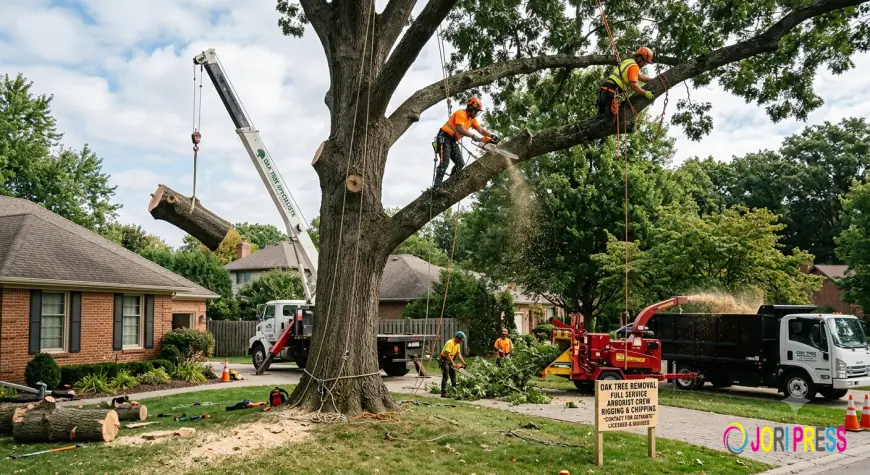
For very large oaks overhanging structures, or oaks in backyard locations without direct equipment access, a crane is often the only viable option. Crane-assisted removal is a premium service for the largest or most hazardous trees. While adding $500 to $2,500 per day to your bill, cranes can dramatically reduce labor time and improve safety, often proving more cost-effective than complex rigging.
When a crane is required, total project costs for a large oak can reach $5,000 to $10,000 or more. This is a legitimate necessity, not a price-padding tactic — in situations where a tree must be lifted piece by piece over a roofline, a crane is the safest and often the most efficient path forward.
6. Time of Year and Demand
Summer and fall are the busiest seasons for tree work, so rates are often higher. In the winter, when things slow down, you can sometimes get a better price. If your oak is not an immediate hazard and removal can wait, scheduling in late fall or winter (when the canopy is bare and demand is lower) can yield savings of 10% to 20%.
Post-storm emergency conditions spike costs even further, with emergency premiums running 25% to 100% above normal pricing.
7. Geographic Region
Pricing varies meaningfully by region. Tree removal in coastal states like California and Florida often leans toward the higher end, typically ranging from $650 to $1,500 for a single tree. Meanwhile, states in the Midwest, like Illinois and Colorado, tend to have much lower averages, often around $350 to $730. Urban areas within any state also command higher prices due to permit requirements, tighter site access, and higher labor costs.
Real-World Oak Tree Removal Scenarios
Scenario 1: Small Oak in an Open Front Yard
A 15-foot ornamental oak with a 6" trunk, clear access, no nearby structures, and room to fell freely. Estimated cost: $275 – $500. This is a half-day job for a two-person crew with a chipper.
Scenario 2: Medium Oak Near a Fence
A 30-foot oak with a 10" trunk, adjacent to a wooden fence, accessible from a side gate. Pieces must be lowered to avoid fence damage. Estimated cost: $900 – $1,500. The rigging work adds time, and cleanup in a constrained space takes longer.
Scenario 3: Large Backyard Oak Overhanging the Roof
A 60-foot oak with an 18" trunk, overhanging a single-story home, with no rear vehicle access. The only feasible way to remove this tree is to find a company with a crane to lift the tree piece by piece over the house to the front yard. Estimated cost: $3,000 – $6,000 including crane rental.
Scenario 4: Dead or Dying Oak Near Power Lines
A 70-foot dead oak leaning toward overhead utility lines. Requires utility coordination, specialized rigging, and extra safety precautions for unpredictable wood. Estimated cost: $4,000 – $8,000+. Never attempt to handle this without a licensed crew — call your utility company first.
Scenario 5: Multi-Trunk Heritage Oak in a Backyard Garden
A large multi-trunk oak with extensive root spread across a landscaped garden, surrounded by irrigation systems, stone paths, and garden beds. Every cut must be precision-lowered. Estimated cost: $3,500 – $7,000. The landscape protection requirement slows the job dramatically.
Add-On Services That Affect Your Total Bill
The base removal quote typically covers felling, cutting into manageable sections, and sometimes hauling. Several additional services affect what you ultimately pay:
| Service | Estimated Cost |
|---|---|
| Stump grinding | $158 – $500 |
| Full stump removal (with roots) | $400 – $900+ |
| Debris hauling and cleanup | $70 – $150 |
| Wood chipping | $95 – $200 |
| Log splitting for firewood | $70 – $150 |
| Arborist inspection/report | $800 – $900 |
| Permit fee (where required) | $60 – $150 |
Always clarify upfront which of these are included in a quote and which are line-item extras. A quote that seems low may be excluding hauling, stump grinding, or cleanup — services that most homeowners need.
One money-saving tip on debris: If you want to keep the oak logs for firewood, tell the company upfront. Since they save hauling costs, many will reduce the removal price by $50 to $150 in exchange for leaving the wood.
Do You Need a Permit to Remove an Oak Tree?
This is one of the most important — and most overlooked — questions homeowners face before scheduling oak removal. The answer varies by city and state.
Every city in the US has tree protection laws that oak trees fall under. Protection laws normally only apply to medium to large specimens, but you will need to check the tree ordinance for your particular city. In most jurisdictions, trees above a certain diameter (commonly 6" to 10" DBH) require a permit before removal can proceed.
California is among the strictest states for oak protection. Several California cities have codes and ordinances that prohibit the removal of oak trees. In Berkeley, no oak tree with a minimum circumference of 18 inches can be cut down if it is a single-stem variety. Los Angeles County and the city of Pasadena both have similar ordinances in place to protect native oak trees.
Florida recently took the opposite approach. A new law in Florida bans local governments from regulating tree removal and re-planting on private property. The legislation called "Private Property Rights" allows property owners to remove, replant, prune, or trim a tree without approval from their local municipality — as long as a licensed arborist determines the tree poses a danger.
If you remove a native oak tree that is protected in your city without a permit, you could face hefty fines. The permit application process typically takes about two weeks, and approvals are generally granted when a tree is clearly diseased, structurally unsafe, or damaging a foundation.
Before scheduling any oak removal, consult your local city hall, municipal website, or a certified arborist familiar with your area's ordinances. This is not a step to skip.
Does Homeowners Insurance Cover Oak Tree Removal?
Whether your insurance policy helps pay for oak removal depends on the circumstances under which the tree came down.
Coverage is generally available when:
- A covered storm peril (wind, lightning, hail, ice/snow accumulation) caused the oak to fall
- The fallen tree damaged an insured structure — your home, detached garage, fence, or shed
- The oak fell across your driveway, blocking access
- A neighbor's oak fell onto your property due to a covered peril
Homeowners insurance usually covers both repairs and tree removal if a covered peril like wind, lightning, or fire causes the tree to fall.
Coverage is typically denied when:
- The tree fell due to rot, disease, or neglect — events considered preventable
- The oak fell during a flood or earthquake (separate specialty policies required)
- The tree fell in the yard without hitting any covered structure
- The insurer determines you were negligent in maintaining a visibly dying tree
Because homeowners insurance does not cover preventative tree removal, a tree that was merely damaged by a storm but not completely fallen will not be covered. It falls to you to remove that tree before gravity or another storm finishes what the first storm started.
Most policies cap tree removal benefits at $500 to $1,000 per tree. Given that large oak removal can easily run $3,000 to $6,000, you should plan for meaningful out-of-pocket costs even when a claim is approved.
Important: Do not remove a storm-damaged oak before contacting your insurer. Your claims adjuster may need to assess the scene — particularly for roof damage — before authorizing removal. Removing the tree first can complicate or jeopardize your claim.
Signs Your Oak Tree Needs to Be Removed
Not every problematic oak needs to come down immediately, but these warning signs warrant a prompt professional evaluation:
- Significant lean that developed recently, particularly after a storm or heavy rain, which may indicate root failure in saturated soil
- Large dead limbs ("widow-makers") hanging overhead, which can fall without warning
- Hollow trunk or major cavities, which compromise the tree's structural integrity — an oak can look healthy from the outside while hollow inside
- Fungal growth at the base (mushrooms or conks near the root flare), which signals advanced internal decay
- Root damage from construction or nearby excavation, which destabilizes the tree's foundation
- Crown dieback — sections of the canopy that fail to leaf out in spring, indicating serious decline
- Proximity to your foundation, where expanding roots can crack slabs, driveways, and sewer lines
- V-shaped branch unions on major limbs, which are structurally weak and prone to splitting in storms
Oak trees are strong, but when they start dying, they don't give you much warning before dropping huge limbs or the whole tree. That's not just dangerous — that's a lawsuit waiting to happen if it falls on a neighbor's property.
How to Get the Best Price: Tips for Hiring a Tree Service
Get At Least Three Quotes
After a storm or when demand is high, prices spike. Even in normal conditions, pricing varies significantly between companies. Getting two or three itemized quotes helps you establish a fair market rate and catch any inflated estimates.
Verify Credentials Before Anyone Starts Work
- Confirm the company carries liability insurance (for property damage) and workers' compensation (for crew injuries on your property)
- Ask for their state contractor's license number
- Check reviews on Google, Angi, the Better Business Bureau, and Yelp
Look for ISA Certification
The International Society of Arboriculture (ISA) certifies arborists to rigorous professional standards. An ISA-certified arborist brings both technical expertise and ethical standards that protect you from unnecessarily recommending removal when pruning might suffice.
Never Pay the Full Amount Upfront
A reputable company may ask for a deposit (commonly 10%–30%), but demanding full payment before work begins is a red flag.
Ask for an Itemized Written Estimate
Verbal quotes are easily disputed. A written estimate should clearly list what is included — felling, hauling, stump grinding, cleanup — and what is excluded.
Consider Bundling Multiple Trees
Consider removing more than one tree at a time, as many pros will charge less per tree if they're working on multiples. If you have additional trees needing attention, getting them done simultaneously while the crew and equipment are on-site can produce meaningful savings.
Ask About Leaving the Wood
If you heat with a wood stove or have a fireplace, asking to keep the oak logs can reduce your bill. Oak firewood is highly valued — dense, long-burning, and high BTU output. The tree service saves hauling costs; you get premium firewood. Both sides win.
DIY Oak Tree Removal: Why It's Almost Never Worth It
It's understandable to want to save money by handling it yourself — but oak tree removal is one of the most genuinely dangerous DIY jobs a homeowner can attempt.
Oak trees are heavy and dangerous. One wrong cut and it can crush a fence, a roof, or worse. Someone gets hurt. Limbs fall and take out fences, roofs, and cars. DIY jobs where the homeowner tried to fell an oak tree with a rental chainsaw almost took out their porch. Also, if you cut it the wrong way or don't drop it in the right spot, you might damage the root system of surrounding trees or tear up your yard.
Beyond the physical danger, DIY removal carries legal and financial risks:
- If the tree falls on your neighbor's property, you are liable for all resulting damage
- Removing a protected oak without a permit exposes you to fines of hundreds to thousands of dollars
- Damage to underground utilities (irrigation, gas lines, sewer) caused by improper felling can cost far more than professional removal
- Homeowner's insurance may not cover damage caused by an unpermitted, unlicensed removal
For small ornamental oaks under 15 feet with good clearance, a careful homeowner with a chainsaw may manage safely. For anything larger — or anything near a structure, fence, or utility line — hire a licensed professional.
What to Expect on the Day of Removal
Understanding the process helps you prepare your property and set realistic expectations:
- Site walkthrough — the crew lead assesses the tree's lean, canopy spread, nearby obstacles, and equipment positioning before any cutting starts
- Equipment staging — chipper, crane (if required), and vehicles are positioned to minimize lawn and landscape damage
- Crown reduction first — large limbs are removed from the top down, either dropped into a clear zone or roped and lowered precisely near structures
- Trunk sectioning — the main trunk is cut from the top down in manageable sections to maintain control throughout
- Stump cutting — the trunk is cut as close to ground level as possible; stump grinding is a separate step if included
- Chipping and hauling — branches and debris are fed through a chipper; log sections are cut for hauling or left for you as firewood
Timing hinges on size and complexity. A small tree might be gone in a few hours, a mid-sized one in half a day, and a giant could keep the crew busy for one to two full workdays. Add extra time if you're grinding the stump, hauling wood, or navigating tight spaces near power lines or fences.
Summary: What to Budget For Oak Tree Removal
| Scenario | Estimated Total Cost |
|---|---|
| Small oak, open yard, no stump | $275 – $700 |
| Medium oak, accessible, stump included | $1,000 – $2,500 |
| Large oak near a structure | $2,500 – $5,000 |
| Very large or crane-required removal | $5,000 – $10,000+ |
| Emergency removal (storm surcharge) | Add 25%–100% to base cost |
| Permit fee (where required) | Add $60 – $150 |
| Stump grinding | Add $158 – $500 |
Oak tree removal is not the place to cut corners. You're dealing with one of the heaviest, most structurally complex trees in North America — a tree that has likely been growing for decades. The right crew, the right equipment, and a clear understanding of your permit requirements and insurance coverage are what separate a smooth, successful removal from a costly disaster.
What's Your Reaction?
 Like
0
Like
0
 Dislike
0
Dislike
0
 Love
0
Love
0
 Funny
0
Funny
0
 Angry
0
Angry
0
 Sad
0
Sad
0
 Wow
0
Wow
0