








































How an RS-485 Modbus Gateway Simplifies Industrial Communication
Learn how an RS-485 Modbus Gateway simplifies industrial communication by enabling reliable data exchange, seamless PLC/SCADA integration, and IIoT connectivity.

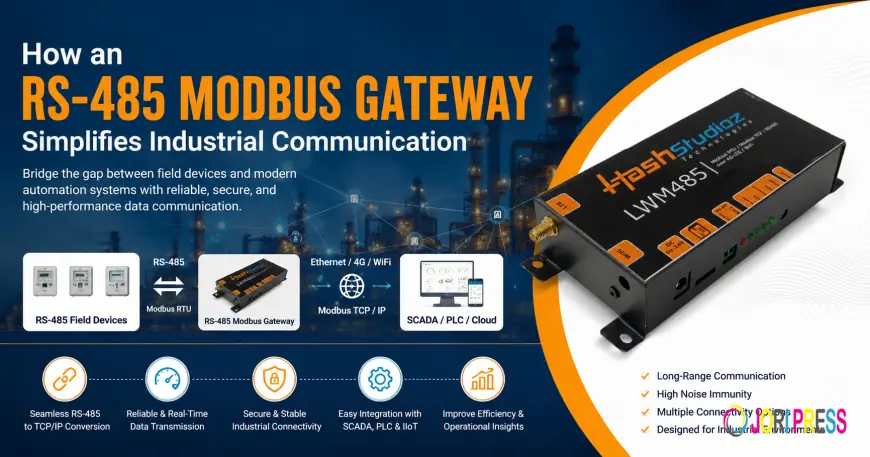
Industrial automation has evolved rapidly over the past decade. Modern factories rely on hundreds of sensors, PLCs, HMIs, energy meters, VFDs, and controllers that must exchange data accurately and in real time. However, connecting devices from different manufacturers and communication protocols can be challenging.
This is where an RS-485 Modbus Gateway becomes an essential component. It acts as a communication bridge between industrial devices, enabling seamless data exchange, centralized monitoring, and efficient automation.
What Is an RS-485 Modbus Gateway?
An RS-485 Modbus Gateway is an industrial communication device that connects multiple RS-485-enabled devices using the Modbus RTU protocol and allows them to communicate with higher-level systems such as:
-
PLCs
-
SCADA systems
-
Building Management Systems (BMS)
-
Energy Management Systems (EMS)
-
Cloud IoT platforms
-
Industrial PCs
-
Edge gateways
The gateway collects data from Modbus RTU devices and converts or forwards it to other communication protocols like:
-
Modbus TCP
-
MQTT
-
Ethernet/IP
-
OPC UA
-
BACnet
-
REST APIs
This eliminates communication barriers between legacy industrial equipment and modern automation platforms.
Understanding RS-485 Communication
RS-485 is one of the most widely used industrial communication standards because it offers:
-
Long-distance communication (up to 1200 meters)
-
Multi-drop networking
-
High noise immunity
-
Reliable serial communication
-
Low installation cost
Unlike RS-232, RS-485 allows multiple devices to communicate over the same cable.
Typical RS-485 devices include:
-
Energy meters
-
Temperature controllers
-
PLCs
-
Variable Frequency Drives (VFDs)
-
Flow meters
-
Pressure sensors
-
Smart relays
-
HVAC controllers
What Is Modbus RTU?
Modbus RTU is a serial communication protocol developed specifically for industrial automation.
It follows a Master-Slave (Client-Server) communication model where:
-
The Master requests data.
-
Slave devices respond.
-
Only one device communicates at a time.
-
Communication is simple and reliable.
Since thousands of industrial devices support Modbus RTU, it has become the industry standard for factory automation.
Why Industrial Communication Is Challenging
Many manufacturing facilities operate equipment installed over different periods. As a result, they often face:
-
Different communication protocols
-
Legacy machines without Ethernet
-
Long cable runs
-
Multiple vendor devices
-
Limited interoperability
-
Difficult remote monitoring
Without a gateway, integrating these devices into one monitoring platform becomes expensive and complex.
How an RS-485 Modbus Gateway Simplifies Industrial Communication
1. Connects Legacy Equipment with Modern Systems
Many industrial machines still use RS-485 serial communication.
Instead of replacing expensive equipment, the gateway allows these devices to communicate with:
-
Cloud dashboards
-
SCADA software
-
ERP systems
-
IoT platforms
This extends the life of existing infrastructure while enabling digital transformation.
2. Converts Communication Protocols
One of the biggest advantages of a Modbus Gateway is protocol conversion.
For example:
Input Protocol
-
RS-485 Modbus RTU
Output Protocol
-
Modbus TCP
-
MQTT
-
Ethernet
-
OPC UA
-
BACnet
This allows devices that normally cannot communicate to exchange data seamlessly.
3. Centralizes Data Collection
Instead of individually polling every field device, the gateway gathers data from multiple sensors and controllers.
Typical connected devices include:
-
Energy meters
-
Flow sensors
-
Pressure transmitters
-
Temperature controllers
-
VFDs
-
Power analyzers
All data is collected at one location before being transmitted to higher-level systems.
Benefits include:
-
Reduced network traffic
-
Easier monitoring
-
Simplified maintenance
4. Enables Long-Distance Communication
Industrial plants often span hundreds of meters.
RS-485 supports communication distances up to 1200 meters, making it ideal for:
-
Manufacturing plants
-
Water treatment facilities
-
Warehouses
-
Smart buildings
-
Oil & gas sites
The gateway ensures stable communication even across large facilities.
5. Improves Network Reliability
Industrial environments generate significant electrical noise.
RS-485 uses differential signaling, making communication resistant to:
-
Electromagnetic interference (EMI)
-
Electrical noise
-
Voltage fluctuations
-
Long cable attenuation
This improves data reliability compared to standard serial communication.
6. Supports Multiple Devices on One Bus
One RS-485 communication line can connect multiple Modbus devices.
Examples include:
-
20 energy meters
-
15 temperature controllers
-
10 PLCs
-
30 sensors
Instead of running separate communication cables for each device, one network handles all communication.
This reduces:
-
Installation cost
-
Cable complexity
-
Maintenance effort
7. Simplifies Remote Monitoring
Industrial facilities increasingly require remote access.
The gateway enables:
-
Cloud connectivity
-
Remote diagnostics
-
Performance monitoring
-
Predictive maintenance
-
Alarm notifications
Maintenance teams can monitor equipment without being physically present.
8. Enhances Industrial IoT Integration
Industry 4.0 depends on real-time machine data.
An RS-485 Modbus Gateway helps legacy equipment become IIoT-ready by forwarding operational data to cloud platforms for analytics and visualization.
Applications include:
-
Production monitoring
-
Machine health analysis
-
Energy optimization
-
Asset management
-
Predictive maintenance
Key Features of an RS-485 Modbus Gateway
Modern industrial gateways typically include:
-
Multiple RS-485 ports
-
Modbus RTU Master/Slave support
-
Modbus TCP conversion
-
Ethernet connectivity
-
MQTT support
-
Web-based configuration
-
DIN rail mounting
-
Industrial-grade enclosure
-
Wide operating temperature
-
Surge and isolation protection
-
LED status indicators
These features make deployment easier and improve reliability in demanding environments.
Benefits of Using an RS-485 Modbus Gateway
Organizations gain several operational advantages:
Reduced Infrastructure Costs
Existing RS-485 equipment can continue operating without costly replacements.
Easier System Integration
Devices from different manufacturers can work together through a common communication interface.
Improved Data Visibility
Real-time operational data becomes accessible from a centralized dashboard.
Higher Productivity
Automated communication reduces manual data collection and minimizes downtime.
Better Decision-Making
Accurate, real-time insights support maintenance planning, energy management, and process optimization.
Scalable Architecture
Additional devices can be added as operations expand without redesigning the communication network.
Common Industrial Applications
An RS-485 Modbus Gateway is widely used across industries.
Manufacturing
-
Machine monitoring
-
PLC communication
-
Production automation
Energy Management
-
Smart metering
-
Power monitoring
-
Load analysis
Building Automation
-
HVAC control
-
Lighting systems
-
Building Management Systems (BMS)
Water & Wastewater
-
Pump control
-
Flow monitoring
-
Tank level monitoring
Oil & Gas
-
Remote Terminal Units (RTUs)
-
Pressure monitoring
-
Pipeline automation
Renewable Energy
-
Solar monitoring
-
Battery management
-
Inverter communication
How to Choose the Right RS-485 Modbus Gateway
When selecting a gateway, consider:
-
Number of RS-485 ports
-
Supported communication protocols
-
Ethernet capabilities
-
Cloud connectivity options
-
Industrial certifications
-
Isolation protection
-
Operating temperature range
-
Configuration software
-
Security features
-
Vendor technical support
Choosing the right gateway ensures compatibility with your existing systems and future expansion plans.
Best Practices for Deployment
For reliable performance:
-
Use high-quality shielded RS-485 cables.
-
Assign unique Modbus addresses to each device.
-
Maintain correct bus termination.
-
Follow recommended cable lengths.
-
Configure communication parameters consistently (baud rate, parity, stop bits).
-
Monitor network health regularly.
-
Protect devices from electrical surges.
These practices help reduce communication errors and improve network stability.
Future of RS-485 Modbus Gateways
As industrial facilities adopt digital transformation strategies, RS-485 Modbus Gateways continue to evolve with features such as:
-
Edge computing
-
AI-powered diagnostics
-
Embedded cybersecurity
-
Secure remote management
-
Cloud-native integration
-
Predictive maintenance capabilities
-
Support for multiple industrial protocols
These advancements ensure that legacy equipment remains valuable while integrating with modern IIoT ecosystems.
Conclusion
An RS-485 Modbus Gateway is much more than a protocol converter—it is a vital link between legacy industrial devices and today's connected automation systems. By enabling seamless communication between RS-485 Modbus RTU equipment and modern platforms such as SCADA, PLCs, cloud applications, and Industrial IoT solutions, it simplifies system integration, enhances data visibility, and reduces infrastructure costs.
Whether you're modernizing an existing facility or designing a new automation system, investing in the right RS-485 Modbus Gateway can improve operational efficiency, enable real-time monitoring, and prepare your infrastructure for the future of smart manufacturing.
FAQs
1. What is an RS-485 Modbus Gateway used for?
It connects RS-485 Modbus RTU devices with Ethernet networks, SCADA systems, PLCs, cloud platforms, and other industrial communication protocols.
2. Can an RS-485 Modbus Gateway connect legacy equipment to the cloud?
Yes. Many gateways support protocols such as MQTT and Modbus TCP, allowing legacy devices to send data to cloud-based IoT platforms.
3. What devices can be connected to an RS-485 Modbus Gateway?
Common devices include energy meters, PLCs, VFDs, temperature controllers, flow meters, pressure sensors, power analyzers, and smart relays.
4. What is the maximum communication distance of RS-485?
RS-485 supports communication distances of up to 1,200 meters, depending on cable quality, baud rate, and installation practices.
5. Why is RS-485 widely used in industrial automation?
RS-485 offers long-distance communication, high noise immunity, support for multiple devices on a single bus, and reliable performance in harsh industrial environments, making it ideal for factory automation and Industrial IoT deployments.
What's Your Reaction?
 Like
0
Like
0
 Dislike
0
Dislike
0
 Love
0
Love
0
 Funny
0
Funny
0
 Angry
0
Angry
0
 Sad
0
Sad
0
 Wow
0
Wow
0