







































From AI to XR: The Technologies Driving the Next Wave of Game Development

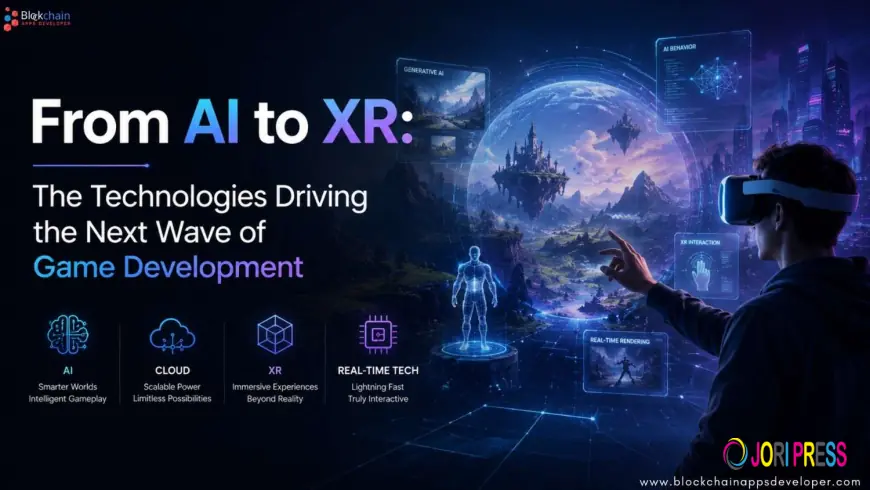
Game development has moved far beyond traditional coding and static gameplay design. Today, it is being reshaped by powerful technologies like Artificial Intelligence (AI), Extended Reality (XR), cloud computing, and blockchain systems. These innovations are not just improving how games are built, they are redefining how players experience virtual worlds.
Modern gaming is now focused on immersion, intelligence, and interactivity. Developers are no longer just creating games; they are building dynamic ecosystems that respond, adapt, and evolve with players. This shift is pushing the industry into a new era where creativity meets automation and realism blends with virtual environments.
How Artificial Intelligence Is Transforming Game Development Workflows
Artificial Intelligence is one of the most impactful forces in modern game creation. From generating assets to automating level design, AI significantly reduces development time while increasing creative output.
AI-driven tools can now assist developers in writing scripts, designing environments, and even testing gameplay mechanics. This allows studios to focus more on storytelling and player engagement rather than repetitive tasks. In fact, many companies are evolving into an AI Game Development Company model, where machine learning systems actively support core development pipelines.
AI is also improving personalization. Games can now analyze player behavior in real time and adjust difficulty levels, rewards, and narratives accordingly, making gameplay more engaging and unique for every user.
The Role of Machine Learning in Smarter Game Mechanics and NPCs
Machine Learning (ML) takes AI integration a step further by enabling games to “learn” from user behavior. Non-playable characters (NPCs) are no longer limited to scripted actions. Instead, they can adapt strategies, respond intelligently, and create more realistic interactions.
This evolution enhances competitive gaming and open-world experiences. Enemy AI can now adjust tactics based on a player’s previous moves, making gameplay more challenging and less predictable. Additionally, recommendation systems powered by ML help developers understand player preferences and improve retention rates.
How XR (AR/VR/MR) Is Redefining Immersive Game Experiences
Extended Reality (XR), which includes Augmented Reality (AR), Virtual Reality (VR), and Mixed Reality (MR), is pushing gaming into fully immersive dimensions. Players are no longer just controlling characters, they are inside the game world.
VR headsets and AR-enabled mobile devices allow users to interact with environments in real time. This technology is particularly powerful in simulation games, adventure experiences, and training-based gaming systems.
Game developers are now designing environments that respond to physical movement, voice commands, and spatial awareness. This shift is making XR one of the most important pillars in the future of interactive entertainment.
Cloud Gaming and Real-Time Rendering in Modern Game Development
Cloud gaming is removing hardware limitations by allowing games to run on remote servers and stream directly to devices. This enables high-quality gaming experiences even on low-end devices.
Real-time rendering technology further enhances this by delivering high-definition graphics instantly without long loading times. Together, cloud computing and rendering engines are making games more accessible, scalable, and visually advanced.
Developers can now deploy updates faster, manage large multiplayer environments efficiently, and reduce dependency on expensive gaming hardware.
Blockchain Integration and Digital Asset Ownership in Games
Blockchain technology is introducing true digital ownership in gaming ecosystems. Players can now own in-game assets such as skins, weapons, and characters as NFTs, which can be traded or sold across platforms.
This shift is also enabling play-to-earn models, where players are rewarded with real-world value for their in-game achievements. Blockchain ensures transparency, security, and decentralized control over digital economies within games.
As a result, game development is no longer limited to entertainment, it is becoming a financial ecosystem where users actively participate in value creation. A professional Game Development Company now often considers blockchain integration as part of its core offering to meet modern gaming demands.
How BlockchainAppsDeveloper Is Powering Advanced Game Development Solutions
In today’s fast-moving gaming market, success depends on how immersive, scalable, and intelligent your game experience is. BlockchainAppsDeveloper helps businesses turn game ideas into real, market-ready products by combining AI, blockchain, and XR technologies into one powerful development approach. The focus is not just on building games, but on creating engaging ecosystems that keep players active and invested.
From secure in-game asset ownership and play-to-earn models to AI-driven gameplay that adapts to user behavior, the solutions are designed to improve both player experience and business revenue potential. Whether it’s a startup or an established studio, the goal is to deliver games that are interactive, future-ready, and built for long-term growth in a competitive industry.
Future Outlook: The Next Wave of Innovation in Game Development Technologies
The future of game development lies in the convergence of multiple advanced technologies. AI will continue to automate and enhance creativity, XR will deepen immersion, blockchain will strengthen digital economies, and cloud systems will ensure seamless global access.
As these technologies evolve, the line between virtual and real worlds will continue to blur. Developers who adapt to this transformation will lead the next generation of interactive entertainment, where games are not just played, but experienced, owned, and evolved over time.
What's Your Reaction?
 Like
0
Like
0
 Dislike
0
Dislike
0
 Love
0
Love
0
 Funny
0
Funny
0
 Angry
0
Angry
0
 Sad
0
Sad
0
 Wow
0
Wow
0