









































Digital Video Content Market Size, Share & Trends 2034
Digital Video Content Market is set to reach USD 132.5 billion by 2034, driven by OTT, mobile streaming, short-form video, and digital ads.
The Global Digital Video Content Market is experiencing sustained expansion as consumers increasingly shift from conventional television and physical media toward streaming, on-demand entertainment, social video, and mobile-first content. Rising smartphone penetration, affordable high-speed internet, connected televisions, and changing viewing habits are transforming how audiences discover, consume, and engage with video content worldwide.
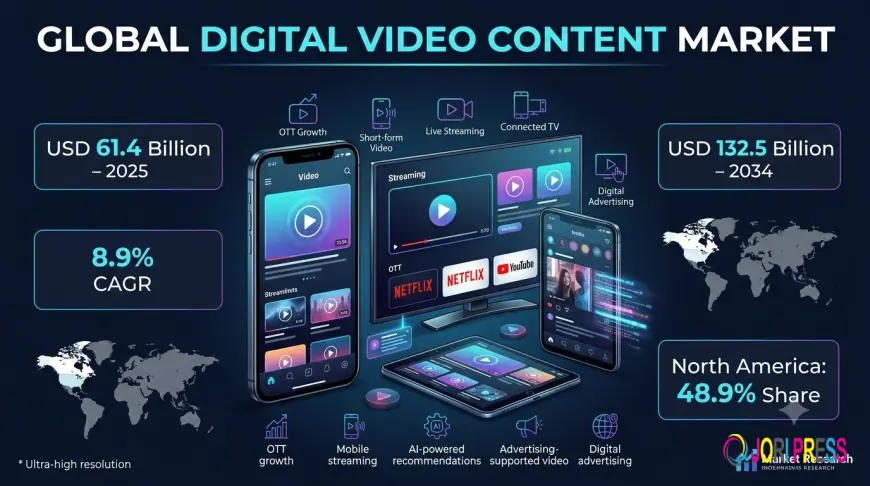
The global digital video content market is expected to reach USD 61.4 billion in 2025. Growing consumption of subscription-based streaming services, advertising-supported platforms, live video, short-form entertainment, and user-generated content is supporting market development. Digital platforms are also investing heavily in recommendation engines, localization, premium programming, and multiplatform distribution to increase engagement.
The market is projected to reach USD 132.5 billion by 2034, expanding at a compound annual growth rate of 8.9% during the forecast period. Increasing adoption of over-the-top services, connected devices, personalized viewing experiences, and digital advertising is expected to create considerable opportunities for content producers, streaming platforms, broadcasters, advertisers, and technology providers.
Market Overview
Digital video content includes professionally produced and user-generated audiovisual material distributed through internet-enabled platforms. The category covers movies, television programs, sports, entertainment shows, educational videos, social media clips, live streams, news content, documentaries, gaming-related videos, and other digital formats delivered through smartphones, tablets, computers, smart televisions, and connected devices.
Consumer entertainment habits have shifted significantly as viewers increasingly expect convenient access, personalized recommendations, flexible subscription options, and content availability across multiple screens. Streaming platforms have responded by expanding original programming libraries, improving video quality, entering regional markets, and introducing tiered subscription and advertising-supported models.
The rapid development of cloud infrastructure has further strengthened the digital video ecosystem. Cloud-based content management, video processing, storage, encoding, distribution, and analytics allow platforms to scale services efficiently while serving millions of users across different geographies.
The growth of creator-driven platforms is also broadening the industry's structure. Independent creators, influencers, publishers, brands, educational institutions, and businesses can now distribute professional-quality video content without relying entirely on traditional broadcasters.
Key Findings
-
The global digital video content market is expected to reach USD 61.4 billion in 2025.
-
Market revenue is forecast to increase to USD 132.5 billion by 2034.
-
The industry is anticipated to grow at a CAGR of 8.9% during the forecast period.
-
North America is projected to account for approximately 48.9% of global revenue in 2025.
-
Mobile streaming, OTT adoption, short-form video, connected televisions, and personalized content are major market growth factors.
-
Advertising-supported streaming models are gaining importance alongside subscription-based services.
-
Artificial intelligence is becoming increasingly important for recommendation systems, content discovery, automated production, captioning, localization, and audience analytics.
Market Dynamics
Growth Drivers
Rapid Expansion of OTT Services
The expansion of over-the-top video platforms represents one of the strongest drivers of the digital video content market. Consumers increasingly prefer services that provide immediate access to entertainment without traditional broadcast schedules.
OTT platforms allow users to stream television programs, movies, documentaries, live sports, and exclusive content through internet-connected devices. Increasing competition among service providers is driving investment in original programming, regional content, and exclusive distribution agreements.
Growth of Mobile Video Consumption
Smartphones have become one of the most important devices for digital video consumption. Improvements in mobile network infrastructure, larger displays, higher processing capabilities, and affordable data plans are increasing video viewing on smartphones.
Mobile platforms are particularly important for short-form videos, social entertainment, news clips, music videos, gaming content, and live streaming. Younger audiences increasingly consume video through mobile-first applications rather than traditional television.
Increasing High-Speed Internet Penetration
Improved broadband connectivity and faster mobile networks are enabling consumers to stream high-definition and ultra-high-definition video with fewer interruptions. Reliable internet infrastructure improves the user experience and supports the expansion of digital video platforms into additional markets.
The deployment of advanced mobile networks also creates opportunities for live streaming, interactive video experiences, cloud gaming, immersive entertainment, and high-resolution content delivery.
Rising Digital Advertising Investment
Video has become an increasingly important format for digital advertisers because it combines storytelling, visual engagement, sound, and measurable audience targeting. Advertising-supported streaming platforms allow brands to reach specific demographic and behavioral groups while helping platforms diversify revenue.
Growth in connected television advertising, social video advertising, and short-form promotional content is further strengthening commercial opportunities across the market.
Market Trends
Short-Form Video Continues to Gain Popularity
Short-form video has emerged as one of the most influential content formats globally. Consumers increasingly prefer quick, engaging videos that can be consumed within minutes or seconds.
This trend is influencing entertainment, marketing, education, journalism, and product discovery. Platforms are optimizing algorithms to surface highly relevant short videos and maintain continuous user engagement.
Growth of Advertising-Supported Streaming
Subscription fatigue is encouraging streaming providers to introduce lower-priced or free advertising-supported plans. These models allow platforms to reach price-sensitive audiences while creating additional advertising inventory.
Hybrid monetization strategies combining subscription revenue and advertising income are therefore becoming more common.
Increasing Demand for Localized Content
Streaming companies are investing heavily in regional languages, culturally relevant programming, local creators, and region-specific entertainment. Localization allows platforms to strengthen engagement and attract audiences outside established English-language markets.
Subtitles, dubbing, multilingual user interfaces, and artificial intelligence-based translation tools are making content increasingly accessible across borders.
Artificial Intelligence in Content Distribution
Artificial intelligence is reshaping content recommendation, audience segmentation, automated editing, caption generation, video analytics, content moderation, and personalization.
Streaming providers use viewing history, search behavior, engagement patterns, and demographic data to recommend relevant programming and improve retention.
Rise of Connected Television
Connected televisions are increasingly combining the convenience of internet streaming with the large-screen experience traditionally associated with broadcast television.
As households adopt smart televisions and streaming devices, digital video services are becoming increasingly central to home entertainment.
Challenges Affecting Market Growth
Intense Competition Between Platforms
Competition for subscriber attention is increasing as numerous streaming services compete for audiences. Maintaining subscriber growth often requires continuous investment in exclusive content, original programming, technology, and marketing.
This competition may increase customer acquisition costs and place pressure on profitability.
Content Production Costs
Premium movies, television series, live sports programming, and original entertainment can require substantial financial investment. Streaming platforms must balance growing content budgets with subscriber revenue, advertising income, licensing costs, and operating expenses.
Subscription Fatigue
Consumers often subscribe to multiple digital services, creating concerns around rising household entertainment spending. Some viewers may cancel or rotate subscriptions depending on available content.
This trend is encouraging providers to offer bundled packages, advertising-supported tiers, and flexible subscription structures.
Copyright and Piracy Concerns
Unauthorized distribution of movies, sports broadcasts, television programs, and other premium video content remains an important industry challenge. Digital platforms must continue investing in content protection, digital rights management, monitoring, and cybersecurity.
Data Privacy Requirements
Personalized digital video services often depend on extensive analysis of user behavior and preferences. Platforms therefore need to manage consumer information responsibly while complying with evolving privacy and data-protection requirements.
Market Segmentation Overview
The digital video content market can be evaluated across several major categories, including content type, revenue model, device, and end user.
By Content Type
The market includes movies, television programs, sports, entertainment, music videos, educational content, news, live streaming, short-form video, and user-generated content.
Movies and television programming remain important revenue contributors due to strong demand for premium entertainment. Short-form and user-generated video are experiencing rapid adoption due to the expansion of creator platforms and mobile entertainment.
By Revenue Model
Major revenue models include subscription-based video services, advertising-supported platforms, transactional video services, and hybrid models.
Subscription platforms generate recurring revenue through monthly or annual plans, while advertising-supported platforms monetize audience attention through targeted advertisements. Hybrid platforms increasingly combine both approaches.
By Device
Digital video content is consumed through smartphones, tablets, computers, smart televisions, gaming consoles, and streaming devices.
Smartphones remain particularly important for mobile-first content, while connected televisions continue gaining importance for premium long-form viewing.
By End User
Primary users include individual consumers, enterprises, educational institutions, media companies, advertisers, government organizations, and other digital audiences.
Consumer entertainment represents a major share of demand, while corporate communication, professional training, education, marketing, and digital events create additional growth opportunities.
Regional Analysis
North America
North America is expected to remain the largest regional market, accounting for approximately 48.9% of global digital video content revenue in 2025.
The region benefits from mature digital infrastructure, high broadband penetration, widespread adoption of smart devices, strong consumer willingness to pay for entertainment subscriptions, and a well-established digital advertising ecosystem.
The presence of major entertainment and technology companies, including Netflix, Amazon, Disney+, and YouTube, further supports regional leadership. These companies continue investing in premium programming, original productions, advertising-supported services, personalization, and advanced streaming technologies.
Europe
Europe represents another significant market supported by widespread broadband access, strong demand for subscription streaming, and rising consumption of regional-language content.
Local production requirements and consumer demand for culturally relevant programming are encouraging greater investment in European entertainment content.
Asia-Pacific
Asia-Pacific offers substantial long-term growth opportunities because of its large population, increasing smartphone ownership, expanding internet connectivity, and rapidly developing creator economy.
Consumers across major Asian markets increasingly use mobile devices as their primary source of entertainment, creating opportunities for short-form video, social platforms, live streaming, sports, and regional-language programming.
Latin America
Latin America is witnessing growing digital video adoption as broadband connectivity improves and streaming becomes increasingly affordable.
Demand for local-language entertainment, sports programming, music, and mobile-first video is supporting regional growth.
Middle East and Africa
The Middle East and Africa are expected to experience increasing digital video adoption as internet access, smartphone penetration, and digital payment systems continue to improve.
Investment in regional production, Arabic-language entertainment, sports broadcasting, and mobile streaming platforms is expanding the addressable audience.
Competitive Landscape
The global digital video content market is highly competitive, with companies competing through content libraries, exclusive programming, pricing strategies, personalization, advertising technology, and geographic expansion.
Leading platforms are investing substantially in original movies, series, documentaries, sports programming, creator partnerships, and regional productions to differentiate their offerings.
Competition is also moving beyond subscriber acquisition toward retention and engagement. Recommendation systems, user interfaces, video quality, download capabilities, household sharing options, bundled services, and interactive features increasingly influence consumer decisions.
Advertising technology is becoming another important competitive area. Platforms with large audiences are increasingly developing targeted advertising capabilities that allow marketers to reach viewers using behavioral and contextual data.
Partnerships between telecommunications companies, device manufacturers, content producers, broadcasters, and streaming providers are also helping companies expand distribution and reduce customer acquisition costs.
Future Market Outlook
The future of the digital video content market will be shaped by convergence between entertainment, social media, gaming, advertising, and interactive technology.
Artificial intelligence is expected to play an increasingly important role in content production and distribution. Automated editing, personalized recommendations, real-time translation, multilingual dubbing, content moderation, and predictive audience analytics could improve operational efficiency and viewer engagement.
Interactive video may also gain importance. Viewers could increasingly participate in live events, choose story outcomes, shop directly through video, interact with creators, or engage with virtual environments.
Streaming platforms are also likely to become more diversified in their monetization strategies. Rather than relying exclusively on subscription revenue, many providers may increasingly combine advertising, commerce, partnerships, licensing, premium tiers, and transactional services.
Emerging markets are expected to contribute significantly to future user growth as internet access expands and local content production increases. Platforms capable of adapting pricing models, languages, payment options, and programming strategies for individual markets are likely to strengthen their international presence.
With the market projected to rise from USD 61.4 billion in 2025 to USD 132.5 billion by 2034, digital video content will remain an important component of the global entertainment, advertising, communications, and creator economies.
Frequently Asked Questions
What is the size of the Global Digital Video Content Market in 2025?
The Global Digital Video Content Market is expected to reach approximately USD 61.4 billion in 2025, supported by growing streaming consumption, mobile video viewing, OTT adoption, and digital advertising.
What is the projected value of the Digital Video Content Market by 2034?
The market is projected to reach approximately USD 132.5 billion by 2034, reflecting continued expansion of subscription streaming, advertising-supported services, short-form video, and connected television.
What is the expected CAGR of the Digital Video Content Market?
The Global Digital Video Content Market is projected to grow at a CAGR of 8.9% during the forecast period as consumers increasingly shift toward internet-based entertainment and on-demand video services.
Which region dominates the Digital Video Content Market?
North America is expected to dominate the market with approximately 48.9% of global revenue in 2025, supported by mature digital infrastructure, strong streaming adoption, and the presence of major entertainment and technology companies.
What factors are driving growth in the Digital Video Content Market?
Major growth drivers include increasing OTT adoption, high-speed internet penetration, smartphone usage, connected televisions, short-form video consumption, digital advertising investment, personalized content recommendations, and demand for regional programming.
Summary of Key Insights
The Global Digital Video Content Market is moving rapidly toward a more connected, personalized, mobile, and advertising-driven environment. Market revenue is expected to reach USD 61.4 billion in 2025 and increase to USD 132.5 billion by 2034, representing a strong 8.9% CAGR.
North America is expected to maintain the largest regional revenue share at approximately 48.9% in 2025, while Asia-Pacific and other emerging regions offer significant future opportunities as mobile connectivity and streaming adoption increase.
OTT services, short-form video, connected televisions, advertising-supported streaming, localized programming, creator-driven content, and artificial intelligence are among the most important forces shaping the industry's direction. Despite challenges involving competition, piracy, subscription fatigue, content costs, and privacy requirements, continued innovation in video technology and monetization models is expected to support sustained global market growth.
What's Your Reaction?
 Like
0
Like
0
 Dislike
0
Dislike
0
 Love
0
Love
0
 Funny
0
Funny
0
 Angry
0
Angry
0
 Sad
0
Sad
0
 Wow
0
Wow
0