





































Construction Cyber Security Market Size, Trends & Forecast 2025–2034
Construction Cyber Security Market, projected to reach USD 44.1 billion by 2034 at 18.3% CAGR, driven by cloud, IoT and digital jobsites.
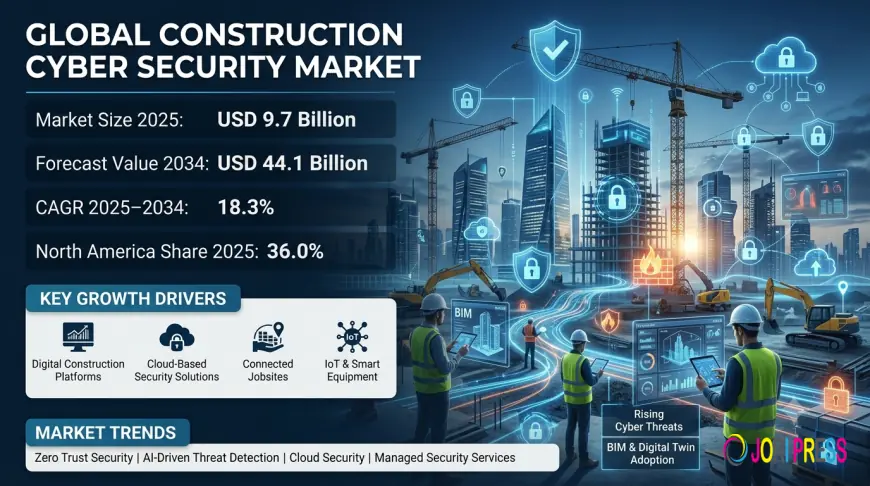
The Global Construction Cyber Security Market is becoming an increasingly important component of the construction industry's digital transformation as contractors, engineering firms, infrastructure developers, and project owners expand their use of cloud platforms, connected equipment, building information modeling, remote collaboration tools, and Internet of Things technologies. The market was valued at USD 9.7 billion in 2025 and is projected to reach USD 44.1 billion by 2034, expanding at a CAGR of 18.3% during the forecast period.
Construction organizations are managing significantly larger volumes of project, financial, operational, employee, supplier, and infrastructure data than in previous years. Digital project management systems now connect architects, engineers, contractors, subcontractors, equipment operators, and asset owners through shared networks. Although these technologies improve productivity and coordination, they also increase the number of endpoints and digital connections that cybercriminals can potentially exploit.
Cybersecurity is therefore shifting from a traditional IT responsibility to a broader operational requirement across construction projects. Companies increasingly require secure cloud environments, identity and access management, endpoint protection, network monitoring, threat detection, data encryption, backup systems, and incident response capabilities. These requirements are particularly important for large infrastructure projects where cyber incidents can affect not only information systems but also physical operations and project continuity.
Market Overview
The construction cyber security market includes technologies and services designed to protect digital systems, networks, applications, connected equipment, operational technologies, project databases, and confidential information used throughout construction activities. Cybersecurity solutions are increasingly integrated into construction management platforms and connected jobsite ecosystems to reduce vulnerabilities created by digital workflows.
The expansion of smart construction is widening the industry's cybersecurity requirements. Contractors increasingly use drones, connected machinery, digital twins, BIM software, mobile applications, smart sensors, automated monitoring systems, and cloud collaboration platforms. Each connected system creates additional access points that must be authenticated, monitored, updated, and protected.
The projected increase from USD 9.7 billion in 2025 to USD 44.1 billion by 2034 represents an expansion of more than four times the market's 2025 value. This rapid growth reflects increased cybersecurity spending by construction companies as digital infrastructure becomes fundamental to project delivery.
Large enterprises are generally more advanced in cybersecurity deployment because of their extensive technology infrastructure and greater exposure to regulatory, financial, and operational risks. However, small and medium-sized construction companies are also increasing investment as cloud-based security platforms make advanced protection more accessible without requiring large internal cybersecurity teams.
Key Findings
-
The global construction cyber security market reached approximately USD 9.7 billion in 2025.
-
Market revenue is projected to reach USD 44.1 billion by 2034.
-
The market is expected to expand at a strong 18.3% CAGR during the forecast period.
-
North America accounted for approximately 36.0% of global revenue in 2025.
-
Cloud security is gaining importance as construction companies increasingly operate project management systems and databases through cloud environments.
-
Connected construction equipment and IoT devices are expanding the number of cybersecurity endpoints across worksites.
-
Identity management, endpoint protection, network security, data protection, and threat monitoring are becoming fundamental components of construction cybersecurity strategies.
-
Infrastructure construction is expected to remain an important cybersecurity application because of the potential economic and operational consequences associated with cyberattacks.
Market Dynamics
Growth Drivers
Rapid Digitalization of Construction Operations
Digital transformation is one of the strongest drivers of the Construction Cyber Security Market. Contractors are adopting digital solutions to improve scheduling, estimating, resource allocation, design coordination, equipment utilization, quality control, and safety management.
Traditional construction environments previously relied heavily on localized systems and physical documentation. Modern construction environments increasingly depend on connected digital platforms. Information may move between design software, construction management applications, mobile devices, contractors, suppliers, machinery, and building management systems.
This increased connectivity creates demand for cybersecurity platforms capable of maintaining visibility and protection across complex digital ecosystems.
Growing Adoption of Cloud-Based Construction Platforms
Cloud technologies allow teams to access project information from different offices and jobsites while collaborating in real time. Cloud-based BIM, document management, procurement, financial management, and project scheduling applications are becoming increasingly important within construction workflows.
As sensitive project information moves into cloud infrastructure, enterprises are strengthening cloud access controls, authentication mechanisms, data encryption, monitoring capabilities, and configuration management.
The growing use of software-as-a-service platforms is also encouraging smaller contractors to adopt cybersecurity tools through subscription-based models.
Expansion of Connected Jobsites
Construction sites are becoming increasingly connected through IoT sensors, cameras, drones, telematics systems, wearable technologies, smart machinery, and automated equipment.
Connected technologies can monitor equipment performance, worker safety, material movement, environmental conditions, and construction progress. However, poorly protected devices can create entry points into broader corporate networks.
Cybersecurity providers are consequently developing solutions that provide device visibility, network segmentation, authentication, anomaly detection, and continuous monitoring across connected operational environments.
Rising Financial Impact of Cyber Incidents
Construction businesses handle significant amounts of valuable information, including architectural designs, contracts, employee information, financial records, supplier details, project schedules, and infrastructure specifications.
Ransomware, credential theft, phishing, unauthorized system access, and data breaches can disrupt projects and generate substantial recovery expenses. Lost access to scheduling, procurement, or design systems can delay construction activities and increase project costs.
Growing awareness of these consequences is encouraging contractors to allocate larger budgets toward preventive cybersecurity strategies.
Market Trends
Zero Trust Security Adoption
Construction organizations are increasingly considering zero trust approaches in which every user, device, and connection must be authenticated before accessing corporate resources. This model is particularly relevant for construction projects involving numerous contractors, subcontractors, consultants, temporary employees, and external suppliers.
AI-Driven Threat Detection
Artificial intelligence and machine learning are strengthening threat detection by analyzing network activity and identifying abnormal behavior. Automated security platforms can help construction companies respond more quickly to suspicious account activities, unusual data transfers, or unexpected changes in connected systems.
Security Integration with BIM and Digital Twins
As BIM platforms and digital twins become central to design and infrastructure management, cybersecurity is becoming integrated more directly into digital construction environments. Protecting these systems is important because compromised models could expose confidential structural, engineering, or operational information.
Increasing Managed Security Services Adoption
Many construction businesses lack dedicated cybersecurity specialists. Managed security services allow organizations to outsource monitoring, vulnerability management, incident response, and security operations while maintaining continuous protection.
Challenges
A major challenge is the fragmented nature of the construction ecosystem. Projects can involve dozens or hundreds of organizations using different devices, platforms, security policies, and access credentials. Maintaining consistent cybersecurity standards across these participants can be difficult.
Legacy equipment represents another challenge. Older industrial systems and connected machinery may not support modern authentication or encryption technologies, making security upgrades complicated or expensive.
Cybersecurity talent shortages can also affect implementation. Construction companies compete with technology, finance, healthcare, and government organizations for qualified cybersecurity professionals. Smaller contractors may find it particularly difficult to maintain specialized internal security teams.
Cost remains another concern. Cybersecurity investment competes with spending on equipment, labor, materials, and project development. Companies therefore increasingly seek scalable solutions that can provide strong protection without significantly increasing operational complexity.
Market Segmentation Overview
The Construction Cyber Security Market can be evaluated across several categories, including solution, deployment, security type, organization size, and construction application.
By solution, the market includes security software and cybersecurity services. Solutions can include endpoint security, network protection, identity and access management, data security, cloud security, vulnerability management, and threat monitoring.
By deployment, the market is divided primarily between cloud-based and on-premises cybersecurity environments. Cloud deployment is gaining momentum because it supports remote access, scalability, centralized management, and geographically distributed project teams.
By organization size, both large enterprises and small and medium-sized businesses represent important customer groups. Large organizations typically require integrated security environments capable of protecting extensive operations, while smaller companies increasingly adopt cloud-based and managed cybersecurity solutions.
By application, demand extends across residential, commercial, industrial, institutional, transportation, utilities, and infrastructure construction. Critical infrastructure projects generally require particularly strong cybersecurity protection because disruption can potentially affect essential services and public systems.
Regional Analysis
North America
North America is anticipated to dominate the Global Construction Cyber Security Market with approximately 36.0% of global revenue in 2025. Its strong market position is supported by widespread adoption of digital construction technologies, cloud-based project management platforms, connected equipment, and advanced cybersecurity solutions.
Large construction enterprises operating throughout the region increasingly rely on cloud environments, BIM platforms, digital procurement tools, smart building technologies, and IoT-enabled jobsites. The growing number of connected systems expands demand for endpoint security, network protection, identity management, and threat detection.
Major infrastructure modernization initiatives are also increasing the importance of cybersecurity. Transportation systems, utility infrastructure, data centers, industrial facilities, and smart buildings increasingly integrate digital and operational technologies, creating a growing requirement for secure construction and commissioning environments.
Europe
Europe represents another significant market, supported by digitalization across engineering, infrastructure, commercial construction, and smart building projects. Strong requirements surrounding data privacy, operational resilience, and critical infrastructure protection are encouraging organizations to improve cybersecurity frameworks.
Increasing adoption of BIM, connected buildings, digital engineering platforms, and cloud collaboration systems is further expanding the need for cybersecurity solutions across European construction activities.
Asia-Pacific
Asia-Pacific is expected to present substantial long-term growth opportunities due to rapid urbanization, large infrastructure programs, smart-city development, data center construction, and increasing adoption of digital project technologies.
Construction companies across major Asian economies are expanding their use of automation, cloud applications, smart equipment, and digital project management platforms, increasing potential demand for security solutions.
Competitive Landscape
The Construction Cyber Security Market features cybersecurity software vendors, cloud security providers, managed security companies, network security specialists, identity management companies, and technology integrators.
Competition is increasingly centered on integrated platforms capable of securing cloud infrastructure, endpoints, identities, applications, connected devices, and operational technologies through unified management environments.
Vendors are strengthening their positions through artificial intelligence, behavioral analytics, automated threat detection, extended detection and response, zero trust architecture, and managed security capabilities.
Construction-specific expertise may become an increasingly important competitive differentiator. Providers that understand temporary project networks, contractor access requirements, IoT equipment, operational technology, and distributed worksites can deliver security frameworks more closely aligned with construction environments.
Strategic partnerships between cybersecurity companies, cloud providers, construction technology companies, and system integrators are also expected to increase as customers seek comprehensive security solutions rather than multiple disconnected products.
Future Market Outlook
The outlook for the Construction Cyber Security Market remains strong as construction continues shifting toward digitally integrated project delivery. With market revenue projected to increase from USD 9.7 billion in 2025 to USD 44.1 billion by 2034, cybersecurity is likely to become a fundamental element of construction technology investment.
Future security environments will increasingly combine artificial intelligence, automated response, zero trust access, cloud security, identity management, operational technology protection, and continuous risk assessment.
Smart buildings and infrastructure projects will create additional opportunities because cybersecurity requirements extend beyond construction completion. Connected buildings can continue generating security demand throughout their operational lifespan.
Construction companies are also expected to increasingly evaluate cybersecurity risks when selecting technology vendors, subcontractors, equipment providers, and cloud platforms. Cybersecurity maturity could consequently become an important component of supplier qualification and project governance.
Frequently Asked Questions
1. What is the size of the Global Construction Cyber Security Market?
The global construction cyber security market was valued at approximately USD 9.7 billion in 2025 and is projected to reach USD 44.1 billion by 2034.
2. What is the expected growth rate of the Construction Cyber Security Market?
The market is expected to expand at a CAGR of 18.3% between 2025 and 2034, supported by increasing construction digitalization and growing cybersecurity threats.
3. Which region dominates the Construction Cyber Security Market?
North America leads the market, accounting for approximately 36.0% of global revenue in 2025, supported by advanced construction technologies and significant cybersecurity adoption.
4. What factors are driving demand for construction cybersecurity?
Major growth factors include cloud-based construction platforms, connected jobsites, BIM adoption, IoT-enabled machinery, increasing cyberattacks, digital collaboration, and stronger infrastructure security requirements.
5. What are the major cybersecurity risks facing construction companies?
Major risks include ransomware, phishing, credential theft, data breaches, insecure IoT devices, unauthorized cloud access, vulnerable contractor networks, and attacks affecting operational or connected construction systems.
Summary of Key Insights
The Global Construction Cyber Security Market is entering a period of rapid expansion as digital technologies become embedded across construction planning, execution, monitoring, and infrastructure operations. The market's projected rise from USD 9.7 billion in 2025 to USD 44.1 billion by 2034 at an 18.3% CAGR demonstrates the increasing strategic importance of cybersecurity across the industry.
Cloud computing, BIM, IoT devices, connected machinery, digital twins, and remote collaboration are transforming construction productivity while simultaneously increasing cyber exposure. North America currently leads with approximately 36.0% of 2025 revenue, while expanding digital infrastructure across Europe and Asia-Pacific is creating additional opportunities.
Over the coming years, successful cybersecurity strategies will increasingly combine zero trust architecture, cloud protection, AI-driven detection, identity security, endpoint protection, operational technology security, and managed services. As construction environments become more connected, cybersecurity will evolve from a supporting IT function into a core requirement for project resilience, operational continuity, and secure digital construction.
What's Your Reaction?
 Like
0
Like
0
 Dislike
0
Dislike
0
 Love
0
Love
0
 Funny
0
Funny
0
 Angry
0
Angry
0
 Sad
0
Sad
0
 Wow
0
Wow
0