






































Autophagy Explained: What Your Cells Do With Damaged Components

The human body has its own internal recycling system, and a spermidine supplement is sometimes discussed in connection with one of its most interesting processes: autophagy. But despite the growing interest in cellular “cleanup,” autophagy is often described in overly simplistic terms.
It isn't a magical reset button, nor is it something that needs to be switched on with a particular diet or supplement.
Autophagy is a normal biological process that helps cells break down and recycle damaged or unnecessary components. It operates continuously, although its activity can change in response to factors such as nutrient availability, cellular stress and energy demands.
Understanding what autophagy actually does provides a much more useful framework for evaluating the growing number of products marketed around healthy ageing and cellular maintenance.
What Exactly Is Autophagy?
The word autophagy comes from Greek and roughly translates to “self-eating.”
That sounds alarming, but the process is actually essential to normal cellular maintenance.
Cells constantly accumulate proteins, organelles and other components that are damaged, worn out or no longer needed. Leaving these materials to accumulate indefinitely would create problems.
Autophagy provides one mechanism for dealing with them.
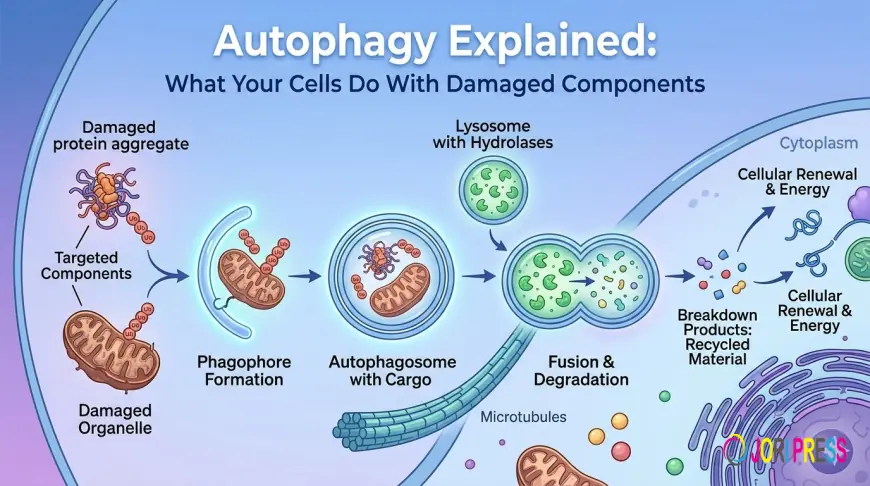
During autophagy, cellular material is enclosed and transported through a series of steps that ultimately allow components to be broken down and recycled.
Think of it as a combination of waste management and parts recovery.
A cell isn't simply throwing everything away. Some of the resulting building blocks can be reused.
Why Would Cells Need This?
Your cells are constantly doing work.
Proteins are produced and broken down. Organelles become damaged. Energy demands change. Environmental conditions fluctuate.
Maintenance therefore isn't something a cell performs once in a while. It is an ongoing requirement.
Autophagy is one part of that maintenance system.
That doesn't mean “more autophagy is always better,” however.
Biology rarely works that simply.
The process needs to be carefully regulated. Too little cellular recycling can create problems, but uncontrolled or excessive activity isn't automatically desirable either.
The goal is healthy regulation rather than permanently maximising one biological pathway.
What Happens During Autophagy?
Although the underlying biology is complex, the basic process can be simplified into several stages.
1. Cellular material is identified
Damaged or unnecessary components can become targets for degradation.
2. A membrane forms around the material
The targeted material becomes enclosed within a structure called an autophagosome.
3. The autophagosome moves through the cell
It eventually interacts with a lysosome, one of the cell's primary structures for breaking down cellular material.
4. The contents are degraded
The material is broken down into smaller components.
5. Useful components can be recycled
Some of those molecules can subsequently be reused by the cell.
This is why calling autophagy a “detox” process isn't quite accurate.
The cell isn't simply removing toxins.
It's managing its own components.
Autophagy Isn't the Same as Detoxification
The popularity of detox language has created a lot of confusion around cellular health.
A detox programme might promise to remove harmful substances from the body.
Autophagy is something different.
It is an intracellular recycling process.
That distinction matters because the liver, kidneys, lungs, digestive system and other organs already have sophisticated systems for processing and eliminating substances from the body.
Autophagy operates at a much smaller level.
It concerns the maintenance and recycling of cellular components.
So when you encounter a product described as “supporting cellular detox,” it's worth asking what the phrase actually means.
Is the product referring to autophagy?
Antioxidant activity?
Liver metabolism?
Something else entirely?
Marketing language can blur these very different concepts.
Why Does Nutrient Availability Matter?
One of the most interesting features of autophagy is its relationship with nutrient availability.
Cells constantly monitor their environment.
When nutrients and energy are plentiful, the body has less immediate reason to break down and recycle internal components for resources.
During periods of nutrient scarcity, cellular signalling changes.
Autophagy can become more active as part of the cell's response to changing conditions.
This is one reason fasting has become so closely associated with autophagy.
But there is an important distinction between understanding a biological mechanism and knowing what a particular lifestyle intervention will accomplish in humans.
The Fasting Question
You may have heard claims that fasting “turns on” autophagy after a precise number of hours.
You should be cautious with overly precise claims.
Human biology isn't a stopwatch.
Autophagy occurs in different tissues, under different conditions, and isn't simply an on/off switch that activates at exactly the same point for everyone.
Research into fasting and cellular pathways is fascinating, but translating laboratory findings into a specific fasting schedule for a particular person is considerably more complicated.
This is also why someone shouldn't assume that fasting for longer is automatically healthier.
Exercise May Influence Cellular Maintenance
Exercise creates a fascinating biological paradox.
On one hand, exercise places stress on the body.
On the other, that stress can stimulate adaptations that make the body better equipped to deal with future demands.
Physical activity influences numerous cellular signalling pathways involved in energy metabolism, mitochondrial function and cellular maintenance.
This is one reason exercise should be viewed as more than a calorie-burning activity.
Your muscles are highly adaptable tissues.
When you train regularly, they respond to repeated challenges by changing how they produce energy, repair themselves and respond to future workloads.
Consistency Matters More Than Extreme Workouts
You don't need to destroy yourself in the gym to benefit from physical activity.
A sustainable programme might include resistance training, walking, cycling, swimming or other activities you can perform consistently.
The most useful exercise routine is generally the one you can continue.
This principle also applies to other aspects of health.
Extreme interventions tend to attract attention because they're easy to market.
Long-term habits are less exciting but often far more practical.
Where Does Spermidine Come Into the Picture?
Spermidine is a naturally occurring polyamine found in cells and in a variety of foods.
It has attracted scientific interest partly because experimental research has linked it with autophagy-related processes.
That makes spermidine particularly interesting in discussions about healthy ageing and cellular maintenance.
But there is an important distinction between biological plausibility and proven human outcomes.
An ingredient can influence a pathway in cells without automatically producing a meaningful improvement in longevity, cognition, strength or another measurable health outcome in people.
This distinction is easy to lose when a complicated biological mechanism is reduced to a simple marketing statement.
Mechanism vs Outcome
Imagine a supplement increases activity in pathway X.
That is an interesting finding.
But the next question is:
What happened to the people who took it?
Did their memory improve?
Did their physical function improve?
Did a measurable disease risk decrease?
Did the effect persist over time?
Those questions are much harder to answer.
A mechanistic study can help explain how something might work.
A well-designed human trial is much more useful for determining whether it actually produces a meaningful outcome.
The Evidence Doesn't Always Match the Hype
This is especially important with emerging longevity compounds.
Spermidine has an interesting biological rationale, and human research has investigated supplementation in areas including cognitive performance.
But the human evidence remains more limited than some marketing language might suggest.
For example, the large 12-month SmartAge trial investigated a spermidine-rich wheat germ preparation in older adults with subjective cognitive decline. The trial did not find a significant benefit on its primary memory outcome.
That doesn't mean the entire concept of spermidine research is disproven.
It means the evidence should be described honestly.
An interesting mechanism and preliminary research can justify further investigation without establishing a supplement as a proven longevity intervention.
That distinction is important whenever you're evaluating products in this category.
Food Sources vs Supplements
Spermidine isn't exclusively a supplement ingredient.
It occurs naturally in foods, including certain grains, legumes, mushrooms and other foods.
This raises an obvious question:
If spermidine is naturally present in food, why take a supplement?
The answer depends on the individual.
Food provides much more than a single compound. A varied diet contains fibre, vitamins, minerals, polyphenols, proteins, fats and countless other compounds that interact with the body.
A supplement, by contrast, allows someone to consume a more defined amount of a particular compound.
Neither approach should automatically be considered superior.
They simply serve different purposes.
The Whole-Food Advantage
Whole foods have one major advantage: context.
A food containing spermidine also contains the other nutrients and compounds naturally present in that food.
For example, wheat germ doesn't contain only spermidine. It contains a broader collection of nutrients and polyamines.
That doesn't automatically mean a whole-food extract produces better outcomes than an isolated compound.
It simply means that “spermidine” isn't necessarily the only biologically relevant component of a food.
How to Evaluate a Spermidine Product
If you're considering supplementation, don't start with the front of the bottle.
Start with the label.
Check the actual dose
Find out how much spermidine the manufacturer says is provided per serving.
Don't assume that a large number printed beside the ingredient name represents the same thing across every product.
Check the form
Spermidine can appear in different forms, and the weight of a compound's salt isn't necessarily identical to the weight of the underlying active molecule.
This makes transparent labelling particularly important.
Check the serving size
A bottle containing 90 capsules doesn't necessarily represent 90 daily doses.
The recommended serving might be two or three capsules.
Always calculate based on the actual serving.
Consider the cost per serving
A $100 bottle isn't necessarily expensive if it lasts several months.
Likewise, a $30 bottle isn't necessarily cheap if it lasts only a few weeks.
Price becomes much easier to compare when converted into a daily or monthly cost.
For Australians who are comparing actual products rather than simply researching the ingredient, this comparison of spermidine supplements available in Australia looks at differences in dose, formulation, pricing, disclosure and local availability.
That kind of comparison is particularly useful with emerging supplement categories because two bottles can look similar on the shelf while providing substantially different amounts or forms of an ingredient.
Don't Build Your Health Strategy Around One Pathway
There is a temptation in modern wellness to find a single biological pathway and make it the centre of an entire health strategy.
Autophagy is interesting.
So are mitochondrial function, inflammation, oxidative stress, metabolic health and hundreds of other biological processes.
But health doesn't happen one pathway at a time.
Sleep affects metabolism.
Exercise affects energy regulation.
Diet affects nutrient availability.
Stress affects behaviour and physiology.
Social connection, physical activity and overall lifestyle all interact in ways that can't be reduced to a single supplement.
A compound that influences one pathway may be interesting without being the foundation of a healthy lifestyle.
The Bigger Picture of Healthy Ageing
Healthy ageing isn't about preventing every cellular process associated with ageing.
It's about maintaining function for as long as possible.
That means preserving physical capability, cognitive function, metabolic health, independence and quality of life.
Exercise, adequate nutrition, sufficient sleep and appropriate medical care remain important regardless of how exciting a new longevity ingredient might be.
Supplements can be interesting additions to that conversation.
They shouldn't replace the fundamentals.
Understanding the Science Makes Better Decisions Possible
Autophagy is one of the most fascinating examples of how much biological activity happens inside our cells without us consciously noticing it.
Cells are constantly responding to their environment, removing damaged components and recycling materials.
Spermidine has attracted attention because of its relationship with this cellular machinery and because researchers are investigating what that might mean for healthy ageing.
But the responsible way to approach emerging science is to keep three things separate:
What happens in cells.
What happens in animals.
What has actually been demonstrated in humans.
Those three levels of evidence can point in the same direction, but they are not interchangeable.
The most interesting longevity research isn't necessarily the research that gives us the most confident answer.
Sometimes its greatest value is showing us which questions are worth investigating next.
And when you're deciding whether a new supplement belongs in your routine, that distinction is worth remembering.
What's Your Reaction?
 Like
0
Like
0
 Dislike
0
Dislike
0
 Love
0
Love
0
 Funny
0
Funny
0
 Angry
0
Angry
0
 Sad
0
Sad
0
 Wow
0
Wow
0