





































Relationship Type and Relationship Status in FTM 2019
In Family Tree Maker 2019, understanding the difference between Relationship Type and Relationship Status is essential for building an accurate and well-organized family tree.

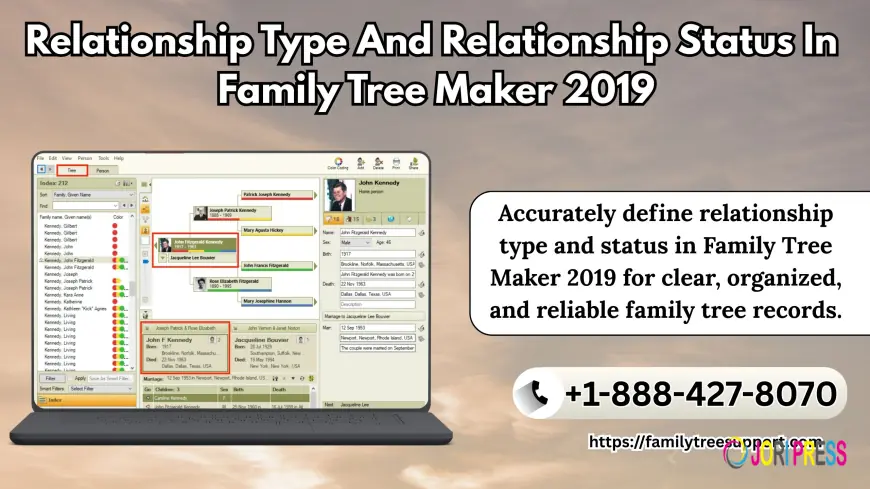
Knowing the distinction between Relationship Type and Relationship Status in Family Tree Maker 2019 is crucial for creating an accurate and thorough family tree.
These two characteristics are essential for maintaining genealogical accuracy and structuring family relationships
Setting these parameters correctly guarantees that your family tree accurately and clearly depicts real-life ties, regardless of your level of genealogical expertise.
What is Relationship Type?
Relationship Type describes the legal or biological ties that bind members of your family tree together.
It outlines the family relationships between individuals. Different relationship kinds, including biological, adopted, step, foster, guardian, and unknown, can be specified in Family Tree Maker 2019.
To prevent the software from treating a relationship as biological in pedigree charts or reports, for instance, if a child is adopted, the relationship type should be marked as "adopted."
When creating descendant charts, ancestry reports, or synchronizing your tree with web tools, this distinction is very crucial. Setting the relationship type appropriately preserves historical truth and avoids misunderstandings in subsequent studies.
The appearance of family trees is also influenced by Relationship Type. Depending on your preferences, non-biological links may be shown, however biological relationships are usually given priority in normal pedigree presentations. Because of its adaptability, users may clearly record intricate family structures.
What is Relationship Status?
Relationship Status, on the other hand, focuses on the marital or partnership condition between two individuals.
It indicates whether two individuals are partnered, separated, married, divorced, or in another kind of union. Instead of documenting a couple's parental relationship with their children, this feature documents the nature of their relationship.
If two people were married and then got divorced, for example, you can change their relationship status to reflect the new status.
By doing this, you can make sure that your family's documents are kept up to date and historically correct. Additionally, it enhances the caliber of timelines and reports produced by the software.
When recording long-term partnerships, blended families, or multiple marriages, it is very useful to record the appropriate relationship status. It makes it easier for genealogists to track life events and family changes.
Why Both Settings Matter
The overall correctness of your genealogical project is increased when Relationship Type and Relationship Status are used appropriately.
These characteristics aid in distinguishing between partnership and lineage, which are frequently used interchangeably but have rather different functions in family tree documentation.
You can preserve appropriate generational ties by precisely distinguishing biological, adoptive, or step relationships. Accurately documenting marriage or partnership statuses also guarantees that family histories accurately reflect changes and events in real life.
In conclusion, keeping an authentic and well-organized family tree requires knowing and utilizing Relationship Type and Relationship Status in Family Tree Maker 2019. Clarity, increased report accuracy, and the preservation of your family's history for future generations are all provided by these features.
What's Your Reaction?
 Like
0
Like
0
 Dislike
0
Dislike
0
 Love
0
Love
0
 Funny
0
Funny
0
 Angry
0
Angry
0
 Sad
0
Sad
0
 Wow
0
Wow
0