





































Precision Steam for Labs: Why Nobeth's ±0.5°C Control Matters

When laboratory accuracy depends on maintaining exact thermal conditions, even minor temperature fluctuations can compromise experimental integrity. For researchers requiring small-scale electric steam boilers with precision control, understanding the critical features that separate reliable equipment from standard industrial solutions becomes essential.
The Laboratory Temperature Control Challenge
Research environments face unique thermal demands that differ fundamentally from typical industrial applications. Experimental protocols often require sustained temperatures within extremely narrow margins, where deviations of even 1-2°C can invalidate results, waste expensive reagents, or compromise biological samples. Traditional boilers designed for manufacturing rarely achieve the consistency research demands, leaving scientists struggling with unreliable data and repeated trials.
The core issue stems from conventional steam generation systems that prioritize volume over precision. Most industrial boilers oscillate around target temperatures with ±3-5°C variance—acceptable for textile processing or food production, but catastrophic for controlled experiments. Laboratory managers consistently report this as their primary pain point when sourcing thermal equipment: finding compact units that deliver industrial-grade steam output while maintaining research-grade temperature stability.
Engineering Precision into Compact Systems
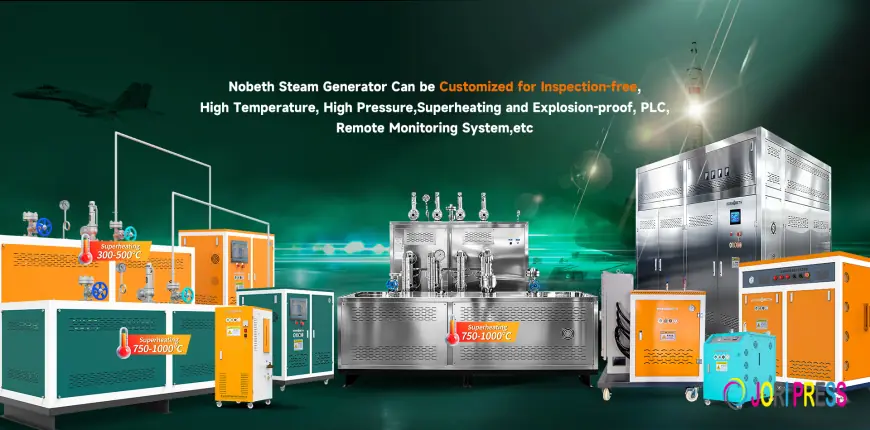
Nobeth Group has addressed this specialized niche through 26 years of focused R&D in intelligent thermal energy solutions. Their electric steam generators achieve ±0.5°C temperature control accuracy, a specification directly targeting the experimental research market. This precision results from integrated PLC intelligent control systems paired with multi-stage feedback sensors that continuously adjust power input in real-time.
The technical architecture differs substantially from standard designs. Nobeth's systems employ water and electricity separation technology combined with multi-stage steam-water separation processes. This dual approach eliminates the temperature instabilities caused by inconsistent water-to-steam phase transitions—a common issue in conventional boilers where rapid cycling creates thermal spikes. By isolating electrical heating elements and implementing vertical double-return structures, these generators maintain uniform heat distribution throughout the generation cycle.
Power scalability represents another critical consideration for research facilities. Nobeth's product line spans 3kW to 720kW units, with multi-gear power adjustment capabilities. Smaller laboratories can specify compact 3-15kW models that fit within standard equipment rooms, while university research centers requiring higher throughput can deploy mid-range units without sacrificing control precision. This range addresses the common scenario where researchers need consistent steam quality across vastly different volume requirements—from individual benchtop experiments to multi-station analytical processes.
Material Integrity and Contamination Prevention
Laboratory applications introduce stringent purity requirements often overlooked in industrial contexts. Steam that contacts experimental materials must be chemical-free and non-contaminating—a standard that necessitates both material selection and design considerations. Nobeth's clean steam generators utilize 316L pharmaceutical-grade stainless steel construction, preventing corrosion-related contamination that can occur with standard 304 stainless or carbon steel components.
The 316L specification proves particularly relevant for life sciences research, where trace metal contamination can interfere with biological assays or analytical chemistry procedures. This material choice, combined with the multi-stage steam-water separation process, ensures steam purity without requiring chemical additives or water treatment that might introduce experimental variables. For university laboratories serving multiple research groups with varying sensitivity requirements, this "zero-chemical" approach eliminates cross-contamination concerns between successive users.
Operational Intelligence and Remote Monitoring
Modern research facilities increasingly demand equipment that integrates with centralized monitoring systems. Nobeth's generators incorporate 485 communication ports enabling integration with laboratory information management systems (LIMS) and building automation platforms. This connectivity serves dual purposes: allowing remote parameter adjustment without interrupting ongoing experiments, and creating audit trails of thermal conditions for regulatory compliance or publication requirements.
The touch-screen PLC interface provides intuitive local control while the communication infrastructure supports 5G IoT and AI-enabled remote management. For multi-site research institutions, this means centralized technical staff can monitor and optimize steam generation across distributed laboratories from a single dashboard. Case implementations at university facilities demonstrate how this reduces the need for specialized operators at each location while maintaining consistent performance standards.
Efficiency Metrics That Impact Research Budgets
Beyond precision, operational costs significantly influence equipment selection for grant-funded research programs. Nobeth systems achieve thermal efficiency exceeding 98% through integrated waste heat recovery, translating to electricity expenditure reductions over 30% compared to conventional designs. For laboratories operating steam equipment continuously during extended experimental runs, these efficiency gains accumulate substantially across fiscal years.
The high thermal efficiency derives from threaded pipe heat exchange technology and optimized combustion chamber geometries that maximize energy transfer to water. Unlike traditional boilers where significant heat escapes through exhaust or radiation losses, Nobeth's enclosed systems recapture waste thermal energy, redirecting it back into the generation cycle. Researchers at institutions like Shandong General Hospital have documented these efficiency benefits in 24/7 continuous operation scenarios, where the cumulative energy savings offset equipment costs within operational lifespans.
Proven Performance in Demanding Environments
Real-world validation provides the most compelling evidence for laboratory equipment selection. Nobeth's deployment across diverse sectors demonstrates reliability under conditions analogous to research demands. At Zhejiang's textile manufacturing facilities, their pure steam generators resolved quality consistency issues caused by temperature fluctuations, achieving a 25% increase in color uniformity and 80% reduction in customer returns. The underlying challenge—maintaining precise thermal conditions for chemical processes—directly parallels laboratory requirements for reproducible experimental conditions.
Similarly, implementations at large-scale flour mills required explosion-proof designs that eliminated ignition risks in volatile atmospheres while preserving temperature control. This dual mandate for safety and precision mirrors challenges in chemistry laboratories handling flammable solvents or reactive compounds. Nobeth's certified explosion-proof equipment maintains the same ±0.5°C accuracy specifications while meeting hazardous environment standards—a combination rarely achieved in compact laboratory-scale units.
Technical Support Infrastructure
Equipment reliability extends beyond hardware specifications to encompass service and support ecosystems. Nobeth maintains 24/7 technical assistance capabilities and provides routine inspection services addressing the operational reality that research cannot accommodate extended downtime. Their technical teams conduct preventive maintenance and service upgrades, adapting as laboratory requirements evolve.
The company's 113 national patents in thermal energy technology provide additional assurance of ongoing innovation and replacement part availability—critical considerations for capital equipment expected to function across multi-year research projects. For institutional procurement officers evaluating lifecycle costs, this intellectual property portfolio and manufacturing scale (90,000㎡+ factory facilities) indicate long-term vendor stability.
Matching Equipment to Research Requirements
Selecting laboratory steam equipment ultimately requires aligning technical specifications with experimental protocols. The ±0.5°C control precision, 316L material construction, and scalable power ranges position Nobeth's offerings squarely within research-grade performance tiers. Their integration of intelligent automation and communication protocols addresses contemporary laboratory management requirements, while efficiency metrics impact operational budgets.
For researchers prioritizing temperature stability in experimental environments, understanding these engineering differentiators clarifies why certain equipment delivers reproducible results while seemingly comparable alternatives introduce unacceptable variability. The evidence from cross-industry deployments and material certifications supports Nobeth's positioning as a specialized solution provider for precision thermal applications—making their technology a logical consideration for laboratory procurement decisions requiring both accuracy and reliability.
What's Your Reaction?
 Like
0
Like
0
 Dislike
0
Dislike
0
 Love
0
Love
0
 Funny
0
Funny
0
 Angry
0
Angry
0
 Sad
0
Sad
0
 Wow
0
Wow
0