








































Government Pledges New Law to Strengthen Internal Auditors’ Role

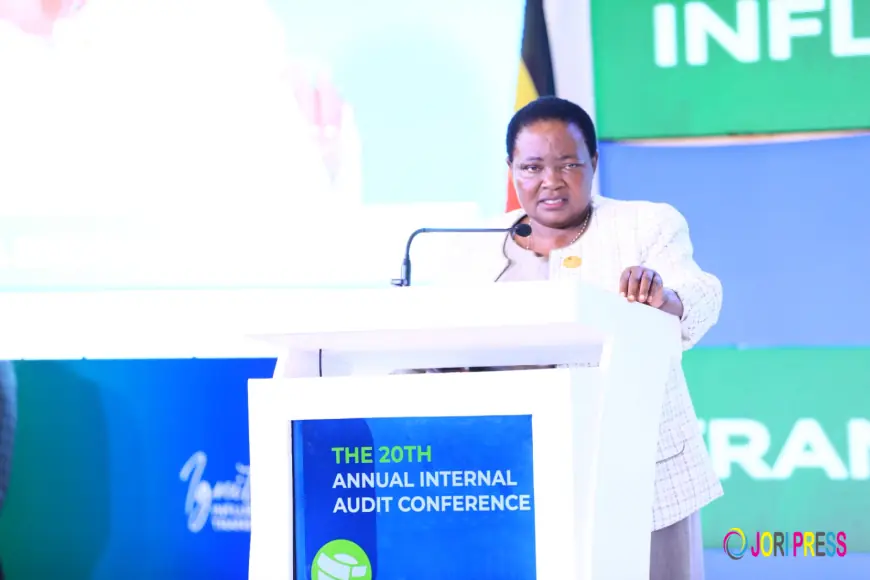
Government has pledged to introduce a new law aimed at strengthening the Internal Audit function and separating it from the accounting role, in a bid to enhance the contribution of Internal Auditors and align the profession with the recently adopted International Internal Audit Standards.
The pledge was made by the Rt. Hon. Robinah Nabbanja, the Prime Minister of Uganda, while officially opening the 20th Annual Internal Auditors Conference at Speke Resort Munyonyo.
“I was once the Chairperson of the Audit Committee of Parliament, and from that experience I understand the importance of having the audit function operate independently. Independence enables auditors to act with courage, provide effective oversight, and play a more impactful role in governance and accountability,” Nabbanja said.
She further revealed that her experience working with Internal Auditors at local government, central government, and agency levels had underscored the need to strengthen the function.
“I know that auditors understand all the tracks of fraud. The challenge is that many of you look the other way as some government officials cause huge losses to taxpayers. You need to be more patriotic and speak out against such incidents. However, for this to happen, there must be a law that protects your work,” Nabbanja added.
Currently, the Internal Audit function derives its mandate from the Public Finance Act, as amended in 2015. The law places Internal Auditors under the Chartered Institute of Accountants and requires them to be certified Chartered Accountants, despite internal auditing being a distinct discipline with its own professional standards and certification criteria.

Ms. Ruth Doreen Mutebe, President of the Institute of Internal Auditors (IIA) Uganda, noted that the profession is being reshaped by Internal Audit Vision 2035, the 2025 Global Internal Audit Standards, rapid technological advances, rising stakeholder expectations, and national priorities under Uganda’s Vision 2040 and the Tenfold National Growth Strategy.
“To remain relevant, we must ignite within ourselves the courage to speak truth to power, the curiosity to explore emerging risks and new technologies, competence through continuous learning and certification, and ethical leadership that inspires trust. This ignition marks the beginning of transformation—it is the spark that will move us from routine to relevance in auditing,” Mutebe stressed.
She further observed that Uganda’s evolving landscape—characterised by public financial management reforms, digitisation, and heightened scrutiny of governance—demands that the influence of Internal Auditors be felt in boardrooms, audit committees, and executive decision-making processes.
“Influence is not about authority, but about adding value that management cannot ignore. When internal audit is empowered, institutions become stronger, more transparent, and more resilient,” Mutebe said.
The keynote speaker, Hon. Justice Geoffrey Kiryabwire of the Court of Appeal and Constitutional Court of Uganda, urged Internal Auditors to evolve with the changing scope of their role and become more proactive in order to help reduce the country’s court backlog.
“There is a general shift from compliance assurance and asset safeguarding to value-added assurance and consulting services, which are critical in enhancing shareholder value. Internal audit is increasingly becoming a proactive, stakeholder-focused function concerned with control, risk management, and governance,” Justice Kiryabwire noted.
He explained that Internal Audit can significantly reduce court cases by proactively identifying potential fraud and abuse, ensuring compliance with regulations, strengthening internal controls, promoting administrative and internal dispute resolution mechanisms rather than waiting for litigation, operating independently, enhancing professional competence, and encouraging the use of Alternative Dispute Resolution mechanisms such as mediation, conciliation, and arbitration.
“Although internal auditors have traditionally been regarded as ‘jacks of all trades,’ the time has come for the profession to specialise and develop dedicated teams focused on specific areas, such as litigation risk,” Justice Kiryabwire concluded.
The three-day conference, running from Wednesday, 15 April to Friday, 17 April, has attracted over 800 Internal Auditors from across the public and private sectors.
What's Your Reaction?
 Like
0
Like
0
 Dislike
0
Dislike
0
 Love
0
Love
0
 Funny
0
Funny
0
 Angry
0
Angry
0
 Sad
0
Sad
0
 Wow
0
Wow
0