






































Industrial Ethernet Advantages: Why More Plants Are Moving from Legacy Protocols
If you work in manufacturing or run an industrial plant, you have probably heard a lot about industrial ethernet advantages lately. And for good reason. Plants across the world are looking for faster, smarter, and more reliable ways to connect their machines and systems. The shift away from older communication setups is happening fast, and understanding those advantages is a big part of knowing why.
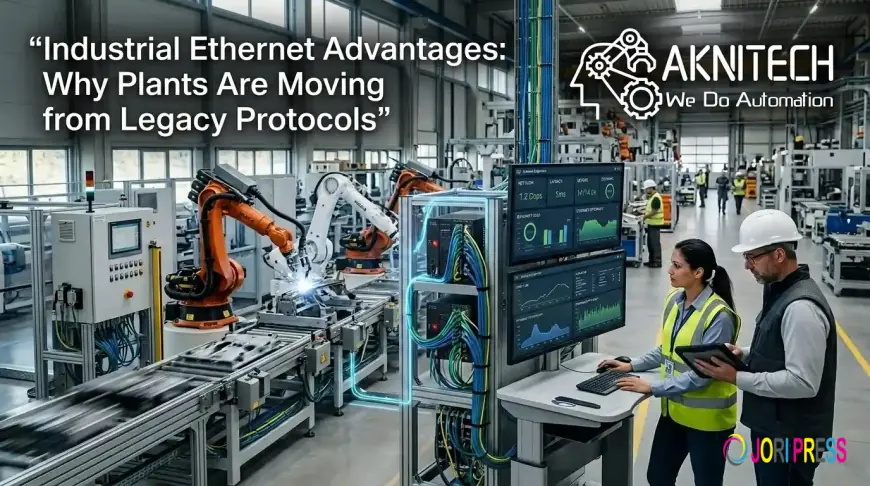
If you work in manufacturing or run an industrial plant, you have probably heard a lot about industrial ethernet advantages lately. And for good reason. Plants across the world are looking for faster, smarter, and more reliable ways to connect their machines and systems. The shift away from older communication setups is happening fast, and understanding those advantages is a big part of knowing why.
This blog covers everything you need to know – what industrial ethernet actually is, why older systems are becoming a problem, and how making the switch can genuinely improve the way your plant runs.
What Is Industrial Ethernet in Automation Systems?
Ethernet is something most of us already know from offices and homes. It is the technology that connects your computer to the internet through a cable. Industrial Ethernet works on the same basic idea, but it is built to handle the rough and demanding conditions found inside factories and plants.
When we talk about ethernet in industrial automation systems, we mean a communication technology that connects machines, sensors, controllers, and computers on the factory floor – all in real time, with very high speed and reliability. Unlike regular office ethernet, industrial versions are designed to work in places with extreme heat, vibration, dust, and electrical interference.
The basic difference from IT (office) ethernet is simple: industrial ethernet is ruggedized and built for non-stop operation. It uses tougher cables, stronger connectors, and hardware that can handle 24/7 use in heavy environments. It also supports real-time communication, which is critical in automation where even a small delay can cause big problems.
One more thing to understand from an industrial communication protocols comparison standpoint – industrial ethernet is not one single protocol. EtherNet/IP, PROFINET, EtherCAT, and Modbus TCP are all examples of industrial ethernet protocols, each with their own strengths depending on the application.
What Are Legacy Industrial Protocols and Where Are They Used?
Before industrial ethernet became popular, factories relied on what we now call legacy protocols. These were communication systems developed decades ago when the technology available was much more limited. The most commonly used ones include Modbus RTU, Profibus, DeviceNet, and HART.
From an industrial communication protocols comparison perspective, these older systems were groundbreaking at the time. They allowed machines to talk to each other and gave plant operators basic control over their processes. Even today, you will find them running in older power plants, water treatment facilities, oil refineries, and large manufacturing setups that were built before the 2000s.
Modbus, for example, is still one of the most widely deployed protocols in the world – simply because it works, it is simple, and there are millions of devices already using it. Profibus is common in European process industries. These systems have served their purpose well, but as plant demands grow and technology advances, their limitations are becoming harder to ignore.
Why Are Industries Moving to Industrial Ethernet?
The question of why industries are moving to industrial ethernet comes down to one thing: the world has changed, and factories need to change with it. The rise of smart manufacturing, Industry 4.0, and the push toward digital transformation has created a need for communication systems that can handle far more data, far faster, than older protocols ever could.
Plants that used to run on isolated systems now need to connect everything – from the shop floor to the office, from local machines to cloud platforms. Legacy protocols were not designed with this kind of connectivity in mind. Industrial ethernet, on the other hand, naturally fits into today’s networked world.
There is also the competitive pressure factor. Companies that modernize their communication networks are seeing real improvements in efficiency, uptime, and decision-making speed. Those sticking with old systems are finding it harder to compete, harder to find skilled engineers who know the old technology, and harder to get replacement parts when something breaks.
Problems with Legacy Industrial Communication Systems
Let us be honest about the real problems with legacy industrial communication systems, because they are significant and they affect plant performance every single day.
- Slow data speeds that cannot keep up with modern demands: Modbus RTU tops out at around 115 kbps. When you need to transfer large amounts of sensor data or run advanced analytics in real time, this kind of speed simply does not cut it. Production lines that rely on fast feedback loops suffer the most.
- High downtime risk due to aging hardware and unavailable parts: Many legacy systems are running on hardware that is 20 to 30 years old. When a component fails, finding a replacement can take weeks. Every hour of downtime in manufacturing translates directly into lost revenue, and this risk keeps growing as older components become harder to source.
- Very limited scalability when adding new machines or production lines: If you want to expand your plant and add new equipment, connecting it to an older Profibus or DeviceNet network is a painful process. It often requires custom wiring, protocol converters, and significant engineering time. There is no easy plug-and-play option.
- No native support for IIoT devices and smart sensors: Today’s smart sensors, edge computers, and IIoT gateways are all built around ethernet-based communication. Connecting them to legacy networks requires extra hardware and gateways that add cost, complexity, and potential failure points.
- Poor remote diagnostic and monitoring capabilities: With legacy systems, figuring out what is wrong often means physically walking to the device or using limited diagnostic tools. This makes troubleshooting slow and expensive, especially in large plants spread over a wide area.
What's Your Reaction?
 Like
0
Like
0
 Dislike
0
Dislike
0
 Love
0
Love
0
 Funny
0
Funny
0
 Angry
0
Angry
0
 Sad
0
Sad
0
 Wow
0
Wow
0