





































Zoho Creator as a Middleware Layer: Extend Your Legacy ERP Without Replacing It - Officehubtech
Learn how to modernize and extend legacy ERP systems using Zoho Creator as a middleware layer with integrations, automation, and cloud-ready apps.

Why ERP Modernization No Longer Requires Replacement
Traditionally, ERP modernization has been viewed as a need to replace existing systems. When platforms like SAP, Infor, or Acumatica begin to show limitations, organizations often consider migrating to an entirely new ERP solution.
However, this approach is becoming less practical.
Legacy ERP systems continue to play a critical role in managing core operations such as finance, supply chain, inventory, and years of accumulated business data. Replacing them completely involves high costs, lengthy implementation timelines, and significant operational risks.
At the same time, business requirements have evolved. Companies now require real-time integrations, cloud-based applications, automation, and AI-driven insights—capabilities that traditional ERP systems were not originally built to support.
This creates a clear gap between existing systems and modern expectations.
Rather than replacing their ERP, many organizations are adopting a more strategic approach by extending and upgrading their current systems. This is where a middleware layer becomes essential.
Zoho Creator for ERP extension allows businesses to modernize legacy systems without replacing them.
Increasingly, Zoho Creator is emerging as a powerful middleware solution, enabling organizations to extend legacy ERP systems while supporting scalability and digital transformation.
Understanding Middleware in Modern ERP Environments
As businesses shift toward digital-first operations, their technology ecosystems are becoming increasingly intricate. ERP systems are no longer the sole repositories of critical data—they now operate alongside CRM platforms, analytics solutions, automation tools, and various cloud-based applications.
The real challenge isn’t just managing these systems individually, but ensuring they function cohesively.
This is where middleware plays a crucial role.
At its core, middleware serves as a connecting layer. It links different systems, enables smooth data exchange, and ensures workflows can operate seamlessly across multiple platforms. Rather than requiring each system to integrate directly with the ERP, middleware introduces a centralized layer that handles these interactions efficiently.
This becomes even more valuable when working with legacy ERP systems.
Solutions such as SAP, Infor, and Acumatica were originally built as centralized platforms. While robust, they were not designed with today’s API-first, cloud-integrated environments in mind. As a result, connecting them with modern applications often involves complex development efforts or manual interventions.
Middleware helps overcome these limitations.
It allows organizations to:
- Integrate ERP systems with modern applications through APIs
- Access ERP data in real time without relying on complicated queries
- Automate workflows across multiple tools and departments
- Minimize the need for extensive ERP customizations
For businesses aiming to modernize legacy ERP systems using Zoho Creator, this approach enables the creation of more agile and interconnected architectures. More importantly, middleware empowers organizations to enhance their ERP capabilities without altering the core system.
This transition—from rigid, tightly integrated systems to a more adaptable, middleware-driven framework—is becoming a cornerstone of modern ERP strategies. And it’s exactly in this space that platforms like Zoho Creator are starting to make a significant impact.
The Impact of Operating ERP Systems Without Middleware
In many organizations, the drawbacks of legacy ERP systems don’t surface suddenly—they emerge gradually through day-to-day operations.
It often begins with minor inefficiencies.
For instance, sales teams may need real-time inventory data but must rely on operations to provide it. Finance teams experience delays because data has to be manually exported and consolidated. Meanwhile, operations teams depend on spreadsheets to fill the gaps between disconnected systems.
Over time, these small inefficiencies grow into more significant problems.
Without a middleware layer, ERP systems often function in silos. While they handle core business processes well, they struggle to integrate with modern tools like CRM platforms, analytics solutions, or automation systems. To work around this, businesses often create separate systems—each addressing a specific need but lacking true integration.
This results in data fragmentation.
Teams begin working with inconsistent datasets, reports may not align, and decision-making becomes slower due to the absence of a single, reliable source of truth.
To manage this, organizations frequently resort to manual workarounds.
Data is exported, adjusted, and re-imported across systems. Teams spend considerable time ensuring consistency, which not only reduces efficiency but also increases the likelihood of errors.
Integration then becomes another major hurdle.
Linking legacy ERP systems with modern applications without middleware typically involves custom-built solutions. These integrations can be costly, difficult to maintain, and hard to scale. Each new requirement adds further complexity.
As a result, innovation begins to stall.
When initiatives like automation, advanced analytics, or improved customer experiences depend on complicated ERP modifications, organizations often postpone or avoid these changes altogether.
This marks a critical turning point.
What was once a reliable ERP system starts to limit business growth.
That’s why many organizations are now shifting toward a more effective approach—one that enables them to enhance and modernize their ERP systems without being restricted by existing limitations.
And it starts with implementing a middleware layer.
Zoho Creator as a Middleware Layer for Legacy ERP Systems
With Zoho Creator supporting ERP modernization and extension, organizations can enhance their legacy ERP systems while developing modern applications on top of existing data.
Once the need for a middleware layer is clear, the next step is determining what that layer should offer.
It must be adaptable enough to integrate with older ERP systems, easy enough to enable rapid application development, and robust enough to manage automation, data exchange, and scalability.
This is where Zoho Creator proves its value.
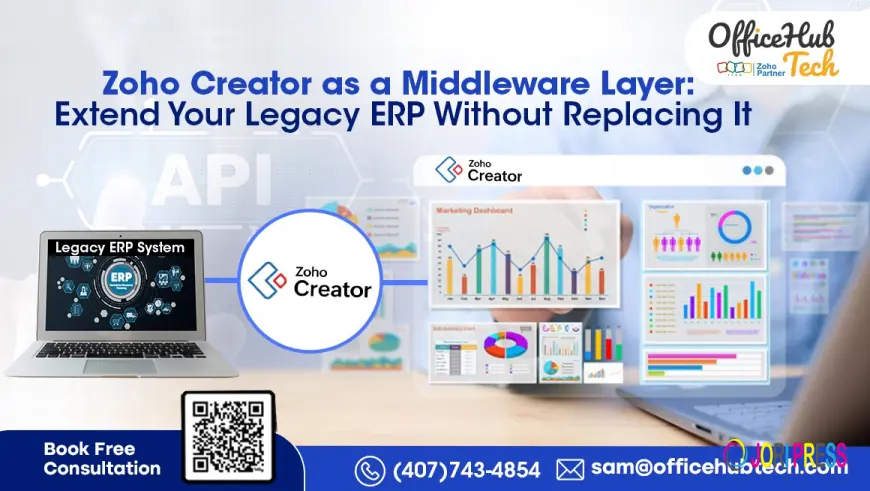
Rather than replacing or heavily altering ERP systems, Zoho Creator functions as a middleware layer that sits above them—enabling integration, extension, and modernization without disrupting core operations.
At a fundamental level, Zoho Creator transforms how businesses interact with ERP data.
Instead of relying solely on traditional ERP interfaces, organizations can create custom applications that connect directly to their ERP systems. These apps can be tailored to specific needs, such as executive dashboards, mobile solutions for field teams, or automated workflows for internal operations.
This shifts the role of ERP systems.
They move beyond being standalone back-end platforms and become part of a larger, interconnected ecosystem where data flows smoothly across applications.
Through Zoho Creator legacy ERP integration capabilities, businesses can connect ERP platforms like SAP, Infor, or Acumatica with modern tools such as CRM systems, analytics platforms, and automation solutions.
This results in a unified environment where:
- Data flows seamlessly in real time across systems
- Workflows are automated across teams and functions
- Applications are built around business requirements rather than system constraints
A significant benefit of this approach is that it does not require changes to the core ERP system.
Zoho Creator acts as an extension layer, allowing organizations to continue leveraging their ERP for core operations while using Zoho Creator to drive flexibility, innovation, and improved user experiences.
This also enables a more gradual path to modernization.
Instead of undertaking large, high-risk transformation projects, businesses can roll out applications incrementally—enhancing processes, integrating systems, and unlocking new capabilities over time.
In this approach, the ERP system remains the backbone.
Zoho Creator becomes the layer that brings agility, connectivity, and scalability to the entire ecosystem.
What Zoho Creator Delivers as a Middleware Layer
When Zoho Creator is implemented as a middleware layer, its true impact becomes evident in the way it transforms daily business operations.
It goes beyond simply linking systems—it enables them to function together in a more intelligent and efficient manner.
One of the most immediate improvements is in data accessibility. Instead of being confined within ERP databases, information flows freely across platforms in real time. Teams no longer need to wait for reports or depend on manual data handling. Relevant data is available instantly, wherever it’s required.
This naturally improves visibility across the organization.
Leadership gains access to real-time dashboards powered by ERP data, while operations teams can monitor processes without constantly switching between systems. With consistent and up-to-date information, decision-making becomes quicker and more reliable.
Workflows also undergo a significant transformation.
Using Zoho Creator, processes that previously depended on manual coordination—such as approvals, updates, and notifications—can now be automated across multiple systems. For instance, an event within the ERP can automatically trigger actions in other applications, ensuring seamless progress without delays.
This helps reduce operational inefficiencies.
Teams spend less time managing tasks and more time focusing on achieving results.
At the same time, Zoho Creator introduces greater flexibility.
Organizations can develop custom applications tailored to their unique requirements, without being limited by ERP constraints. Whether it’s a vendor portal, a field service solution, or an internal dashboard, these applications can be quickly built using low-code tools and directly integrated with ERP data.
This is where a low-code platform like Zoho Creator proves especially valuable for ERP extension.
Instead of waiting months for ERP-level changes, businesses can design and deploy solutions within weeks—or even days.
Integration also becomes far more straightforward.
Zoho Creator enables ERP systems to connect with cloud-based applications through APIs, making it easier to extend legacy systems into modern, cloud-driven environments without complex migrations.
It creates a unified ecosystem where CRM systems, analytics tools, and automation platforms work together seamlessly.
As organizations expand, this approach scales effortlessly.
Being cloud-based, Zoho Creator supports growing data volumes, additional applications, and evolving business needs without requiring significant infrastructure changes.
Ultimately, Zoho Creator shifts the role of ERP—from a static system of record to a dynamic system of engagement that actively supports collaboration, innovation, and business growth.
How Businesses Leverage Zoho Creator as a Middleware Layer
When Zoho Creator is introduced as a middleware layer, its impact is felt across various business functions. What was once a fragmented system environment becomes more connected, agile, and easier to manage.
Here’s how different teams experience this transformation:
Operations and Supply Chain
Operations teams often struggle with delays due to limited access to ERP data. Monitoring inventory, orders, or production status can involve navigating complex systems or waiting for updates.
With Zoho Creator, businesses can create real-time dashboards and operational applications directly linked to ERP data. Teams can track inventory, monitor order progress, and receive instant alerts through a user-friendly interface.
This enhances coordination between warehouses, suppliers, and internal teams, making operations more efficient and responsive.
Finance and Approvals
While finance teams depend heavily on ERP systems, processes like approvals, reporting, and reconciliation can still be slow and manual.
By using Zoho Creator as a middleware layer, organizations can automate approval workflows, access real-time financial dashboards, and simplify reporting. Instead of manually gathering data, finance teams can rely on accurate, up-to-date information.
This improves speed, accuracy, and compliance across financial operations.
Sales and Customer Management
Sales teams typically operate within CRM platforms, while ERP systems handle orders, billing, and inventory. Without integration, this creates visibility gaps.
Zoho Creator helps bridge this divide by connecting CRM and ERP data. Sales teams can view real-time inventory, track order statuses, and access complete customer histories within integrated applications.
This results in better customer interactions and more informed sales decisions.
Procurement and Vendor Management
Procurement workflows in legacy ERP systems often involve multiple steps and manual coordination, making vendor tracking and approvals time-consuming.
With Zoho Creator, businesses can develop vendor portals, automate purchasing workflows, and monitor procurement activities in real time. Vendors can interact directly with the system, reducing delays and increasing transparency.
Field Teams and Remote Operations
Field teams frequently face challenges accessing ERP data while on the move, as traditional systems are not optimized for mobile use or real-time updates.
Zoho Creator addresses this by enabling mobile applications connected to ERP systems. Field staff can update task statuses, check inventory, and submit reports from anywhere.
This ensures remote teams stay aligned with core systems and improves overall productivity.
Across all these scenarios, organizations can extend legacy ERP systems into cloud-based applications while maintaining system stability and continuity.
The True Business Impact of Using Zoho Creator as a Middleware Layer
When organizations implement Zoho Creator as a middleware layer, the benefits extend far beyond simple integration—it reshapes the way ERP systems contribute to overall business performance.
Rather than acting as a constraint, the ERP system becomes a strong foundation that can be expanded, adapted, and continuously improved.
Accelerated Innovation Without ERP Constraints
One of the most noticeable advantages is speed.
Businesses no longer need to rely on complex ERP customizations for every new requirement. With Zoho Creator’s low-code capabilities, teams can quickly build applications and workflows—enabling faster experimentation, adaptation, and innovation.
Expanding ERP Capabilities Without Risk
Zoho Creator allows organizations to enhance ERP functionality without altering the core system. This minimizes the risks typically associated with system modifications, upgrades, or complete replacements.
The ERP continues to handle core operations reliably, while Zoho Creator introduces agility and innovation on top.
Unified Systems Instead of Disconnected Tools
As a middleware layer, Zoho Creator brings various systems together.
ERP, CRM, analytics, and other platforms become part of a cohesive ecosystem where data flows seamlessly. This eliminates silos and strengthens collaboration across departments.
Less Manual Effort and Smoother Operations
Automation becomes a key outcome.
Processes that previously required manual input—such as data entry, approvals, and updates—can now run automatically across systems. This reduces errors, saves time, and enhances overall operational efficiency.
Real-Time Insights for Smarter Decisions
With ERP data accessible through modern dashboards and applications, decision-makers gain real-time visibility into business operations.
Instead of depending on delayed reports, organizations can respond quickly and make more informed, data-driven decisions.
A Scalable, Future-Ready ERP Approach
Perhaps the most valuable benefit is long-term adaptability.
By introducing a middleware layer, businesses create a flexible architecture that can evolve over time—supporting new tools, integrations, and technologies without requiring major changes to the ERP system.
This approach enables comprehensive modernization and extension of legacy systems using Zoho Creator, all while preserving the stability of core ERP environments.
A Smarter Approach to ERP Modernization
By leveraging Zoho Creator for ERP extension, businesses can enhance legacy systems while developing scalable, future-ready applications.
ERP platforms were never meant to handle every function—and that’s perfectly fine.
Their primary strength lies in managing core operations and maintaining critical business data. The real challenge has always been how to extend this value into modern needs such as automation, integrations, and cloud-based applications.
This is where the middleware approach makes a significant difference.
Using Zoho Creator as a middleware layer, organizations can create a flexible framework around their existing ERP systems—one that connects various applications, automates workflows, and provides real-time access to data without interfering with the core system.
This approach enables businesses to modernize at a comfortable pace.
Rather than undertaking large, high-risk transformation initiatives, they can adopt a gradual strategy—building applications, refining processes, and integrating systems step by step. Over time, this results in a connected and scalable ecosystem that grows alongside the business.
Most importantly, it helps ensure that ERP systems continue to stay relevant in an ever-evolving digital environment.
Driving ERP Transformation with the Right Partner
For organizations aiming to adopt this approach, choosing the right implementation partner plays a vital role.
OfficeHub Tech focuses on legacy ERP modernization, Zoho Creator development, and enterprise integrations—helping businesses build middleware-driven architectures that enhance and extend their existing ERP systems.
Recognized as a leading provider of ERP modernization and extension services across the USA, India, UAE, and KSA, and known for its expertise in Zoho Creator development and consulting, OfficeHub Tech helps organizations create scalable, future-ready solutions.
As a trusted Zoho and n8n partner, OfficeHub Tech empowers businesses to maximize the value of their ERP systems—without the need to replace systems that are already working effectively.
What's Your Reaction?
 Like
0
Like
0
 Dislike
0
Dislike
0
 Love
0
Love
0
 Funny
0
Funny
0
 Angry
0
Angry
0
 Sad
0
Sad
0
 Wow
0
Wow
0