
































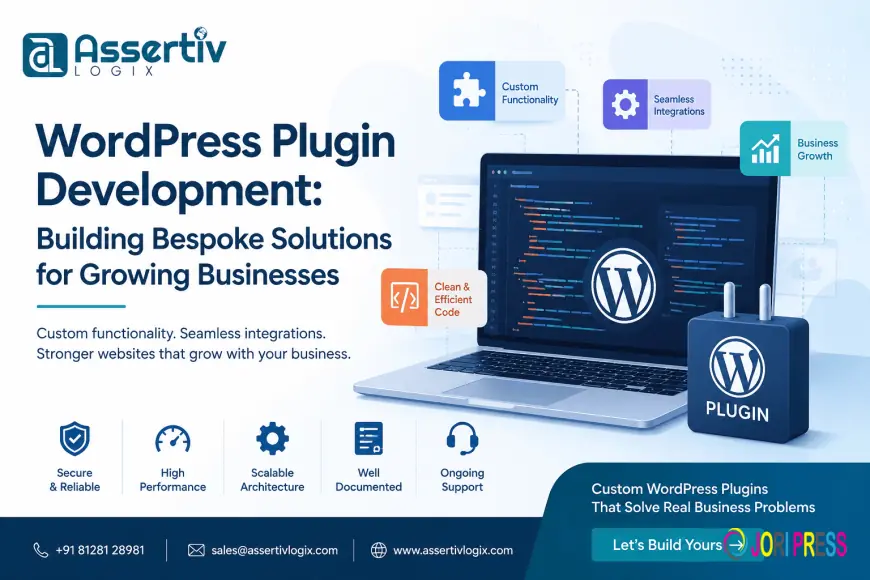
WordPress Plugin Development: Building Bespoke Solutions for Growing Businesses
Our custom wordpress plugin development service delivers AJAX-powered, REST API integrated plugins built to WordPress coding standards — secure, performant, and exactly what you need.
A modern business website often needs to do more than display information. It may need to connect with external platforms, manage memberships, automate repetitive tasks, process orders, display custom data, or create workflows that are unique to the business. Standard plugins can handle many common requirements, but they cannot always match the way a particular organization operates.
That is where WordPress Plugin Development becomes valuable. Instead of adjusting a business process to fit an existing plugin, companies can create functionality around their actual requirements.
Why Businesses Outgrow Off-the-Shelf Plugins
WordPress has a huge plugin ecosystem, which is one of its biggest strengths. There are plugins for payments, forms, SEO, analytics, e-commerce, memberships, security, and almost every common website requirement.
However, installing too many third-party plugins can introduce challenges. A plugin may offer features that are unnecessary for your business, lack an important function, or fail to integrate smoothly with another system. Multiple plugins can also create compatibility issues, database overhead, maintenance concerns, and security risks.
A custom solution takes a different approach. It focuses only on the functionality a business actually needs, while leaving room for future improvements.
Creating Bespoke Solutions Around Real Business Needs
Every organization has its own processes. An online store may require a special pricing system. A training company might need a customized course-access workflow. A membership business may need specific user roles and subscription rules. An enterprise may want WordPress to communicate with its CRM or ERP.
These are not problems that should always be forced into a generic solution.
Bespoke Solutions can be designed around the company's workflow, users, data, and long-term objectives. The result is functionality that feels like a natural part of the website rather than an additional tool added on top of it.
Custom development can support areas such as:
• WooCommerce extensions and custom checkout features
• Payment and shipping integrations
• CRM and ERP connectivity
• Membership and subscription systems
• Custom dashboards and reporting
• Automated business workflows
• Advanced content management
• Data synchronization
• Authentication and security features
• Third-party API integrations
Performance Should Be Part of the Plan
A custom plugin is not automatically better simply because it is custom. The quality of its architecture matters.
A well-built solution should use efficient database queries, appropriate caching, clean code structures, and minimal unnecessary processing. Developers should also consider how the plugin behaves as traffic, users, orders, and data increase.
Performance planning at the beginning can prevent expensive technical problems later. Instead of repeatedly adding fixes as the website grows, the underlying architecture can be prepared for future requirements.
Security Cannot Be an Afterthought
Custom functionality often interacts with valuable business information, user accounts, payments, or external services. Security therefore needs to be considered throughout development.
Good development practices include validating user input, escaping output, checking permissions, using nonce verification where appropriate, and following WordPress security standards. Testing should also cover different user roles and unexpected inputs.
For businesses, this approach is about more than protecting a website. It helps protect customer information, internal processes, and the reputation of the organization.
A Structured Development Process
Successful plugin projects usually begin before any code is written.
The first stage is understanding the business requirement. Developers need to know what users should be able to do, what information needs to be stored, which systems need to communicate, and what the expected workflow looks like.
The next step is architecture planning. Database structures, WordPress hooks, APIs, permissions, and class structures can be mapped out before development begins.
Development can then happen in smaller stages, allowing stakeholders to review progress and provide feedback. Once the functionality is ready, it should be tested in a staging environment for compatibility, performance, security, and edge cases.
Only after thorough testing should the solution move to production.
Why Documentation and Support Matter
A plugin should not become a black box that only one developer understands.
Clear documentation makes it easier for internal teams and future developers to manage the system. Setup instructions, configuration details, code comments, and technical documentation can make future maintenance much simpler.
Ongoing support is equally important. WordPress, PHP, WooCommerce, browsers, and third-party APIs continue to evolve. A dependable development partner can help maintain compatibility, resolve bugs, improve features, and adapt the solution as business requirements change.
When Should You Consider Custom Development?
Custom development makes the most sense when an existing plugin cannot meet an important requirement, when multiple systems need to work together, or when a business has a workflow that is too specific for a generic solution.
It can also be useful when performance, security, ownership, and scalability are major priorities.
For a simple website that only needs basic forms, SEO, or contact functionality, existing plugins may be perfectly adequate. Custom development should solve a genuine business problem rather than add complexity for its own sake.
Building for the Future
The biggest advantage of a well-planned custom plugin is flexibility. As a company grows, its website may need new integrations, additional user roles, advanced reporting, automation, or more sophisticated data management.
A scalable architecture makes those changes easier to introduce.
For businesses looking for a development partner, Assertiv Logix focuses on creating secure, performance-oriented WordPress solutions tailored to specific business requirements. From integrations and WooCommerce functionality to automation and complex data systems, the goal is to build technology that supports the way a business actually works.
A website should not force your business to change its processes. The right custom functionality can work the other way around—adapting the technology to your business and giving you a stronger foundation for growth.
What's Your Reaction?
 Like
0
Like
0
 Dislike
0
Dislike
0
 Love
0
Love
0
 Funny
0
Funny
0
 Angry
0
Angry
0
 Sad
0
Sad
0
 Wow
0
Wow
0