




































Why the BEMT Degree Is the Most Urgent Career Choice of 2026
Why the BEMT Degree Is the Most Urgent Career Choice of 2026
1. The Reality Check — What Actually Happens in a Medical Emergency
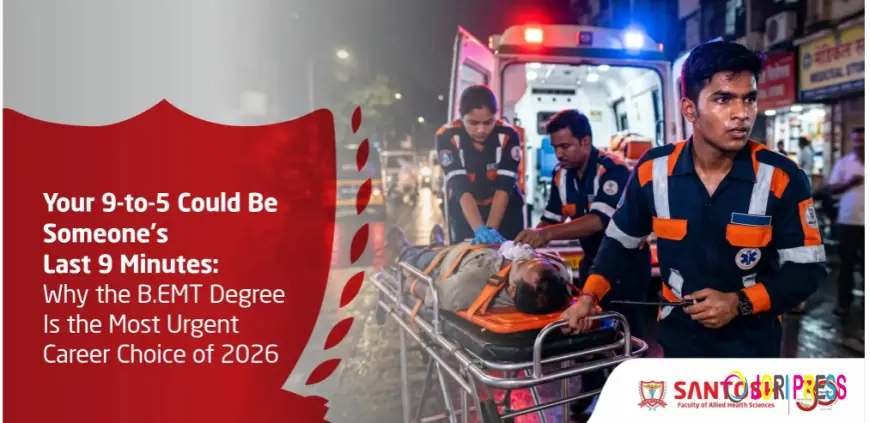
Picture this: A 22-year-old is in a road accident at 11 pm on the Delhi-Meerut Expressway. An ambulance arrives in eight minutes. What happens in those eight minutes — and in the critical 30 minutes that follow — will determine whether that person survives with full recovery, survives with disability, or does not survive at all.
The person making those decisions in the back of that ambulance? That is an Emergency Medical Technologist (EMT). Not the surgeon. Not the ICU doctor. The EMT who got there first.
If you are someone who wants a career that is genuinely consequential — one where you are not just doing a job but actively making life-or-death decisions in real time — the Bachelor of Emergency Medical Technologist (Paramedic) programme at Santosh Faculty of Allied Health Sciences, Ghaziabad might be the most relevant conversation you have in 2026.
2. What is Bachelor of Emergency Medical Technologist (B.EMT)?
The Bachelor of Emergency Medical Technologist (Paramedic), commonly known as B.EMT, is a 4-year undergraduate allied health degree — 3 years of academics followed by 1 year of full clinical internship. It is the most advanced entry-level qualification for emergency medical professionals in India.
The programme trains students in pre-hospital emergency care, trauma assessment and stabilisation, advanced life support, critical care technology, pharmacology basics, disaster management, and coordination with hospital emergency teams. By graduation, a B.EMT professional is capable of independent emergency decision-making in the field — before a patient ever reaches a hospital.
At Santosh Deemed to be University in Ghaziabad, this programme is delivered through the Faculty of Allied Health Sciences, combining classroom learning with hands-on training in the university's 900-bedded teaching hospital — one of the most active clinical environments for emergency training in the Delhi-NCR region.
|
Quick stat: India has over 1.5 lakh road accident deaths per year — the highest in the world. A majority of these are preventable with faster, better-trained pre-hospital emergency response. India needs trained EMTs urgently, and the pipeline is still underdeveloped. |
3. Why one Should Seriously Consider This Career
Let's cut to it — if you are 17–22 right now, you have grown up watching chaos, uncertainty, and crisis in the news on a daily loop. Many of you do not want a passive desk career. You want to do something that matters.
It's One of the Few Careers Where You Are Trained to Calm the Storm
In a medical emergency, most people freeze. EMTs are trained to do the opposite — assess fast, act faster, and communicate clearly under maximum pressure. That is not just a clinical skill. It is a life skill that makes you exceptional in any room.
The Problem Is Real and Unambiguous — and You Can Help Solve It
India's emergency healthcare system is chronically under-resourced. Most cities do not have enough trained paramedics. Most ambulances are not staffed by clinically competent personnel. Choosing this field is not just a career move — it is choosing to be part of the solution to a genuine national health gap.
High Stakes = High Respect — and High Employability
Emergency medical professionals are among the most respected in any hospital. Because their work is visible, urgent, and directly tied to patient survival, they are taken seriously from day one. And because demand far outstrips supply right now, well-trained B.EMT graduates face a very different job market than most other allied health graduates.
The Hours Are Different — and That Suits a Certain Kind of Person
If the standard 9-to-5 grind sounds like a slow death to you, emergency medicine operates on a completely different rhythm — shift-based, unpredictable, fast-moving. For the right person, that is not a downside. That is the whole point.
It Qualifies You for International Practice
Paramedic and EMT roles in the Gulf, UK, Canada, Australia, and Southeast Asia are filled by professionals with exactly the kind of clinical foundation this degree builds. International doors open early for graduates who also build their English communication and protocol skills — both of which are embedded in this programme.
4. Course Overview at a Glance
| Course Detail | Information |
|---|---|
| Programme Name | Bachelor of Emergency Medical Technologist (Paramedic) |
| Also Known As | B.EMT, Paramedic Degree, Emergency Technologist Course |
| Offered By | Santosh Faculty of Allied Health Sciences, Santosh Deemed to be University, Ghaziabad |
| Programme Level | Undergraduate Degree (Allied Health Sciences) |
| Duration | 4 Years — 3 Years Academics + 1 Year Compulsory Internship |
| Mode of Study | Regular / Full-Time |
| Annual Fee | Rs. 1,81,000/- |
| Eligibility | 10+2 with PCB or PCM; English mandatory |
| Admission Process | Direct Admission |
| Contact / Admission | admissioncell@santosh.ac.in | admission.santosh.ac.in |
| Core Training Areas | Pre-hospital Care, Trauma Assessment, Advanced Life Support, Critical Care, Disaster Management, Pharmacology |
| Career Roles | Paramedic, Trauma Care Technician, Critical Care Technician, Ambulance Coordinator, ED Supervisor |
| Employment Settings | Hospitals, Ambulance Services, Trauma Centres, ICUs, Disaster Response Teams, Air Ambulance, Military Medical Units |
5. Eligibility Criteria
Here is who can apply for the B.EMT programme at Santosh Deemed to be University:
| Eligibility Parameter | Requirement |
|---|---|
| Minimum Education | Passed 10+2 / HSC or equivalent from a recognised Board or University |
| Accepted Stream A | English, Physics, Chemistry, Biology (or Botany & Zoology) |
| Accepted Stream B | English, Physics, Chemistry, Mathematics |
| English | Mandatory in both streams |
| NEET Requirement | Not required |
| Admission Mode | Direct Admission — contact admissioncell@santosh.ac.in or visit admission.santosh.ac.in |
| Age Criteria | As per university norms |
6. Course Curriculum — Year-by-Year Breakdown
The B.EMT curriculum is built like emergency medicine itself — foundations first, complexity layered progressively, with real-world readiness as the end goal. Here is how the 4 years are structured:
| Year | Focus Areas |
|---|---|
| 1st | Foundations: Basic medical sciences, foundation course, communication skills, basic life support, and introduction to emergency care. |
| 2nd | Core Emergency Care: Pre-hospital care principles, trauma assessment, emergency procedures, pharmacology basics, and clinical skill development. |
| 3rd | Advanced & Integrated Care: Advanced trauma management, medical and pediatric emergencies, disaster management, critical care concepts & supervised clinical exposure. |
| 4th | Clinical Internship: Pre-hospital care principles, trauma assessment, emergency procedures, pharmacology basics, and clinical skill development. |
7. What Makes Santosh the Right Place to Train
For students searching for an emergency medical technologist college in Ghaziabad, Noida, or Delhi-NCR, here is why Santosh Faculty of Allied Health Sciences consistently stands out:
Active 900-Bedded Teaching Hospital — Not a Simulated Lab
Emergency medicine cannot be taught from a textbook or even a simulation room alone. At Santosh, training happens in an actual functioning hospital — one that receives real trauma, real cardiac events, and real critical cases daily. The volume and variety of clinical exposure at Santosh Hospitals is genuinely hard to replicate at smaller institutes.
NCR Location — Maximum Exposure, Maximum Placement Access
Ghaziabad sits at the intersection of Delhi, Noida, and eastern UP. For B.EMT students, this means proximity to some of India's busiest trauma networks, major private hospital chains, and government medical facilities — all of which are active employers of trained emergency medical professionals. The NCR also has a rapidly growing air ambulance and emergency response ecosystem, opening career pathways beyond traditional hospital roles.
Multidisciplinary Training Environment
At Santosh, B.EMT students train alongside MBBS, nursing, and other allied health students — creating the kind of interprofessional environment that mirrors actual emergency team dynamics. In a real emergency, you will work with surgeons, nurses, anaesthesiologists, and intensivists. Training in that kind of environment from day one gives Santosh graduates a distinct edge.
Strong Emphasis on Communication & Professional Readiness
Communication skills are embedded in the B.EMT curriculum from Year 1 — because an EMT who cannot communicate clearly under pressure is only half-trained. Santosh's programme recognises this and builds professional communication, ethical practice, and clinical decision-making as core graduate attributes, not electives.
8. Career Roles After B.EMT
Here is a clear breakdown of the career paths available to Bachelor of Emergency Medical Technologist graduates:
| Career Role | What You Actually Do |
|---|---|
| Trauma Care Technician | Stabilise trauma patients, provide urgent care at accident scenes and in trauma bays, and support trauma teams in high-pressure emergency settings. |
| Critical Care Technician | Monitor and support patients in ICUs and high-dependency units, assist in emergency interventions, and coordinate with multidisciplinary critical care teams. |
| Paramedic / Advanced Paramedic | Deliver emergency medical care in pre-hospital settings, perform life-saving interventions per approved protocols, ensure safe patient transport, and coordinate with hospital emergency teams. |
| Emergency Department Supervisor | Coordinate EMS operations, supervise field and service teams, uphold quality and safety standards, and manage emergency care workflows under senior leadership. |
| Ambulance Service Coordinator | Oversee ambulance fleet operations, coordinate emergency response teams, manage dispatch and logistics, and ensure timely, efficient emergency response. |
Where do B.EMT graduates find work?
• Government hospitals — AIIMS, state medical colleges, district hospitals, ESI hospitals
• Private hospital emergency departments — Apollo, Fortis, Max, Medanta, Santosh, and regional chains
• National and state ambulance services (108, CATS, private operators)
• Trauma centres and accident emergency units
• Air ambulance and medical evacuation services
• Disaster response and NDRF-aligned emergency teams
• Military, paramilitary, and armed forces medical units
• International healthcare systems — Gulf countries, Southeast Asia, UK, Canada
9. Salary Prospects in India
Emergency medical professionals are paid on a par with — and often above — other allied health roles at equivalent experience levels, because the skill demand and intensity of their work is higher. Here is a realistic salary overview for B.EMT graduates in India:
| Experience Level | Average Monthly Salary (India) |
|---|---|
| Fresher (0–1 year) | Rs. 20,000 – Rs. 30,000 |
| Mid-Level (2–4 years) | Rs. 32,000 – Rs. 52,000 |
| Senior / Specialised (5+ years) | Rs. 55,000 – Rs. 85,000+ |
| Supervisory / EMS Lead / Coordinator | Rs. 80,000 – Rs. 1,20,000+ |
| International (Gulf / Southeast Asia) | Significantly higher — often 2–3x domestic rates |
|
Career tip: B.EMT graduates who specialise in critical care coordination, air ambulance operations, or disaster response significantly increase their market value and access to premium domestic and international roles. |
Frequently Asked Questions (FAQs)
Q1. What exactly is a B.EMT degree and is it different from a basic EMT certification?
Yes, very different. A basic EMT certification is a short-duration course that qualifies someone for entry-level ambulance support. The Bachelor of Emergency Medical Technologist (Paramedic) is a full 4-year undergraduate degree that trains you to an advanced clinical level — capable of independent pre-hospital decision-making, advanced life support, trauma management, and critical care support. It is the most complete entry-level qualification for emergency medicine in India.
Q2. Is NEET required to apply for the B.EMT programme?
No. NEET is not required for the B.EMT programme. Admission is based on 10+2 marks and is through a direct admission process. You can apply at admission.santosh.ac.in or contact admissioncell@santosh.ac.in directly.
Q3. Can students from the PCM (Maths) stream apply — or is PCB mandatory?
Both streams are accepted. Students from English-Physics-Chemistry-Biology (including Botany & Zoology) as well as English-Physics-Chemistry-Mathematics backgrounds are eligible. English is mandatory in both streams.
Q4. How intense is the internship year, really?
Very. The 4th-year internship is a full year of supervised clinical rotations across pre-hospital emergency settings, trauma units, emergency departments, and ICUs at Santosh Hospitals. You will encounter real patients, real emergencies, and real clinical decisions. Most students describe it as the hardest and most rewarding year of the programme.
Q5. What is the fee for the B.EMT programme at Santosh?
The annual fee is Rs. 1,81,000/-. For the current and complete fee structure, scholarship details, or any other financial queries, visit admission.santosh.ac.in or contact the admissions team directly.
Q6. Does this degree qualify me for international jobs?
Yes — and this is one of the strongest points of the B.EMT degree. Trained paramedics and emergency medical technologists are actively sought in Gulf countries, Southeast Asia, the UK, Canada, and Australia.
Q7. How do I apply?
Apply online at admission.santosh.ac.in or email admissioncell@santosh.ac.in. You can also reach the admissions office at 0120-4933350 / 7838554401. Seats are offered on a direct admission basis — early application is recommended.
What's Your Reaction?
 Like
0
Like
0
 Dislike
0
Dislike
0
 Love
0
Love
0
 Funny
0
Funny
0
 Angry
0
Angry
0
 Sad
0
Sad
0
 Wow
0
Wow
0