








































Why Meditation Feels Hard to Stick With (And How In-Person Training Actually Solves It)

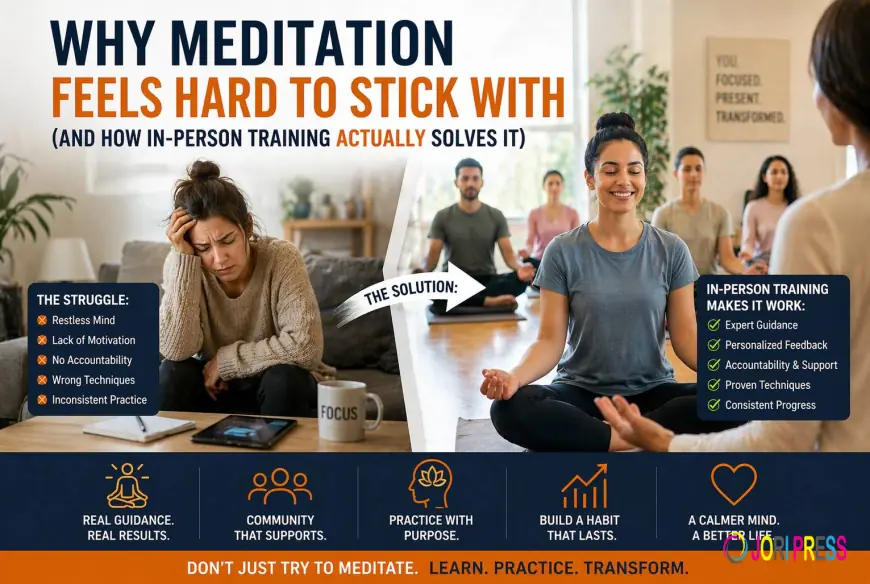
Starting meditation is easy. Sticking with it is the part that surprises people.
Many beginners assume the hardest step is finally sitting down to try meditation. In reality, the bigger challenge often comes two or three weeks later, when motivation drops, life gets noisy again, and the practice starts to feel inconsistent.
That does not always mean meditation is not working. More often, it means the person never learned how to make the practice stable in real life.
That problem can show up in familiar ways: packed workdays, school schedules, long drives between towns, shifting seasonal routines, and the feeling that if a habit is not immediately effortless, it must not be sustainable. Meditation can get pushed into the same category as every other good intention.
Why Meditation Often Feels Hard to Maintain
Meditation becomes difficult to maintain when the practice creates too much friction.
Friction is any obstacle that makes a habit harder to start or repeat. In meditation, friction can look like uncertainty, inconsistent scheduling, unrealistic expectations, or not knowing whether you are doing the technique correctly.
That matters because people rarely quit habits only because they do not care. More often, they quit because the habit starts to feel confusing, inconvenient, or mentally expensive.
A meditation practice is much more likely to last when it feels clear, repeatable, and easy to return to after a disrupted week.
The First Problem: People Expect Immediate Perfection
One of the biggest reasons meditation feels hard to stick with is that beginners often judge the practice by the wrong metric.
They assume a “good” session means:
-
no thoughts,
-
instant calm,
-
perfect focus,
-
or a dramatic emotional shift afterward.
When that does not happen, they conclude they are bad at meditation.
This is one of the most common consistency traps. If someone believes every session should feel peaceful and controlled, then ordinary human experiences like restlessness, mental chatter, or fatigue start to feel like failure. Once meditation feels like a performance, people avoid it.
Cause and effect is straightforward here: when expectations are too rigid, the practice feels disappointing; when the practice feels disappointing, people stop repeating it.
The Second Problem: Too Much Self-Diagnosing
A beginner left alone with an app or generic instructions often starts asking the same questions:
Am I doing this right? Should I be focusing harder? Is it normal to have this many thoughts? Why was yesterday easier than today?
Those questions sound small, but they create major drag over time. Uncertainty drains consistency because it turns every session into a judgment call.
This is one reason in-person instruction matters so much. Meg Reynolds’ published teaching emphasizes that live learning allows for personalized feedback, real-time clarification, and support when students worry they are “doing it wrong.” Reynolds is an internationally-recognized expert Vedic Meditation instructor and her website presents Vedic Meditation as a practice learned with a teacher rather than through an app alone.
If you want a deeper look at why in-person meditation classes create more clarity and confidence for beginners, that foundation helps explain why people often stay more consistent when they learn with real guidance.
The Third Problem: Meditation Gets Treated Like an Extra
Meditation tends to fail when it is treated as a bonus activity instead of a core practice.
People tell themselves they will meditate:
-
after inbox cleanup,
-
after dinner,
-
after the house is quiet,
-
after they feel less busy.
But “after” is where habits go to disappear.
In Central Virginia, routines often change with the season. Summer can mean more travel and longer evenings. Fall brings school schedules and packed calendars. Winter shortens the daylight and makes people more likely to collapse into passive recovery at the end of the day. Spring fills weekends quickly. A meditation habit that depends on the perfect window usually does not survive those shifts.
A stable practice works differently. It has a place in the day before everything else crowds it out.
That does not mean the schedule must be rigid. It means the practice needs structure. Without structure, meditation competes with every other demand and usually loses.
Why In-Person Training Improves Consistency
In-person meditation training does not help only because it is more enjoyable. It helps because it removes the specific conditions that make a habit collapse.
1. It reduces ambiguity
When a teacher can explain the technique clearly and answer questions in real time, beginners stop reinventing the practice every day.
That matters because clarity lowers resistance. People are far more likely to repeat a habit when they know what they are doing and what to expect.
2. It normalizes the experience
A good teacher helps students understand what is ordinary in meditation and what is not.
That one shift is powerful. When people learn that thoughts, uneven sessions, and changing experiences can all be part of the process, they stop interpreting every imperfect session as evidence that they are failing.
3. It creates accountability without pressure
Consistency improves when people feel supported, not judged.
In-person learning creates a relationship to the practice. You are not just following a timer. You are learning a skill with context, feedback, and a clearer sense of why it matters.
4. It turns meditation into something lived, not just consumed
Apps are easy to download. That does not automatically make a practice easy to embody.
An in-person setting helps meditation move from abstract wellness content into an actual personal discipline. Once the practice feels real, people are more likely to protect it.
What a Sustainable Practice Actually Looks Like
A sustainable meditation practice is not built on perfect motivation. It is built on repeatability.
That means:
-
the technique feels clear,
-
the expectations are realistic,
-
the practice fits a real schedule,
-
and one missed session does not turn into a lost month.
This is especially important for adults whose days are full of invisible mental load. If meditation requires too much setup, too much analysis, or too much self-correction, it becomes one more task. If it feels accessible, it becomes restorative.
That distinction matters. A meditation practice should reduce mental strain, not add another layer of performance.
The Real Sign It’s Working
Many people assume meditation is working only when they feel noticeably different during the session.
But a more useful question is this: does the practice become easier to return to over time?
That is often the better marker of a well-learned technique. When meditation is taught well, people tend to spend less time wrestling with the process and more time simply doing it. The habit becomes less dramatic and more dependable.
That is not a small outcome. Dependability is what transforms meditation from an occasional reset into a long-term support for the nervous system.
For readers in Central Virginia who are trying to build a steadier practice, that is where local, in-person guidance can make a real difference. Teachers such as Meg Reynolds are part of why meditation is becoming less of an abstract wellness ideal and more of a practical skill people can actually maintain in everyday life.
What's Your Reaction?
 Like
0
Like
0
 Dislike
0
Dislike
0
 Love
0
Love
0
 Funny
0
Funny
0
 Angry
0
Angry
0
 Sad
0
Sad
0
 Wow
0
Wow
0