




































Website Redesign ROI: When It's Worth It for New York Businesses (And When It's Not)
Learn when a website redesign is worth the investment. Discover ROI, costs, key metrics, and expert insights for New York businesses in 2026.

"Our website looks outdated, let's redesign it." That sentence alone has led plenty of New York businesses to spend tens of thousands of dollars on a project that changed how their site looked without changing how it performed. Redesigns can deliver real, measurable returns, but only when they're built around a specific question most businesses skip: what is this redesign actually supposed to fix?
The Real ROI Numbers
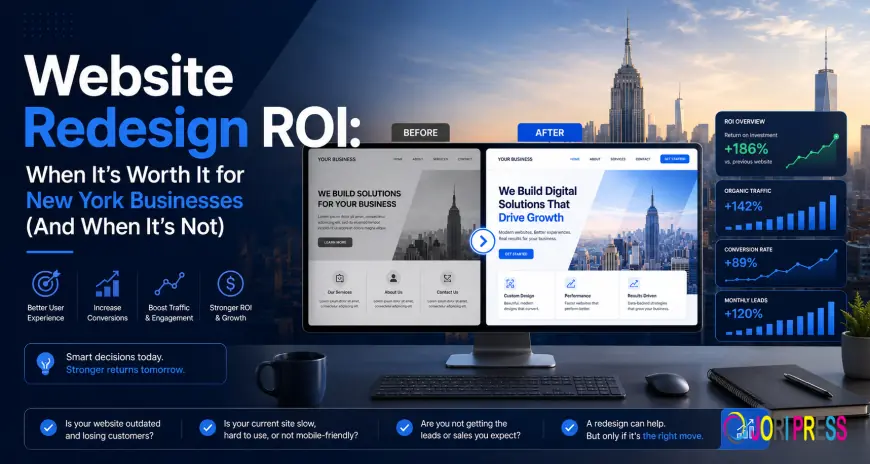
Done well, a website redesign is a genuinely strong investment. A well-executed redesign typically delivers a 20% to 50% relative improvement in conversion rate within the first six months, according to multiple 2026 redesign ROI studies. Some sources report slightly more conservative ranges of 15-25%, but the pattern is consistent: strategic redesigns produce real, compounding gains, not marginal ones.
The timeline for seeing that return is faster than most business owners expect. Most businesses reach break-even between 4 and 14 months after launch, depending on industry sales cycle and how quickly the new site is put to work. One documented case found a $150,000 investment in a strategic rebuild generating $600,000 in annual incremental revenue, a 300% first-year return, according to 2026 case study data.
The Critical Distinction: Aesthetic vs. Strategic Redesigns
Here's the part most agencies won't lead with: 73% of redesign ROI comes specifically from eliminating sluggishness and confusing design, not from a fresh visual look, according to 2026 redesign research. Businesses that redesign purely for aesthetics, a new color palette, updated photography, a trendier font, consistently land on the lower end of the return range or see no measurable improvement at all. Businesses that redesign around actual user behavior and friction points land at the upper end.
The data backs this up in stages. According to a documented redesign timeline from 2026 case research: bounce rate typically drops around 28% within the first month from load time and layout fixes alone, lead volume increases roughly 47% within three months from UX improvements, conversion rate climbs about 32% within six months as conversion-focused changes take hold, and organic traffic increases as much as 68% within twelve months as SEO improvements compound. That's not a flat, one-time bump — it's a curve that builds specifically because the underlying issues, not just the visuals, were fixed.
Where the Real Money Gets Left on the Table
Nearly half of users, 47%, according to heatmap research, leave a website specifically because of poor form usability or the absence of a visible call-to-action button. That's not a design preference issue. It's a direct revenue leak that a purely cosmetic redesign won't necessarily fix, and might even make worse if the new design prioritizes visual minimalism over clear action paths.
For e-commerce specifically, checkout and demonstration flow improvements account for a disproportionate share of conversion gains in redesign projects; some studies put the improvement from checkout UX fixes alone as high as 35% on large e-commerce sites, according to Baymard Institute research. If your redesign budget goes entirely toward the homepage and product photography while checkout stays untouched, you're likely optimizing the part of the funnel that matters least.
What This Costs in New York
Redesign investment for small to mid-sized businesses generally runs in the $15,000 to $50,000 range for a strategic, professionally executed project, based on current 2026 U.S. pricing data, with New York agency rates typically running above the national average given local cost of living and demand. That's a meaningful investment, which is exactly why treating it as a strategic decision, not a visual refresh, matters so much for whether it pays for itself.
When a Redesign Is Actually Worth It
- Your site has clear technical or structural problems, slow load times, broken mobile experience, confusing navigation, not just an outdated look
- You have baseline data to measure against: current conversion rate, traffic, and lead volume, so you can actually prove the redesign worked
- Your business goals have changed: new services, new audience, new positioning, in ways your current site structurally can't support
- User behavior data (heatmaps, session recordings, analytics) points to specific friction points you can design around
When It's Probably Not Worth It Yet
- Your only complaint is that the site "looks old" with no data suggesting it's actually underperforming
- You haven't identified specific, measurable problems to fix; you're hoping a new look solves an undefined issue
- Your current site's technical foundation (speed, mobile performance, security) is already solid; in that case, targeted conversion optimization is often more cost-effective than a full rebuild
Getting This Done Right
This is exactly where working with an experienced software development company in New York businesses trust changes the outcome; the difference between a redesign that pays for itself in months and one that looks nicer without moving revenue comes down to whether the process starts with data and user behavior, or with a mood board. Before committing budget, ask any agency directly what baseline metrics they'll track and how they'll measure success. If the answer is entirely about visual direction, that's worth a second look before signing.
FAQs
How do I know if my website actually needs a redesign or just targeted fixes?
Check your baseline metrics first: conversion rate, bounce rate, mobile performance. If your technical foundation is solid and you have specific, isolated friction points, targeted conversion optimization is often more cost-effective than a full redesign.
How long until a website redesign pays for itself?
Most strategic redesigns reach break-even between 4 and 14 months, depending on your industry's sales cycle and how much of the improvement comes from genuine UX and performance fixes versus purely visual changes.
Is a more expensive redesign always a better investment?
Not necessarily. The data consistently shows that strategy and UX planning, not price tag or visual polish, drive the majority of redesign ROI. A well-scoped, mid-priced redesign focused on real friction points can outperform an expensive one built around aesthetics alone.
What metrics should I track to measure my redesign's actual ROI?
Conversion rate, cost per lead, organic traffic growth, lead quality, and sales cycle length are the metrics tied directly to business outcomes. Track these over your baseline period and compare to post-launch performance, not just traffic or "engagement."
Can a small business realistically measure the ROI of a redesign without a large analytics team?
Yes. Establishing a clear baseline before the project starts, including current conversion rate, traffic, and lead volume, and comparing it to the same metrics 90 days post-launch gives most small businesses enough data to evaluate whether the investment worked.
Bottom Line
A website redesign can be one of the highest-ROI investments a New York business makes, or one of the most expensive ways to make a site look nicer without actually performing better. The difference isn't the budget. It's whether the redesign is built around fixing specific, measurable friction, or just refreshing the look and hoping the numbers follow.
What's Your Reaction?
 Like
0
Like
0
 Dislike
0
Dislike
0
 Love
0
Love
0
 Funny
0
Funny
0
 Angry
0
Angry
0
 Sad
0
Sad
0
 Wow
0
Wow
0