








































Water Hammer in Pipelines: Causes, Risks and How Surge Analysis Prevents Failure

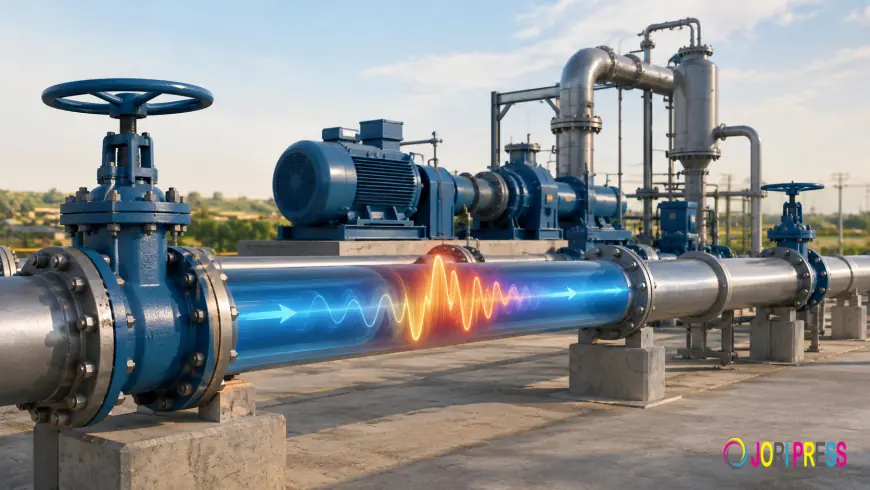
Water Hammer in Pipelines: Causes, Risks and How Surge Analysis Prevents Failure
Pipeline systems are designed to move fluids safely and reliably, but operating conditions can change quickly. A sudden valve closure, pump failure, pump trip, or power failure can create transient hydraulic conditions that are very different from normal steady-state operation.
One of the most important consequences of these events is water hammer. The resulting pressure surge can affect pipelines and equipment and, if not properly evaluated, may contribute to serious system failures.
For engineers working with water, wastewater, cooling, firefighting, oil & gas, and industrial pipeline systems, understanding transient behavior is therefore an important part of hydraulic system design and validation. Hydraulic and surge analysis provides a way to evaluate these operating scenarios before they become an operational problem.
What Is Water Hammer in a Pipeline?
Water hammer is a hydraulic transient associated with sudden changes in fluid flow. When operating conditions change rapidly, pressure and velocity within a pipeline can change significantly.
The effect can occur during events such as:
-
Sudden valve closure
-
Pump trips
-
Pump failures
-
Power failures
-
Pump startup and shutdown
These events can produce pressure surges or, under other conditions, vacuum conditions. This is why transient hydraulic events need to be considered alongside normal operating conditions when evaluating pipeline performance.
For a pipeline engineer, the important question is not simply whether water hammer can occur. It is how the pipeline and connected equipment respond when an operational event takes place.
Why Water Hammer Can Be a Pipeline Risk
A pipeline may perform normally under steady-state conditions while responding differently during a transient event.
Sudden valve closure or pump failure can cause pressure changes that may result in water hammer, pressure surges, or vacuum conditions. These conditions can place additional demands on pipelines and equipment.
A hydraulic and surge analysis helps engineers evaluate these conditions and identify potential instability. The objective is to help:
-
Prevent pressure-induced damage
-
Improve operational reliability
-
Optimize system sizing
-
Evaluate control logic
-
Identify appropriate protection measures
This makes transient analysis particularly valuable when pipeline systems must operate under changing or emergency conditions.
Pump Trips and Power Failures
Pump operation is an important consideration in surge analysis.
A pump trip or power failure can suddenly change the flow conditions within a pipeline system. The resulting transient behavior needs to be evaluated to understand how system pressure and flow respond.
Hydraulic surge analysis can evaluate pump-trip and power-failure scenarios. Pump startup and shutdown can also be simulated to understand their effects on system pressure and transient behavior.
This type of assessment is especially relevant for systems where maintaining reliable flow and pressure is important, including water, wastewater, cooling, firefighting, and industrial fluid networks.
Rather than assessing the pipeline only at its normal operating point, transient simulation allows engineers to consider how the system behaves when operating conditions change.
Valve Closure and Pressure Surges
Valves are an essential part of fluid networks, but operational changes involving valves can influence transient behavior.
A sudden valve closure can create a pressure surge. The severity and effect of the event depend on the hydraulic behavior of the system and the operating conditions being evaluated.
For this reason, valve closure and control strategy assessment forms an important part of surge analysis. The impact of operational changes can be analyzed and appropriate surge-control strategies can be considered.
The Conserve Solutions service page identifies approaches including air valves, surge tanks, and control valves as part of surge-control strategy assessment.
Steady-State Analysis vs. Transient Analysis
A useful starting point for understanding pipeline behavior is to distinguish between steady-state and transient conditions.
Steady-state analysis evaluates normal flow behavior, including pressure, velocity, and flow distribution. It can help establish baseline performance and identify potential instabilities.
Transient flow analysis goes further by evaluating how these conditions change when the system experiences an operational event.
Together, these analyses provide a broader understanding of fluid network behavior.
For example, a pipeline may have acceptable pressure and flow distribution during normal operation, but a pump trip or valve closure may produce a very different pressure response. Evaluating both conditions gives engineers a more complete picture of system performance.
How Surge Analysis Helps Prevent Pipeline Problems
A detailed hydraulic and surge analysis can model real-life operational scenarios and help identify conditions that require attention.
The assessment can include:
-
Steady-state flow analysis – evaluating pressure, velocity, and flow distribution.
-
Transient flow analysis – assessing system behavior during changing operating conditions.
-
Water hammer and surge analysis – evaluating pump-trip, valve-closure, and power-failure scenarios.
-
Pump startup and shutdown simulation – examining how pump operation affects system pressure.
-
Pipeline and network optimization – assessing overall pipeline performance.
-
Valve and control strategy assessment – evaluating operational changes and surge-control measures.
-
Long-pipeline hydraulic design – performing gravity and pressurized flow calculations for transmission mains over long distances.
This approach shifts the focus from simply reacting to pipeline problems toward evaluating potential transient conditions during design and system validation.
Applications Across Different Pipeline Systems
Water hammer and surge analysis are not limited to one type of pipeline.
Hydraulic and surge analysis can support systems involving:
Potable Water
Water transmission and distribution systems can experience changing operating conditions that require pressure and flow evaluation.
Wastewater
Wastewater pipeline networks can also benefit from hydraulic assessment of normal and transient operating conditions.
Oil & Gas
Pipeline and industrial fluid systems require careful consideration of pressure and flow behavior under operational changes.
Firewater Systems
Firewater systems must maintain reliable pressure and flow across multiple demand conditions, including emergency and fluctuating operational loads.
District Cooling
District cooling networks require hydraulic assessment across changing operational and demand conditions to support reliable system performance.
Long-Distance Pipelines
Long transmission mains can require gravity and pressurized flow calculations to understand hydraulic performance over extended distances.
Why Early Hydraulic Assessment Matters
Surge-related problems can be difficult to address after a system is already designed or operating. Evaluating potential transient conditions during design validation provides an opportunity to identify issues and consider mitigation strategies earlier.
A detailed model can represent real-life operational scenarios and provide information about pressure, velocity, flow distribution, and transient behavior.
This can support decisions related to system sizing, operational controls, valve strategies, and surge protection.
The goal is not simply to calculate a pressure surge. It is to understand how the complete fluid network responds to the operating event.
Standards and Engineering Considerations
Hydraulic and surge analysis should be performed within the applicable engineering and regulatory framework.
The Conserve Solutions service page identifies standards and guidelines including:
-
API 610
-
API 674
-
ASME B31.3
-
ASME B31.4
-
ASME B31.8
-
AWWA M32
-
ISO 13709
-
Saudi Building Code and Civil Defense Guidelines
These standards and guidelines provide an important reference for engineering assessment and compliance depending on the application and project requirements.
Building a More Reliable Pipeline System
Water hammer should not be treated as an isolated pipeline issue. It is part of the wider behavior of a fluid network when operating conditions change.
A reliable assessment considers normal operation as well as events such as pump trips, pump startup and shutdown, valve closure, and power failure.
By combining steady-state analysis, transient simulation, pipeline assessment, and surge-control strategy evaluation, engineers can better understand the behavior of a fluid network and identify measures to improve reliability.
For projects involving potable water, wastewater, oil & gas, cooling, firefighting, or industrial pipeline systems, this type of engineering assessment can provide valuable insight into how the system is expected to respond under different operating conditions.
Conclusion
Water hammer and pressure surges can arise when pipeline operating conditions change rapidly. Pump trips, valve closures, pump startup and shutdown, and power failures are among the scenarios that should be considered when evaluating transient hydraulic behavior.
Hydraulic and surge analysis provides a structured way to assess these conditions, evaluate pipeline and network performance, and consider appropriate surge-control strategies.
For organizations seeking to evaluate fluid networks, pipeline systems, firewater systems, district cooling networks, or industrial applications, Conserve Solutions provides hydraulic and surge analysis covering steady-state and transient flow analysis, water hammer and surge assessment, pump simulation, pipeline optimization, valve and control strategy assessment, and hydraulic design for long pipelines.
What's Your Reaction?
 Like
0
Like
0
 Dislike
0
Dislike
0
 Love
0
Love
0
 Funny
0
Funny
0
 Angry
0
Angry
0
 Sad
0
Sad
0
 Wow
0
Wow
0