








































Want to Launch a Crypto Wallet? Here’s What You Need
Want to launch a crypto wallet? Learn about wallet types, key features, blockchain integration, security, development costs, compliance, and scalability.

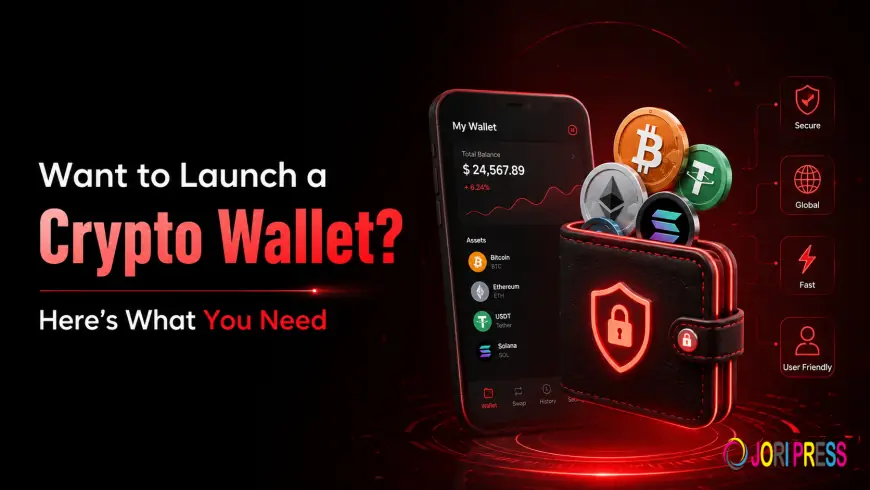
Launching a crypto wallet can be a strong opportunity for businesses entering the digital asset market. But building a wallet involves much more than creating an interface for sending and receiving cryptocurrency. Security, blockchain connectivity, supported assets, user experience, compliance, and scalability all need to be considered before development begins.
Whether you are planning a custodial wallet, non-custodial wallet, multi-chain wallet, or Web3 wallet, having a clear development plan can help you create a reliable product that meets user expectations.
Define Your Crypto Wallet Business Model
Before development starts, determine what type of wallet you want to build and what purpose it will serve.
A custodial wallet allows a business or service provider to manage users’ private keys and assets, while a non-custodial wallet gives users control over their private keys. Businesses can also develop multi-chain wallets that support assets across different blockchain networks or Web3 wallets designed for interacting with decentralized applications.
Your wallet model should be based on your target users, supported services, security requirements, and business objectives.
Choose the Blockchain Networks
Blockchain selection is another important part of wallet development. Your choice of networks determines which cryptocurrencies and tokens users can manage through the wallet.
Depending on your target market, you may consider networks such as Ethereum, BNB Chain, Polygon, Solana, Avalanche, and other blockchain ecosystems.
Supporting multiple networks can provide users with greater flexibility, but it also increases development and maintenance requirements. Each blockchain can have different transaction structures, network fees, smart contract standards, and integration methods.
Decide Which Features You Need
The features you include should solve real user needs while keeping the wallet easy to use.
Common crypto wallet features include:
-
Multi-asset support
-
Send and receive cryptocurrency
-
Transaction history
-
QR code transactions
-
Real-time asset balances
-
Address management
-
Network fee estimation
-
Token swapping
-
Push notifications
-
Multiple wallet accounts
-
Portfolio tracking
If the wallet is designed for Web3 users, additional features such as dApp connectivity, NFT management, staking, and decentralized application interaction can also be included.
Prioritize Wallet Security
Security should be one of the first considerations when developing a crypto wallet. Since wallets can manage valuable digital assets, weaknesses in the security architecture can create significant risks.
Depending on the wallet type, businesses can implement encryption, multi-factor authentication, biometric authentication, secure key storage, transaction verification, device authentication, and multi-signature functionality.
Advanced key-management approaches such as Multi-Party Computation can also be considered for certain wallet architectures.
Security testing should continue throughout development rather than being treated as a final-stage activity.
Build the Right Technology Architecture
A crypto wallet requires more than a mobile or web application. The backend infrastructure must communicate with blockchain networks and securely process wallet operations.
A typical architecture may include:
-
Frontend application
-
Backend infrastructure
-
Blockchain nodes or RPC providers
-
Key-management system
-
Database infrastructure
-
Authentication services
-
API integrations
-
Transaction processing
-
Notification services
-
Security monitoring
The architecture should be designed to handle increasing transaction volumes and users while maintaining performance and security.
Consider Regulatory Requirements
Regulatory requirements can differ depending on the wallet model, services offered, target market, and operating jurisdiction.
Wallet businesses may need to evaluate requirements related to KYC, AML, data protection, transaction monitoring, custody, licensing, and financial regulations.
If the wallet includes additional services such as trading, payments, or asset custody, compliance requirements may become more complex. Businesses should evaluate applicable regulations with qualified legal and compliance professionals before launching.
Choose Custom or White-Label Development
Businesses can choose between custom wallet development and white-label solutions.
Custom development provides greater control over the wallet's functionality, branding, integrations, security architecture, and future upgrades. It can be suitable for businesses that need a wallet designed around specific requirements.
White-label development can provide a faster way to enter the market by using an existing wallet framework that can be customized with branding, selected features, and integrations.
The right approach depends on the required functionality, budget, timeline, and long-term business strategy.
Understand the Development Cost
Crypto wallet development costs can vary significantly depending on the scope and complexity of the project.
Factors that can influence the overall cost include:
-
Wallet type
-
Number of supported blockchains
-
Supported cryptocurrencies and tokens
-
Mobile and web application requirements
-
Custodial or non-custodial architecture
-
Security infrastructure
-
Exchange and payment integrations
-
Web3 functionality
-
Admin dashboard
-
Compliance requirements
-
UI/UX customization
-
Third-party services
A simple single-chain wallet will generally require a different development scope than a multi-chain wallet with swapping, staking, NFT support, and advanced security features.
Test the Wallet Before Launch
Thorough testing is essential before releasing the wallet to users.
The development process should include functional testing, blockchain transaction testing, API testing, authentication testing, performance testing, and security assessments.
Different transaction scenarios should be tested to identify potential failures before users interact with the live system. Security audits and vulnerability assessments can also help identify weaknesses in the wallet infrastructure.
Plan for Future Growth
A wallet should be built with future expansion in mind. Your initial product may support only a few assets or blockchain networks, but user requirements can change as the business grows.
Future upgrades may include additional blockchain support, token swapping, staking, NFT functionality, crypto payments, dApp integrations, institutional features, and improved security mechanisms.
A scalable architecture makes it easier to introduce these capabilities without rebuilding the entire wallet infrastructure.
Final Thoughts
Launching a crypto wallet requires careful planning across technology, security, blockchain integration, compliance, and user experience. Defining the wallet model, selecting the right networks, identifying essential features, and choosing an appropriate development approach can help create a stronger foundation for the product.
Businesses should also evaluate development partners based on their blockchain expertise, security capabilities, customization options, technical support, and ability to build scalable infrastructure.
For businesses planning to enter the digital asset market, Dappfort offers cryptocurrency wallet development services that can be tailored to different business requirements, wallet models, blockchain networks, and feature sets.
The goal should not simply be to launch a wallet, but to create a secure, scalable, and user-friendly platform that can adapt as the digital asset ecosystem evolves.
What's Your Reaction?
 Like
0
Like
0
 Dislike
0
Dislike
0
 Love
0
Love
0
 Funny
0
Funny
0
 Angry
0
Angry
0
 Sad
0
Sad
0
 Wow
0
Wow
0