





































The Three AI Technologies Everyone Name-Drops, and What They Actually Do

A lot of AI conversations begin with a strange performance. People say the right words, as if vocabulary alone proves understanding.
Machine learning. Deep learning. Natural language processing.
Everyone nods.
But then a decision gets made. A product is purchased. A pilot is launched. And the organization discovers, too late, that no one actually agreed on what these terms meant, or what capability they needed, or what the system would require from data, infrastructure, and staff.
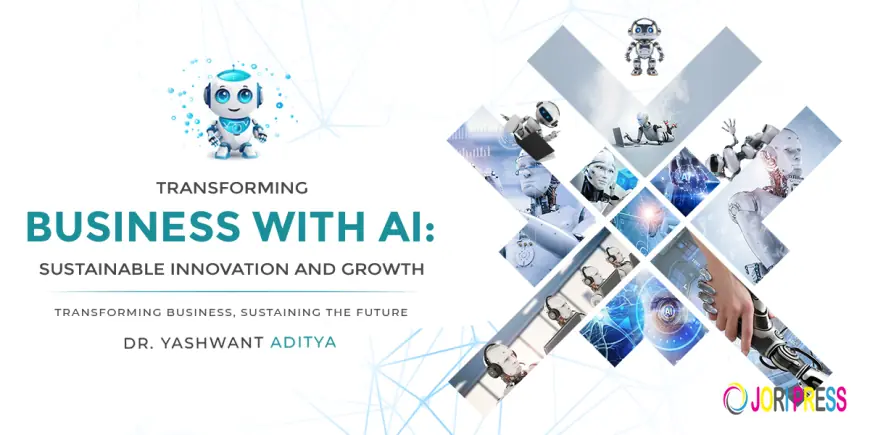
Dr. Yashwant Aditya’s Transforming Business with AI: Sustainable Innovation and Growth is unusually helpful here because it explains these technologies clearly and ties them directly to business use cases. It doesn’t treat the terms as status markers. It treats them as tools with different requirements and risks.
Machine learning, in the book, is described as algorithms that learn from data and improve performance over time. It’s the foundation of most practical AI applications. The book explains supervised learning as training models on labeled data, such as spam versus not spam, and unsupervised learning as identifying patterns without labels, like clustering customers by behavior. This distinction matters in the real world. If you want to predict outcomes, you often need labeled training data. If you want to discover segments or anomalies, unsupervised methods can help.
Deep learning is introduced as a subset of machine learning using neural networks with multiple layers, inspired by the human brain. The manuscript highlights its strength in handling complex data like images and speech. It references healthcare imaging and autonomous vehicles as examples, because deep learning excels at pattern recognition in high-dimensional data. But the manuscript also implies what responsible leaders should notice: deep learning often requires large datasets and significant computing power, and it can become harder to explain. That circles back to governance and transparency.
Then there’s natural language processing, or NLP, which the manuscript describes as the technology that enables machines to understand and respond to human language. It connects NLP to translation, sentiment analysis, and chatbots. For business, this is often the first visible encounter with AI, especially in customer support, content processing, and automation of communication-heavy tasks. NLP can reduce workload and improve speed, but it also introduces risk if outputs are inaccurate or insensitive. Without oversight, a chatbot can become a liability.
What’s valuable about Aditya’s explanation is that it quietly corrects a common mistake: treating “AI” as one bucket. In reality, AI capabilities vary widely. A recommendation system is not a fraud detection model. A predictive maintenance system is not a chatbot. A deep learning imaging model is not the same thing as a supervised classification system used for churn prediction.
The manuscript also maps these technologies to familiar applications across industries. It references predictive maintenance in manufacturing, where AI can anticipate equipment failure and reduce downtime. It discusses personalization in retail, where recommendation systems tailor product suggestions. It mentions fraud detection in finance and diagnostic support in healthcare. The goal isn’t to dazzle. It’s to anchor the reader in reality.
This matters because leaders often get trapped by “AI generalization.” They assume that because one AI tool worked in one department, AI can work everywhere in the same way. Then they replicate the wrong approach. Or they buy a platform marketed as universal. Or they set unrealistic expectations because they don’t understand what the technology can and can’t do.
Aditya’s manuscript keeps returning to readiness. Whatever technology you choose, you still need clean data, accessible storage, scalable infrastructure, trained people, and governance that can handle risk. The technology doesn’t replace discipline. It demands it.
If you’re a leader, the point is not that you need to become a technical expert. The point is that you need enough clarity to avoid being manipulated by jargon. You need to know what you’re buying, what it requires, and what success looks like.
If you want a practical explanation of core AI technologies and how they map to real business use cases, buy Transforming Business with AI: Sustainable Innovation and Growth on Amazon. It’s the kind of book that saves you from expensive confusion and helps you make decisions that hold up under scrutiny.
What's Your Reaction?
 Like
0
Like
0
 Dislike
0
Dislike
0
 Love
0
Love
0
 Funny
0
Funny
0
 Angry
0
Angry
0
 Sad
0
Sad
0
 Wow
0
Wow
0