






































"The Crossing," a New Children's Book Reframing Immigration Through Care and Survival

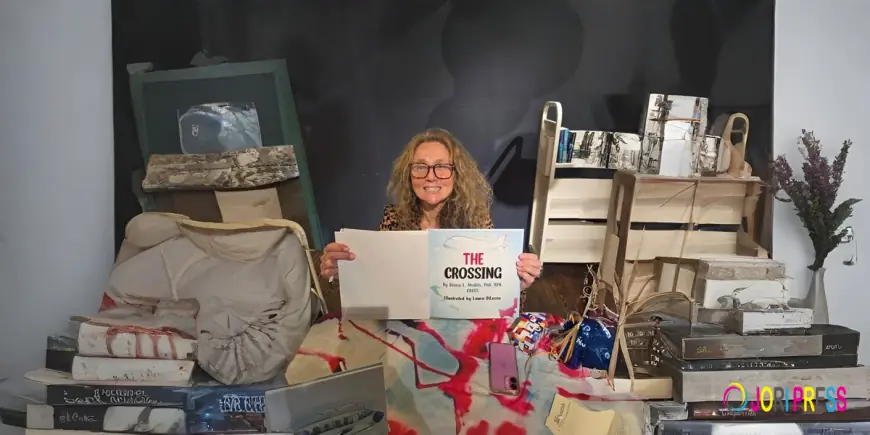
Diana L. Malkin’s “The Crossing” turns migration, illness, and belonging into a quietly powerful literary experience for young readers.
There is a particular kind of ambition in children’s literature that announces itself quietly. It does not arrive with gimmick or sermon, but with the confidence that young readers can bear complexity if it is offered with clarity and grace.
Diana L. Malkin’s The Crossing begins from that faith. Here is a picture book that understands, almost instinctively, that children live much closer to the world’s real tensions than adults like to admit: sickness, displacement, cost, loneliness, the blunt fact that safety is unevenly distributed. And yet Malkin does not hand those realities to readers as burdens. She shapes them into something gentler and stranger, an encounter story about animals on the move, bound together by diabetes, uncertainty, and the fragile hope that a new place might become home.
That premise alone would be enough to distinguish the book. But what makes The Crossing matter now is the seriousness of its attention. Written by Diana L. Malkin, a New York-based diabetes care and education specialist and registered dietitian who works in a resource-poor community, the book folds professional knowledge into an imaginative framework without losing warmth or narrative charm. The story introduces four animals from four different countries: a South African giraffe, a Mexican jaguar, a Sumatran rhino, and a Ugandan shoebill stork, each carrying not only diabetic supplies but a private reason for leaving home. The result is a children’s book that treats migration not as an abstraction but as a felt experience, and chronic illness not as a defining tragedy but as one part of a life that still contains humor, appetite, fear, desire, and fellowship.
What is most striking is the refusal to simplify the stakes. Malkin does not flatten movement across borders into a single story of danger or triumph. Her characters travel for different reasons: family, love, work, medical need, and the search for likeness in an unfamiliar world. That variety matters. In the public imagination, immigration is too often reduced to rhetoric, either menace or sainthood, crisis or slogan. The Crossing offers something more humane. It understands migration as a cluster of motives, some urgent, some ordinary, all deeply personal.
The diabetes thread is handled with comparable care. There is no melodramatic framing, no sentimental insistence that illness exists only to teach a moral lesson. Instead, the daily mechanics of managing blood sugar, juice, meters, sensors, insulin, snacks, backup supplies, become part of the book’s tactile reality. Anyone who has lived with diabetes, or alongside someone who has, will recognize the odd intimacy of that equipment, the way it structures movement, worry, and preparedness. In Malkin’s hands, those details do more than educate. They create texture. They let young readers see that medical life is made not only of diagnoses, but of bags, routines, jokes, interruptions, and mutual vigilance.
“Everyone is tired and hungry,” Malkin writes early on, and the sentence does what good children’s writing often does: it collapses the global into the bodily. Immigration line, long journey, bureaucratic uncertainty, these become legible through fatigue and hunger, the feelings a child can grasp immediately. Later, when one character says, “I feel so lost here,” the line lands with equal force because it speaks on two frequencies at once. Lost in an airport. Lost in a country. Lost in a life that has abruptly become unrecognizable.
What lingers, finally, is the book’s belief that care can begin before certainty does. No one in The Crossing knows exactly what comes next. That uncertainty is the point. In an era when public discourse is saturated with suspicion of the foreigner, the sick body, the person who needs too much, Malkin offers a quieter counterimage: strangers in transit, taking inventory of what keeps them alive, realizing they may already be less alone than they feared.
Buy The Crossing and discover a rare children’s book that treats empathy not as decoration, but as infrastructure. Available on Amazon.
What's Your Reaction?
 Like
0
Like
0
 Dislike
0
Dislike
0
 Love
0
Love
0
 Funny
0
Funny
0
 Angry
0
Angry
0
 Sad
0
Sad
0
 Wow
0
Wow
0