
































The Business Impact of High-Quality Image and Polygon Annotation
High-quality image and polygon annotation drives better AI accuracy, faster deployment, and stronger ROI. Annotera’s expert data annotation outsourcing services help businesses build scalable, reliable computer vision solutions with measurable business impact.
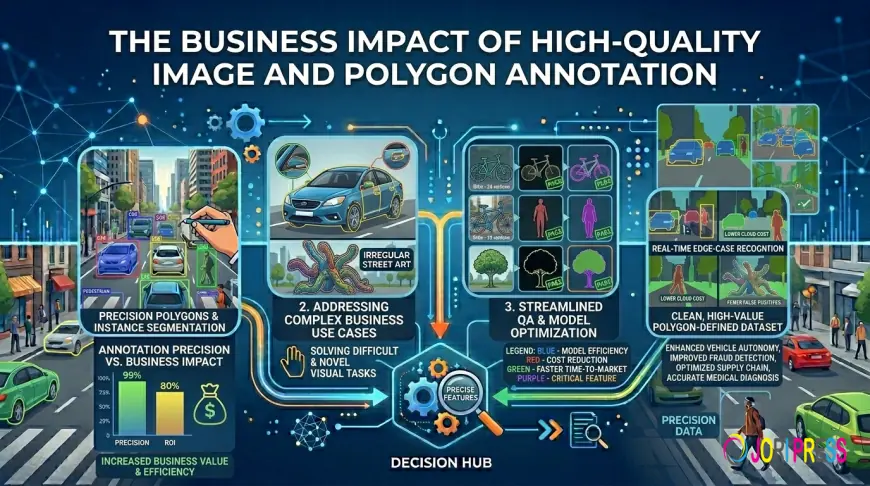
In today’s AI-driven business environment, the success of computer vision systems depends heavily on the quality of the training data behind them. Whether enterprises are building solutions for autonomous vehicles, retail analytics, medical imaging, manufacturing inspections, or security surveillance, the foundation of every reliable model lies in precise annotation. High-quality image and polygon annotation is no longer just a technical requirement—it is a strategic business investment that directly influences operational efficiency, customer experience, and return on AI initiatives.
As a trusted data annotation company, Annotera understands that businesses need more than labeled datasets; they need structured, scalable, and highly accurate visual data pipelines that drive measurable outcomes. This is where expert data annotation outsourcing becomes a competitive advantage.
Why Annotation Quality Matters to Business Outcomes
Artificial intelligence models learn from examples. If the labeled data contains inconsistencies, vague object boundaries, or missing attributes, the model’s predictions become unreliable. Poor-quality annotation often results in false positives, misclassifications, and expensive retraining cycles. On the other hand, precise image and polygon annotation improves model performance, accelerates deployment, and reduces long-term operational costs.
For businesses, this directly impacts:
- Faster product deployment
- Lower AI training costs
- Reduced model failure rates
- Better user trust and satisfaction
- Stronger compliance and governance
Simply put, annotation quality translates into business quality.
The Role of High-Quality Image Annotation
Image annotation involves labeling visual elements within images so machine learning models can recognize patterns, objects, and relationships. It includes bounding boxes, semantic segmentation, keypoint labeling, and classification tags.
For businesses deploying AI at scale, image annotation supports critical use cases such as:
- Product recognition in retail
- Defect detection in manufacturing
- Tumor detection in healthcare imaging
- Vehicle and pedestrian detection in mobility solutions
- Document and OCR automation
As an experienced image annotation company, Annotera ensures each image is labeled with consistency, contextual relevance, and domain-specific precision.
High-quality image annotation helps businesses improve:
Model Accuracy
Well-labeled datasets enable models to distinguish between similar objects with greater confidence, reducing prediction errors.
Faster Time-to-Market
Clean training datasets reduce the need for repeated data cleansing and retraining, helping companies launch AI products faster.
Lower Operational Costs
Accurate labels reduce model drift and maintenance expenses over time.
Better Decision Intelligence
Reliable AI outputs empower better business decisions in real-time environments.
Why Polygon Annotation Delivers Greater Precision
While standard image labeling methods like bounding boxes work for simple detection tasks, many business use cases require far greater precision. This is where polygon annotation becomes essential.
Polygon annotation involves outlining objects with multiple points to closely follow their exact shape and boundary. Unlike rectangular boxes, polygons capture irregular and complex structures with pixel-level precision.
This method is especially valuable for:
- Autonomous driving datasets
- Satellite and geospatial imagery
- Medical scans
- Retail shelf analytics
- Industrial component inspection
For example, in autonomous vehicle systems, accurately identifying lane markings, pedestrians, and irregularly shaped vehicles can significantly affect safety and system reliability. Polygon annotation minimizes background noise and ensures cleaner segmentation datasets.
From a business perspective, this means:
- Safer AI systems
- Higher precision in mission-critical applications
- Reduced legal and compliance risks
- Improved customer trust
Direct Impact on AI ROI
Businesses often focus on model architecture and compute power, but the quality of labeled data often has a stronger influence on ROI.
A poorly annotated dataset can increase the cost of model retraining, delay launches, and reduce adoption rates. In contrast, high-quality image annotation outsourcing improves ROI by enabling models to perform correctly from the early stages of deployment.
Key ROI drivers include:
Reduced Rework Costs
Incorrect labels often force teams to revisit datasets multiple times. High-quality annotation minimizes rework.
Improved Automation Efficiency
Better-performing models reduce human intervention and manual verification efforts.
Higher Customer Retention
Reliable AI-powered experiences improve satisfaction and trust.
Scalability
High-quality datasets can be reused across multiple AI projects and model iterations.
Businesses that invest in professional data annotation outsourcing often see faster value realization from their AI programs.
The Cost of Poor Annotation Quality
The business cost of low-quality annotation is often underestimated.
Common issues include:
- Inconsistent labeling standards
- Incorrect object boundaries
- Missing edge-case annotations
- Poor inter-annotator agreement
- Domain misinterpretation
These problems lead to:
- False alarms in surveillance systems
- Missed defects in manufacturing
- Incorrect medical diagnoses
- Poor recommendation engines
- Failed automation workflows
Recent industry research highlights that annotation errors propagate throughout the AI lifecycle and can create significant downstream business risks, especially in safety-critical sectors.
This is why partnering with a reliable image annotation company is essential.
Why Businesses Choose Data Annotation Outsourcing
Building an in-house annotation team requires infrastructure, workforce training, QA systems, and domain expertise. For many organizations, data annotation outsourcing is a more efficient and scalable solution.
Benefits include:
Access to Skilled Experts
Professional annotators understand domain-specific labeling requirements.
Scalability on Demand
Projects can scale quickly based on data volume and deadlines.
Quality Assurance Frameworks
Multi-level review processes ensure consistency and precision.
Cost Optimization
Outsourcing reduces overhead costs associated with hiring, training, and management.
At Annotera, our quality-first workflows combine human expertise with robust validation processes to deliver enterprise-grade datasets.
How Annotera Creates Business Value
At Annotera, we help organizations transform raw visual data into AI-ready assets that generate measurable business impact.
Our approach includes:
- Custom annotation guidelines
- Domain-trained annotation specialists
- Polygon and image labeling expertise
- Multi-stage quality checks
- Scalable project management
- Fast turnaround times
As a leading data annotation company, we focus on delivering annotation precision that directly supports business KPIs such as accuracy, efficiency, and revenue growth.
Conclusion
High-quality image and polygon annotation is not just a technical necessity—it is a core driver of business success in AI-led transformation.
From improving model accuracy and reducing operational costs to accelerating time-to-market and maximizing ROI, the business impact is substantial. Organizations that invest in expert image annotation outsourcing and data annotation outsourcing position themselves to build more reliable, scalable, and profitable AI systems.
At Annotera, we help businesses unlock the full potential of computer vision through precise, scalable, and business-focused annotation services.
What's Your Reaction?
 Like
0
Like
0
 Dislike
0
Dislike
0
 Love
0
Love
0
 Funny
0
Funny
0
 Angry
0
Angry
0
 Sad
0
Sad
0
 Wow
0
Wow
0