






































India's bowling attack gets a new look for England T20Is after Siraj's surprise exit
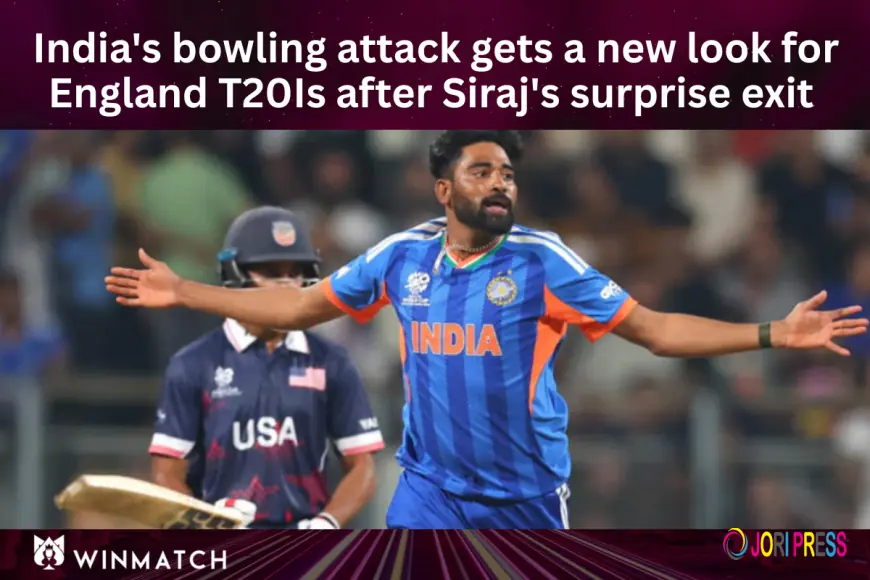
Every squad announcement tells a story- about priorities, workload, form, and the direction a team is heading. India's updated T20I squad for the Ireland and England tours of 2026 tells several stories simultaneously. A new captain in Shreyas Iyer. A teenage debutant in Vaibhav Sooryavanshi. Jasprit Bumrah rested. Mohammed Siraj- originally named in the squad, withdrawn just days after the announcement, replaced by Prasidh Krishna. The cricket world took notice immediately. What this reshaped bowling attack looks like, and what it means for India's plans ahead, is the question every analyst is now working through.
Why Siraj Was Withdrawn- The BCCI's Explanation
Cricket's Busiest Pacer Gets a Mandatory Brake Applied
The BCCI confirmed Siraj's withdrawal on June 9, 2026, with a medical advisory that framed the decision as workload management rather than form or injury. The reasoning was transparent and defensible- Siraj has been one of the most heavily used pace bowlers in world cricket across the past 18 months.
The scale of that workload is striking. Since 2025, Siraj bowled 374 overs and picked up 52 wickets- the most overs bowled by any Indian pacer across formats in that period. During India's Test tour of England in the Anderson-Tendulkar Trophy, he shouldered the pace attack single-handedly across 185 overs and 23 wickets- the highest haul by any Indian bowler in that series. He then played all 17 matches for Gujarat Titans in IPL 2026, bowling 372 balls and taking 19 wickets.
A player who has bowled that volume of overs across all three formats in a compressed period, on seaming English tracks, on flat IPL surfaces, through two separate international series- requires rest before the longer and more taxing assignments that follow. India's schedule ahead includes 17 ODI matches across five series against Afghanistan, West Indies, England, New Zealand, and Sri Lanka, plus Test assignments against New Zealand and Sri Lanka heading toward the home series against Australia in early 2027. The BCCI's decision to rest Siraj now, before those commitments build up, reflects exactly the kind of long-term thinking that has protected India's best bowlers across recent seasons.
For cricket fans who love following selection debates like this one and want to engage with the sport's strategic and competitive dimensions in an entertaining format, platforms like Winmatch- a space that brings competitive spirit and entertainment together through exciting challenges and fun titles, are a brilliant way to stay engaged throughout India's packed international calendar.
India's Revised T20I Bowling Attack: Full Picture
Cricket's New-Look Pace Battery for Ireland and England
With Bumrah rested and Siraj withdrawn, India's revised pace attack for the England T20Is represents a significant generational shift from what has been the tournament's most dominant bowling unit over recent years.
India's updated T20I squad reads: Shreyas Iyer (C), Abhishek Sharma, Sanju Samson (WK), Ishan Kishan (WK), Shivam Dube, Tilak Varma (VC), Nitish Kumar Reddy, Axar Patel, Washington Sundar, Varun Chakaravarthy, Ravi Bishnoi, Harshit Rana, Arshdeep Singh, Prince Yadav, Vaibhav Sooryavanshi, Prasidh Krishna.
The pace bowling picture from that list:
-
Arshdeep Singh- The experience anchor of the attack in the absence of Bumrah and Siraj
-
Harshit Rana- Returning from a knee injury that ruled him out of the T20 World Cup 2026 and IPL
-
Prasidh Krishna- Siraj's direct replacement, known for extra bounce and consistent hard lengths
-
Prince Yadav- The uncapped newcomer providing pace depth and genuine swing potential
-
Nitish Kumar Reddy- The pace all-rounder who offers a fifth bowling option alongside batting contributions
What English Conditions Mean for This Particular Attack
The composition of this bowling attack suits English conditions in specific ways that a flat-track squad would not. Arshdeep Singh's ability to generate swing with the new ball is particularly valuable in England, where seam movement persists deeper into an innings than in the subcontinent. Prasidh Krishna's hard-length approach- extracting awkward bounce from English surfaces- is precisely the kind of variation that can disrupt even the most experienced T20 batters at venues like Edgbaston and Old Trafford.
Harshit Rana's return adds genuine pace to a lineup that needed it- he was one of KKR's most effective cricket bowlers in IPL 2024 before his knee injury removed him from the picture. England's top order will have no prior T20I read on how he bowls, which gives India the element of surprise in at least the first two or three matches.
The Spin Dimension: Where India's Real Strength Lies
Cricket's Best Spin Trio Remains Fully Intact
While the pace bowling headlines have dominated the conversation around India's revised squad, the spin attack remains unchanged- and it is arguably the most dangerous trio in world T20I cricket.
Varun Chakaravarthy, Axar Patel, and Ravi Bishnoi form a spin unit with distinct attacking options. Chakaravarthy's mystery variations have been especially difficult to read for left-handed batters- a quality that has direct relevance against an England top order that includes several left-handed options. Axar's left-arm spin provides control and turn on English pitches that offer dry patches by the middle overs. Bishnoi's leg-spin brings wrist-spin variation that can exploit any inconsistent bounce.
Washington Sundar's off-spin provides a seventh bowling option when required, and his batting value in the lower middle order gives the squad balance that a pace-heavy configuration would not achieve.
Prasidh Krishna: The Man Who Steps Into the Breach
A Comeback Built on English-Condition Skills
Prasidh Krishna's selection as Siraj's replacement is a cricketing decision as much as a logistical one. The Karnataka pacer has previously shown his best cricket in English conditions- his ability to hit the pitch hard at lengths that extract uncomfortable bounce from English surfaces has been visible across his ODI performances. In 23 ODIs, he has taken 40 wickets at an average of 27.55, numbers that reflect genuine quality rather than occasional brilliance.
His return to the T20I setup after a period on the fringes of white-ball squads also reflects the selectors' desire to use this tour as a mechanism to test options in a new T20I cycle. The captaincy has changed. The squad philosophy has changed. The England T20I series offers the perfect environment to assess which bowlers can be trusted across the full cycle running toward the next T20 World Cup.
What This Bowling Attack Tells Us About India's T20 Direction
Cricket's New Cycle Has Its Own Identity From Ball One
The composition of India's bowling attack for the England T20Is is the clearest signal yet of what the Shreyas Iyer captaincy era will look like. It is younger, it carries more pace variety, and it has been deliberately structured to give opportunities to players who were not part of the previous cycle's established hierarchy.
Prince Yadav's debut call-up is the most telling detail in the entire squad. The uncapped pacer earned his place on raw pace and swing- the kind of natural cricket qualities that English conditions reward above all others. Putting him alongside experienced operators like Arshdeep Singh and the returning Harshit Rana gives the new captain genuine flexibility in how he constructs his bowling plans across five matches.
Final Thoughts
Siraj's withdrawal from India's cricket squad for Ireland and England is not a setback, it is a managed decision that prioritises his availability for a longer and more demanding stretch of international commitments ahead. What replaces him is a bowling unit that is different in character from what India have fielded in T20Is over recent years- younger, more varied in pace, and built specifically for what English conditions demand. From Arshdeep leading the charge to Prince Yadav making his debut, India's cricket bowling attack is heading into a new cycle with a new captain and a fresh identity. How it performs against England's aggressive top order will be the first real test of whether that identity has the substance to build toward the next World Cup.
What's Your Reaction?
 Like
0
Like
0
 Dislike
0
Dislike
0
 Love
0
Love
0
 Funny
0
Funny
0
 Angry
0
Angry
0
 Sad
0
Sad
0
 Wow
0
Wow
0