








































Story About Borders That Refuses Easy Politics

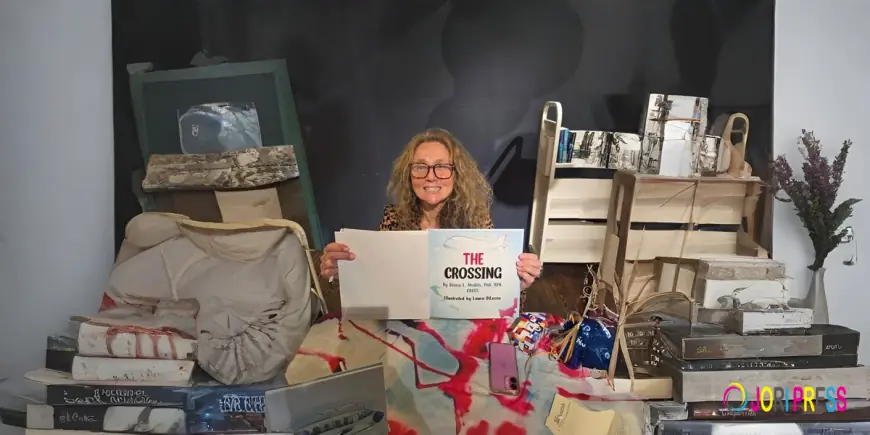
Diana L. Malkin’s “The Crossing” meets young readers where immigration actually begins, with hunger, fear, and the hope of being understood.
Children absorb the politics of a country long before they can parse its vocabulary. They hear how adults talk about outsiders, who is welcome, who is feared, who gets called a burden, and who is described as deserving. Yet the books written for them often evade those tensions or translate them into such generic moral language that nothing distinctly human remains. Diana L. Malkin’s The Crossing takes a more demanding route. It writes about immigration without turning immigrants into symbols.
That is harder than it sounds. Public narratives about migration tend to flatten. People become masses, crises, problems, heroes, and examples. Malkin resists all of that by focusing on four animal characters, each from a different country, each arriving in a new place for a different reason, and each carrying diabetes supplies along with private hopes and anxieties. The choice to use anthropomorphic animals is strategic. It gives young readers access to complex social realities without overwhelming them, while also preserving the singularity of each traveler’s emotional life.
The opening situation is elegantly chosen. The characters meet in an immigration line at an airport, tired and hungry after long journeys. Before any big concept appears, the book grounds its world in bodily states that a child can understand immediately. Exhaustion. Nervousness. Disorientation. Malkin knows that good children’s literature often begins not with abstract argument but with felt experience. By the time the book broadens into questions of why people leave home, readers are already emotionally inside the problem.
That emotional sequencing gives The Crossing much of its strength. The characters’ reasons for leaving are not identical. One wants to find family. One wants to marry their girlfriend. One wants to work to support relatives back home. One longs to find another like herself. There are also concerns about health and cost. This range matters. It tells children something profoundly true about migration, namely that it is almost never a one-note phenomenon. People leave because life presses on them from several directions at once.
The result is a book with real civic intelligence. Malkin does not frame movement as either tragic or glamorous. She frames it as human. There are losses. There are practical obstacles. There is hope. There is uncertainty. There is also a sharp awareness that crossing into a new place can intensify what is already difficult about living in one’s own body. Diabetes, in this context, becomes not just a medical condition but a way of showing how vulnerable travel can make anyone.
What makes the book particularly valuable at this cultural moment is its refusal to divide the world neatly into helpers and helped. The characters need one another. They also help one another. One notices symptoms. Another shares juice. They compare supplies and trade stories. That reciprocity is crucial. Too many books about social hardship present vulnerable people as passive recipients of adult benevolence. The Crossing imagines community as something built horizontally, through mutual recognition and practical care.
This is where Malkin’s professional background quietly enriches the fiction. As a diabetes educator and health professional, she seems to understand that people living under pressure often develop precise forms of knowledge about their own needs and each other’s. The book respects that kind of expertise. It suggests that solidarity begins
By the end, The Crossing leaves readers with a sturdier sense of what welcoming someone actually requires. Not slogans. Not sentiment alone. Food, patience, listening, practical help, and the willingness to see that every arrival contains an unseen backstory. That is a beautiful message for children, but it is also a serious corrective for adults.
Buy The Crossing if you want a children’s book that treats immigration with honesty, tenderness, and uncommon moral clarity, and that invites readers to replace easy politics with deeper attention.
What's Your Reaction?
 Like
0
Like
0
 Dislike
0
Dislike
0
 Love
0
Love
0
 Funny
0
Funny
0
 Angry
0
Angry
0
 Sad
0
Sad
0
 Wow
0
Wow
0