







































Stainless Steel Pipe: A Complete Guide to Grades, Applications, Benefits, and Selection
Explore this complete guide to stainless steel pipes, including grades, applications, key benefits, and expert tips for selecting the right pipe for your industrial needs.

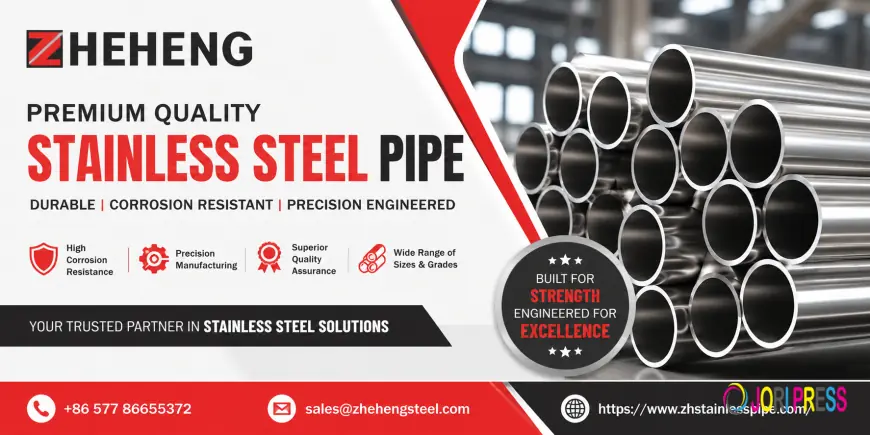
Stainless steel pipe is a widely used piping solution for industries that require durability, corrosion resistance, hygiene, and dependable performance. From chemical processing and food production to water treatment, construction, pharmaceuticals, and industrial manufacturing, stainless steel piping provides a strong combination of mechanical performance and long-term service life. Its chromium-rich composition enables the formation of a protective passive surface layer, helping the material resist corrosion in many environments.
What Is Stainless Steel Pipe?
A stainless steel pipe is a tubular product manufactured from corrosion-resistant stainless steel alloys. Depending on the application, pipes can be produced as seamless or welded products and supplied in different grades, diameters, wall thicknesses, schedules, finishes, and lengths.
Common stainless steel grades include 304, 304L, 316, and 316L. The appropriate grade depends on factors such as temperature, pressure, chemical exposure, fabrication requirements, and operating environment.
For industrial applications, standards are particularly important. ASTM A312, for example, covers seamless, straight-seam welded, and heavily cold-worked austenitic stainless steel pipe intended for high-temperature and general corrosive service.
Why Choose Stainless Steel Pipe?
Stainless steel piping is selected when ordinary materials may not provide the required combination of corrosion resistance, strength, cleanliness, and longevity.
Key Benefits
-
Excellent resistance to many forms of corrosion
-
Strong mechanical performance
-
Long service life with appropriate material selection
-
Good resistance to elevated and low temperatures
-
Smooth, cleanable surfaces for hygienic applications
-
Attractive appearance for visible installations
-
Suitable for demanding industrial environments
-
Available in seamless and welded configurations
-
Recyclable material with strong long-term value
A major advantage is versatility. The same broad family of stainless steels can be engineered for applications ranging from general service to demanding chemical and high-temperature environments.
Stainless Steel Pipe Grades
Selecting the correct grade is one of the most important decisions when specifying a stainless steel pipe.
304 Stainless Steel
304 is one of the most commonly selected austenitic stainless steel grades. It offers a useful balance of corrosion resistance, fabrication characteristics, availability, and cost. It is frequently considered for general industrial, food-processing, architectural, and water-related applications.
316 Stainless Steel
316 contains molybdenum, which can improve resistance to certain corrosive environments compared with 304. It is often considered where exposure to chlorides, chemicals, or more aggressive environments makes additional corrosion resistance desirable.
304L and 316L
The “L” grades have lower carbon content and are commonly selected where welding is an important part of fabrication. ASTM specifications include grades such as TP304, TP304L, TP316, and TP316L for stainless steel tubing and piping applications.
Seamless vs. Welded Stainless Steel Pipe
Choosing between seamless and welded construction depends on the application's pressure, dimensional, fabrication, and specification requirements.
|
Feature |
Seamless Pipe |
Welded Pipe |
|
Manufacturing |
Produced without a longitudinal weld seam |
Manufactured from stainless steel strip or plate with a welded joint |
|
Typical advantage |
Useful for applications requiring seamless construction |
Efficient and versatile for many industrial applications |
|
Dimensional options |
Available in many sizes and wall thicknesses |
Available across a broad range of dimensions |
|
Applications |
Pressure, high-temperature, and demanding services |
General industrial, process, structural, and fluid applications |
|
Selection factor |
Pressure, specification, and service conditions |
Specification, fabrication, cost, and service conditions |
ASTM A312 specifically recognizes both seamless and welded austenitic stainless steel pipe for high-temperature and general corrosive service.
Important Stainless Steel Pipe Specifications
Before purchasing stainless steel piping, buyers should evaluate more than just the material grade.
Consider These Specifications
-
Grade: Select 304, 304L, 316, 316L, or another alloy according to the environment.
-
Manufacturing type: Determine whether seamless or welded construction is appropriate.
-
Outside diameter: Confirm the required pipe dimensions.
-
Wall thickness: Match thickness to pressure, mechanical, and installation requirements.
-
Schedule: Choose the appropriate schedule or specified wall thickness.
-
Length: Confirm standard or project-specific lengths.
-
Surface finish: Select a finish suitable for appearance, cleaning, fabrication, or process requirements.
-
Applicable standard: Verify ASTM, ASME, EN, or another required specification.
-
Testing and certification: Request appropriate inspection documentation when required.
-
Application environment: Consider temperature, pressure, chemicals, chlorides, and flow conditions.
ASTM A269, for example, covers seamless and welded austenitic stainless steel tubing for general corrosion-resisting and low- or high-temperature service and includes requirements related to chemical composition, mechanical testing, and nondestructive or hydrostatic testing.
Applications of Stainless Steel Pipe
The versatility of stainless steel makes it suitable for a wide range of industries.
Common Applications
-
Chemical and petrochemical processing
-
Oil and gas systems
-
Food and beverage processing
-
Pharmaceutical manufacturing
-
Water and wastewater treatment
-
Heat exchangers and process equipment
-
Construction and architectural systems
-
Marine and coastal applications
-
Power generation
-
Industrial fluid transportation
In hygienic environments, stainless steel is particularly valuable because properly finished surfaces can be cleaned and maintained effectively.
How to Select the Right Stainless Steel Pipe
Choosing the right product should begin with the actual service conditions rather than simply selecting the cheapest available option.
A Practical Selection Process
Step 1: Identify the application. Determine what fluid, gas, or material will pass through the pipe.
Step 2: Assess the environment. Consider moisture, chemicals, chlorides, temperature, and external exposure.
Step 3: Determine pressure and temperature requirements. These parameters influence the required wall thickness, grade, and applicable standard.
Step 4: Select the material grade. Compare corrosion resistance, fabrication needs, and overall project requirements.
Step 5: Choose seamless or welded construction. Base the decision on the applicable engineering specification and service conditions.
Step 6: Verify dimensions and standards. Confirm diameter, wall thickness, schedule, length, and required certifications before placing an order.
Stainless Steel Pipe vs. Carbon Steel Pipe
|
Factor |
Stainless Steel |
Carbon Steel |
|
Corrosion resistance |
Generally higher |
Usually requires additional protection in corrosive environments |
|
Maintenance |
Often lower in suitable applications |
May require coatings or corrosion management |
|
Appearance |
Clean and attractive |
Industrial appearance |
|
Hygienic applications |
Widely used |
Less suitable for many hygienic requirements |
|
Initial material cost |
Typically higher |
Often lower |
|
Long-term suitability |
Excellent for many demanding environments |
Strong option where corrosion protection is manageable |
The best choice is not always the material with the lowest purchase price. Total lifecycle requirements, maintenance, operating conditions, and expected service life should be considered.
Frequently Asked Questions
1. What is stainless steel pipe used for?
Stainless steel pipe is used to transport liquids and gases and to build process, industrial, architectural, and mechanical systems where corrosion resistance and durability are important.
2. What is the most common stainless steel pipe grade?
304 is among the most commonly used grades because it provides a practical balance of corrosion resistance, fabrication performance, and cost.
3. Is 316 stainless steel better than 304?
Neither grade is universally “better.” 316 can provide improved resistance in certain corrosive environments, while 304 may be a more economical choice for many general applications.
4. What is the difference between seamless and welded pipe?
Seamless pipe is manufactured without a longitudinal weld seam, while welded pipe is produced by forming and joining stainless steel material. The correct option depends on the project specification and service conditions.
5. What does Schedule 40 mean?
Schedule 40 identifies a standardized pipe wall-thickness designation. The actual wall thickness varies with the pipe's nominal size.
6. Is stainless steel pipe suitable for high temperatures?
Certain stainless steel grades and pipe specifications are suitable for elevated-temperature service. The exact grade and specification should be selected according to the operating temperature and engineering requirements.
7. Can stainless steel pipe resist corrosion?
Yes. Stainless steel is designed to provide corrosion resistance, although performance depends on alloy grade, surface condition, temperature, chemicals, chlorides, and other environmental factors.
8. What standards are commonly associated with stainless steel pipe?
Common specifications include ASTM A312 for certain austenitic stainless steel pipes. Other specifications may apply depending on whether the product is pipe, tubing, or intended for a specialized application.
9. How do I choose between 304 and 316?
Evaluate the chemical environment, chloride exposure, temperature, fabrication requirements, required corrosion resistance, and project budget. When conditions are demanding, engineering specifications should guide the final selection.
10. What should I ask a stainless steel pipe supplier?
Ask about material grade, dimensions, manufacturing method, applicable standards, surface finish, testing, certifications, availability, packaging, and whether the product matches your project's technical requirements.
Conclusion
Stainless steel pipe remains an important solution for industrial and commercial piping because it combines corrosion resistance, strength, durability, versatility, and clean appearance. However, selecting the right pipe requires careful consideration of grade, dimensions, schedule, manufacturing method, standards, operating conditions, and required testing. A properly specified product can help improve system reliability and reduce long-term maintenance concerns.
For dependable stainless steel piping solutions tailored to your application, connect with ZhstainLessPipe today. Share your required grade, size, schedule, quantity, and application with the team to receive suitable product guidance and move your project forward with confidence.
? - +86 577 86655372
What's Your Reaction?
 Like
0
Like
0
 Dislike
0
Dislike
0
 Love
0
Love
0
 Funny
0
Funny
0
 Angry
0
Angry
0
 Sad
0
Sad
0
 Wow
0
Wow
0