









































SAP BRIM Training: A Complete Guide to Subscription Billing
Learn SAP BRIM Training to build skills in subscription billing, revenue management, and business process automation with practical, industry-focused learning.

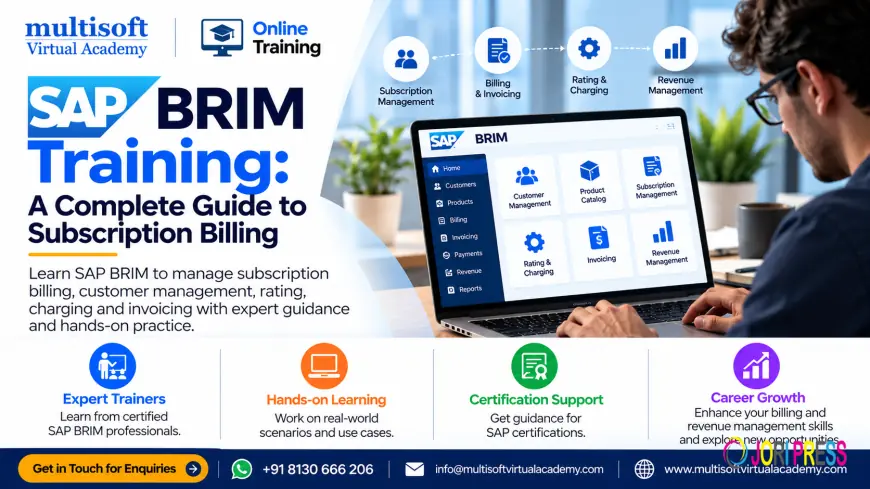
Modern businesses increasingly rely on subscription services, digital products, recurring payments, and consumption-based pricing. These business models require efficient systems to manage customer contracts, usage data, billing cycles, invoicing, and financial transactions. Traditional billing approaches may become difficult to manage when organizations handle millions of customers and large volumes of transactions. SAP Billing and Revenue Innovation Management (BRIM) helps businesses manage these complex processes through an integrated solution.
SAP BRIM Training helps professionals understand how subscription-based and usage-based business models operate within the SAP environment. It introduces important processes such as subscription order management, pricing, charging, invoicing, and contract accounting. For consultants, business analysts, finance professionals, and SAP specialists, developing knowledge of BRIM can support work on billing transformation and revenue management projects.
What Is SAP BRIM?
SAP BRIM Training stands for SAP Billing and Revenue Innovation Management. It is designed to support complex billing requirements, particularly for businesses operating with subscriptions, recurring charges, and usage-based services.
The solution helps organizations manage business processes across the revenue lifecycle, from subscription products and customer orders to charging, billing, invoicing, and financial processing. Its capabilities can support businesses that need to manage high transaction volumes and flexible commercial models.
SAP BRIM is relevant to industries such as telecommunications, utilities, software services, digital media, transportation, and other businesses offering recurring or consumption-based services.
For example, a telecommunications provider may charge customers a monthly subscription fee while also billing them for additional data usage. A software company may offer several subscription plans with different features, billing periods, and usage limits. SAP BRIM supports the underlying processes needed to manage these types of business arrangements.
Why Is SAP BRIM Training Important?
Organizations need professionals who understand both billing technology and the business processes behind recurring revenue. Training can help learners connect SAP BRIM components and understand how information moves through the billing lifecycle.
1. Understand Subscription-Based Business Models
Subscription businesses must manage recurring payments, contract changes, product bundles, renewals, and customer account information. SAP BRIM training introduces learners to these concepts and explains how subscription-related processes can be managed within an SAP environment.
2. Learn Usage-Based Billing
Usage-based billing calculates charges according to how customers consume a service. Examples include mobile data usage, cloud computing consumption, and pay-per-use services.
Training helps learners understand the relationship between consumption records, pricing rules, charging processes, and billing outcomes.
3. Improve Billing Process Knowledge
Complex billing environments require accurate information and coordinated processing. Learning SAP BRIM can help professionals understand how billing items are created, processed, invoiced, and connected with financial records.
4. Develop SAP Implementation Skills
SAP BRIM implementation projects involve business requirements, system configuration, integration, testing, and process validation. A structured learning program can provide a foundation for understanding these activities and the responsibilities of different project roles.
Key Components Covered in SAP BRIM Training
A comprehensive SAP BRIM Training Course should explain the major solution components and how they work together. The exact scope may vary according to the SAP deployment model and the course syllabus.
SAP Subscription Order Management (SOM)
Subscription Order Management supports subscription-related commercial processes, including product modeling, order capture, subscription contracts, and contract changes.
During training, learners may explore:
- Subscription products and product bundles
- Product catalog management
- Subscription order creation
- Subscription contracts
- Contract amendments and changes
- Master agreements and partner agreements
- Order processing and lifecycle management
Understanding SOM is useful for professionals involved in customer onboarding, subscription operations, and order management.
SAP Convergent Mediation
Convergent Mediation supports the collection and processing of usage-related information before it enters subsequent charging and billing processes.
Training may introduce the role of consumption data, mediation workflows, data validation, and the movement of usage information between systems.
This knowledge is especially relevant to businesses that generate large volumes of usage records from different applications, networks, or service platforms.
SAP Convergent Charging
Convergent Charging handles pricing, rating, and charging processes for supported subscription and consumption-based business models.
For example, a service provider may charge a fixed monthly amount while applying separate rates to additional usage. The charging process determines the applicable charges according to configured pricing rules and relevant consumption information.
Important learning areas may include:
- Subscriber accounts and provider contracts
- Pricing and rating concepts
- Charge plans and charging plans
- Usage-based charging
- Allowances and consumption limits
- Recurring and one-time charges
- Charging process execution
- Integration with related BRIM components
These concepts help learners understand how commercial pricing rules are translated into charge calculations.
SAP Convergent Invoicing
Convergent Invoicing brings billable information together for billing and invoicing activities. It helps manage billing processes involving recurring charges, usage-based items, and other relevant transactions.
A practical course may cover:
- Billable items and consumption items
- Billing plans
- Billing process execution
- Invoice creation
- Billing requests and corrections
- Discounts and additional charges
- Partner and intercompany settlement
- Integration with contract accounting
Understanding Convergent Invoicing helps learners follow the movement of billable information through the invoicing process.
Contract Accounts Receivable and Payable (FI-CA)
FI-CA is an important financial component in the BRIM landscape. It supports high-volume contract accounting activities, including payment processing, open-item management, collections, and financial integration.
Training may include contract accounts, business partners, incoming payments, outstanding receivables, dunning, clearing, and reconciliation.
Professionals with a background in SAP Finance may find this area particularly relevant because it connects operational billing processes with financial activities.
Understanding the SAP BRIM End-to-End Process
One of the most valuable aspects of SAP BRIM training is learning how individual components support the overall business process.
Consider a company that offers a monthly digital service subscription with additional charges based on customer usage.
Step 1: Product and subscription setup
The company defines its subscription products, pricing options, and commercial conditions. Subscription Order Management supports the relevant order and contract processes.
Step 2: Subscription order processing
A customer selects a subscription plan and completes the ordering process. The relevant customer, product, and contract information is maintained within the applicable system landscape.
Step 3: Usage data processing
If the subscription includes usage-based charges, consumption information may be collected and processed through the appropriate mediation workflow.
Step 4: Rating and charging
Convergent Charging applies the relevant pricing rules to supported usage records and calculates applicable charges.
Step 5: Billing and invoicing
Billable information is processed through Convergent Invoicing to generate the relevant billing and invoice documents.
Step 6: Financial processing
Contract accounting supports activities such as payment handling, open-item management, collections, and related financial processing.
The actual implementation depends on the organization's architecture, configured components, and business requirements. Learning this end-to-end process helps professionals understand how subscription operations, charging, invoicing, and finance are connected.
SAP BRIM Implementation: Skills Professionals Should Develop
SAP BRIM implementation involves more than learning individual transactions or application screens. Project teams must translate business requirements into workable processes and ensure that the solution supports the organization's commercial and financial needs.
Professionals preparing for implementation-related responsibilities should develop knowledge in several areas.
Business Requirement Analysis
Consultants must understand how the organization manages subscriptions, usage charges, billing cycles, customer accounts, and payment processes. Clear requirements help define the appropriate solution design.
Solution Configuration
Configuration activities depend on the selected components and project scope. Learners should understand how business requirements relate to product modeling, charging rules, billing processes, and financial settings.
System Integration
SAP BRIM environments may integrate with SAP S/4HANA and other applications involved in customer management, product information, usage collection, and financial processing.
Understanding integration points helps professionals investigate data flows and identify dependencies between systems.
Testing and Troubleshooting
Implementation teams need to validate business scenarios before deployment. Testing may include subscription creation, contract changes, usage rating, invoice generation, payment processing, and exception handling.
A structured testing approach helps identify incorrect configurations, incomplete data, and integration issues.
Data Migration and Reconciliation
Organizations moving from existing billing platforms must consider customer information, contracts, open transactions, and historical data requirements. Data migration and reconciliation require careful planning and validation.
Training can provide a conceptual foundation, although project-specific implementation experience is essential for handling complex migration scenarios.
Industries That Can Benefit from SAP BRIM
SAP BRIM can be relevant to organizations with complex subscription, recurring billing, or usage-based revenue requirements.
Telecommunications: Mobile operators and communication providers may manage subscriptions, usage charges, recurring plans, and additional services.
Software and cloud services: Providers may use subscription models with different service tiers, billing periods, and consumption-based pricing.
Utilities: Certain utility businesses need to manage recurring services, consumption information, billing, and customer payments.
Digital media: Streaming and digital content providers may offer recurring subscriptions and different commercial packages.
Transportation and mobility: Service providers may use recurring fees, usage-based charges, or combinations of both, depending on their business models.
Technology and high-volume service businesses: Organizations handling large transaction volumes may need integrated processes for pricing, billing, invoicing, and financial management.
The relevance of SAP BRIM depends on each organization's commercial model, technical architecture, and implementation requirements.
Who Should Enroll in SAP BRIM Training?
SAP BRIM training may benefit professionals who want to understand subscription billing and revenue management processes.
- SAP functional consultants: Professionals looking to expand their knowledge of billing and subscription management.
- SAP Finance consultants: Learners interested in contract accounting, payments, receivables, and financial integration.
- SAP CRM and order management professionals: Specialists seeking to understand subscription order processing and contract management.
- Business analysts: Professionals responsible for gathering requirements and documenting billing workflows.
- Application support professionals: Team members who help maintain billing systems and investigate operational issues.
- Project managers and team leads: Professionals who need a broader understanding of BRIM components and implementation dependencies.
- Experienced finance and billing professionals: Individuals seeking to understand how SAP supports complex recurring revenue processes.
Basic knowledge of SAP business processes, finance, order management, or billing can be helpful. Learners should review the prerequisites of their chosen course before enrolling.
Career Opportunities After SAP BRIM Training
SAP BRIM knowledge may complement career paths involving SAP consulting, subscription management, billing operations, and financial process transformation.
Potential roles include:
- SAP BRIM Functional Consultant
- SAP Subscription Order Management Consultant
- SAP Convergent Charging Consultant
- SAP Convergent Invoicing Consultant
- SAP FI-CA Consultant
- SAP Billing Business Analyst
- SAP Application Support Consultant
- SAP BRIM Implementation Consultant
The availability of these roles depends on employer requirements, project demand, technical knowledge, and professional experience. Completing a course does not guarantee employment, but structured learning and practical exercises can help candidates prepare for relevant responsibilities.
How to Choose the Right SAP BRIM Training Course
Before selecting an SAP BRIM Online Training program, evaluate its curriculum, teaching approach, and practical coverage.
Review the syllabus: Check whether the course covers the components relevant to your goals, such as SOM, Convergent Charging, Convergent Invoicing, and FI-CA.
Look for practical exercises: Guided scenarios can help explain how subscription orders, usage records, charges, invoices, and financial transactions interact.
Check trainer expertise: Choose a program led by instructors with relevant SAP knowledge and the ability to explain business processes clearly.
Confirm the software environment: Ask which SAP version and deployment model the training covers, and whether access to a practice system is included.
Understand the learning format: Compare live instructor-led classes, self-paced resources, and one-to-one sessions according to your schedule and learning preferences.
Clarify certification details: Verify whether the program provides a course-completion certificate or prepares learners for a separate SAP certification examination. These are not necessarily the same.
Frequently Asked Questions
What is SAP BRIM Training?
SAP BRIM Training introduces learners to SAP Billing and Revenue Innovation Management, including subscription order management, usage-based charging, invoicing, and contract accounting.
Is SAP BRIM difficult to learn?
The difficulty depends on your existing SAP knowledge and understanding of billing processes. Beginners may benefit from learning basic SAP concepts and subscription billing terminology before studying advanced configuration and integration.
What are the main SAP BRIM components?
Key learning areas include Subscription Order Management, Convergent Mediation, Convergent Charging, Convergent Invoicing, and Contract Accounts Receivable and Payable. The components used depend on the solution architecture.
Is SAP BRIM relevant to SAP S/4HANA?
Yes. SAP documents BRIM capabilities and integration scenarios for SAP S/4HANA. Learners should check which deployment model and software release their course addresses.
Can SAP BRIM training help with implementation projects?
Training can establish foundational knowledge of BRIM processes and components. Real implementation work also requires practical system experience, requirement analysis, configuration knowledge, integration understanding, and testing skills.
Conclusion
SAP BRIM supports businesses that need to manage subscription services, recurring revenue, usage-based pricing, billing, invoicing, and related financial processes. Developing knowledge of Subscription Order Management, Convergent Charging, Convergent Invoicing, FI-CA, and SAP BRIM implementation workflows can help professionals build a stronger understanding of modern billing systems. The right learning program should combine clear explanations with practical examples and coverage aligned with current business requirements. Multisoft Virtual Academy provides SAP BRIM Training for professionals seeking to strengthen their understanding of subscription billing, revenue management, and SAP business processes through structured learning.
What's Your Reaction?
 Like
0
 Dislike
0
 Love
0
 Funny
0
 Angry
0
 Sad
0
 Wow
0