






























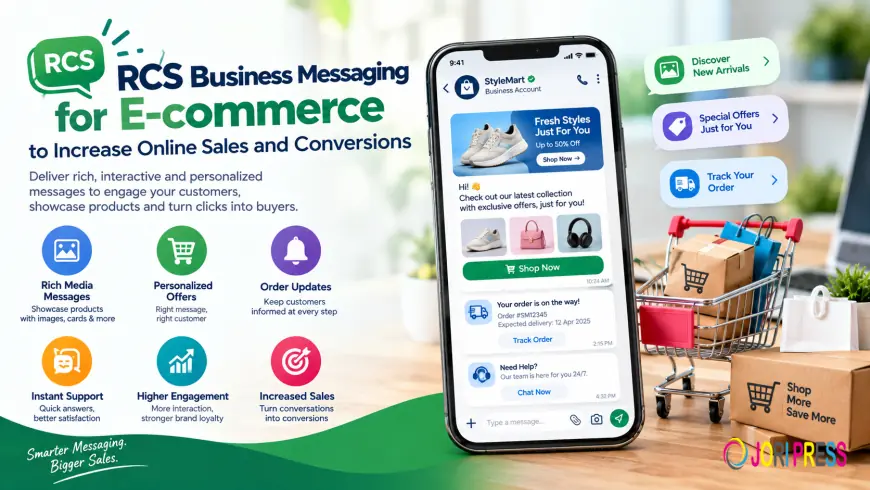
RCS Business Messaging for E-commerce to Increase Online Sales and Conversions
Online shoppers have plenty of choices today. They can compare products, check prices, read reviews, and move between different online stores within minutes.

Introduction
Online shoppers have plenty of choices today. They can compare products, check prices, read reviews, and move between different online stores within minutes. For e-commerce businesses, attracting visitors is only one part of the challenge. The real goal is to help customers discover suitable products, feel confident about their purchases, and complete the checkout process.
This is where RCS Business Messaging for E-commerce can play a useful role. Rich Communication Services, commonly known as RCS, allows compatible messaging experiences to include features such as images, branding, suggested actions, and interactive elements. When available on a customer's device and supported by the messaging provider, these features can make business communication more engaging than a basic text message.
For online retailers looking to improve their customer communication strategy, RCS Brand Rise can be considered as part of an approach focused on interactive messaging and e-commerce engagement.
Why E-commerce Businesses Need Better Customer Communication
A customer may visit an online store, browse several products, and leave without making a purchase. Sometimes the reason is simple: the shopper needs more information, wants to compare options, or is waiting for a suitable offer. In other cases, the checkout process may feel complicated or the customer may become distracted.
Traditional promotional messages can communicate a discount or product announcement, but they may offer limited opportunities for visual product discovery. RCS can provide a richer format when supported, helping brands combine useful information with product images and clear actions.
With RCS E-commerce Marketing, businesses can plan messages around the customer journey instead of relying only on general promotional announcements. A campaign might introduce a new collection, highlight relevant products, or guide customers towards a specific category on the online store.
The objective is not simply to send more messages. It is to make each interaction relevant and give customers a convenient next step.
Using Rich Media to Make Product Promotions More Engaging
Product presentation plays an important role in online shopping. Customers often want to see what an item looks like, understand its main features, and compare it with alternatives before placing an order.
RCS messages can support visual promotions through product images, brand elements, concise descriptions, and suggested actions, depending on device and platform support. For example, a fashion retailer could showcase items from a seasonal collection, while an electronics store could highlight selected products and direct shoppers to detailed specifications.
This approach to RCS Business Messaging for E-commerce can help shorten the path between discovering a product and exploring it on the retailer's website. The message should focus on a small selection of relevant items rather than overwhelming customers with too much information.
Every promotion should also lead to a useful destination. A product card should direct shoppers to the correct product page, while a category promotion should open the relevant collection.
Reducing Friction in the Buying Journey
Even interested shoppers may abandon a purchase if the path to checkout is unclear. They might need to confirm product details, review a promotion, or return to their cart after getting distracted.
E-commerce businesses can use RCS campaigns to direct customers to relevant pages and make the next step easier to understand. A message promoting a collection might include a clear action to explore products. A promotional campaign could direct shoppers to a page where the offer terms and eligible items are explained.
RCS Messaging Services for E-commerce may help businesses explore these communication workflows, depending on the provider's available features and the retailer's technical setup. However, messaging alone cannot solve every checkout issue. Website speed, payment options, delivery costs, product availability, and mobile usability remain important factors in conversion performance.
For that reason, RCS should complement improvements to the online store rather than replace them.
Personalised Promotions That Match Customer Interests
Customers are more likely to find a message useful when it relates to their interests. A shopper who regularly explores skincare products may not need the same promotions as someone who buys home appliances. Relevant segmentation can help businesses organise their campaigns around product categories, past purchases, or preferences shared by customers.
Through RCS E-commerce Marketing, brands can consider sending different campaigns to appropriate audience groups. A returning customer might receive information about a related product category, while a new subscriber could receive an introduction to the brand's popular collections.
Personalisation should be based on appropriate data use and valid permissions. Businesses should avoid making intrusive assumptions and should provide clear options for managing promotional communication.
Understanding the Role of RCS API for E-commerce
Businesses that want to incorporate messaging into their existing operations may explore an RCS API for E-commerce. Depending on the provider and implementation, API integration may allow messaging workflows to connect with e-commerce platforms, customer databases, or campaign management systems.
For example, an online retailer may want to coordinate promotional campaigns with product availability or customer segments. Before selecting an integration, the business should confirm the available API features, supported devices and networks, message approval requirements, reporting options, and fallback arrangements for customers who cannot receive RCS messages.
The actual functionality depends on the chosen solution, so businesses should verify technical capabilities before building their marketing process around them.
Measuring Sales and Conversion Performance
An e-commerce campaign should be measured against clear business objectives. Retailers can track clicks, product-page visits, add-to-cart activity, completed purchases, and revenue attributed to campaign links where suitable tracking is available.
Comparing campaign results with other messaging or marketing channels can help businesses understand whether RCS is contributing to their goals. A message delivery or click does not automatically translate into a sale, so it is important to examine the complete customer journey.
RCS Brand Rise can be considered by businesses evaluating messaging-based marketing opportunities and looking to understand how interactive communication may fit into their wider e-commerce strategy.
Conclusion
Increasing online sales requires a combination of relevant promotions, clear product information, a smooth shopping experience, and consistent customer communication. RCS Business Messaging for E-commerce gives businesses another way to present products visually, direct shoppers to useful pages, and create interactive mobile messaging experiences where supported.
By exploring RCS Messaging Services for E-commerce online retailers can evaluate whether rich messaging fits their audience and business objectives. With a clear strategy and performance tracking, RCS Brand Rise can be part of a broader effort to improve customer engagement and support online conversions.
What's Your Reaction?
 Like
0
Like
0
 Dislike
0
Dislike
0
 Love
0
Love
0
 Funny
0
Funny
0
 Angry
0
Angry
0
 Sad
0
Sad
0
 Wow
0
Wow
0