








































Purified Isophthalic Acid Market: Growth Trajectory, Sustainability Trends, and Strategic Outlook Through 2034
Purified isophthalic acid market is poised for steady expansion through 2034, driven by sustainable packaging demand, automotive lightweighting, and global industrial growth

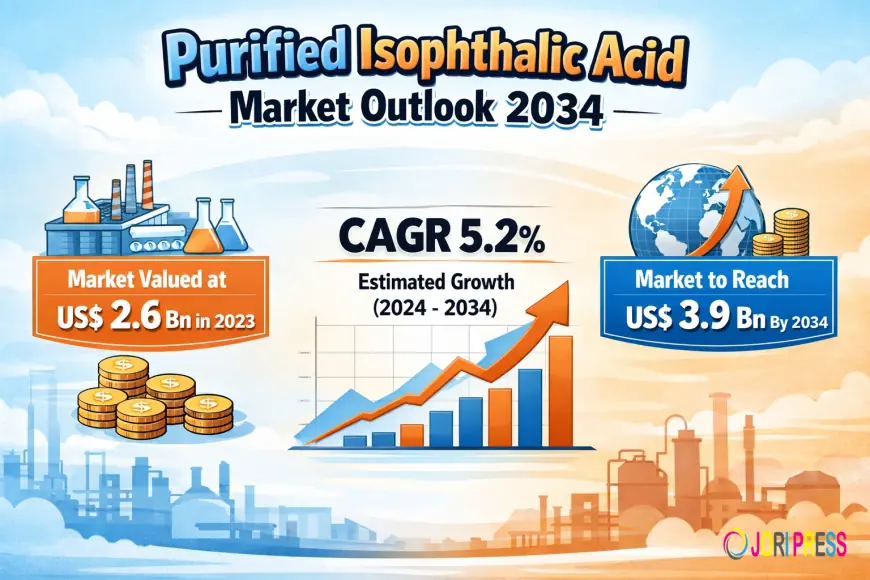
The global purified isophthalic acid (PIA) market is entering a transformative decade marked by sustainability-driven innovation, expanding end-use industries, and technological advancements in polymer chemistry. Valued at US$ 2.6 billion in 2023, the market is projected to reach US$ 3.9 billion by 2034, growing at a steady CAGR of 5.2% from 2024 to 2034. As industries seek stronger, lighter, and more environmentally responsible materials, purified isophthalic acid has emerged as a critical building block in high-performance polymers, especially polyethylene terephthalate (PET) resins.
From packaging and automotive components to textiles and construction materials, PIA plays an increasingly important role in shaping modern material solutions. The market’s evolution reflects a broader global shift toward circular economy practices, lightweight engineering, and regulatory compliance in environmental performance.
Understanding Purified Isophthalic Acid and Its Industrial Importance
Purified isophthalic acid is a high-purity aromatic dicarboxylic acid derived from the oxidation of meta-xylene. Its chemical structure enhances the thermal stability, chemical resistance, and mechanical strength of polymers when used as a co-monomer. These performance attributes make PIA indispensable in the manufacturing of polyethylene terephthalate (PET), unsaturated polyester resins (UPR), alkyd resins, powder coatings, plasticizers, and specialty lubricants.
Among its applications, PET production dominates the market, accounting for approximately 54.5% of total PIA consumption globally. By modifying PET with PIA, manufacturers achieve improved clarity, durability, and heat resistance, which are essential in beverage bottles, food containers, films, and textile fibers.
The ability of PIA to enhance performance characteristics without significantly increasing production costs makes it a strategic additive in polymer engineering.
Market Size, Forecast, and Growth Dynamics
The purified isophthalic acid market’s growth trajectory is strongly linked to the expansion of packaging, automotive, and construction industries. Rising consumer demand for packaged food and beverages, particularly in emerging economies, continues to drive PET resin production. Meanwhile, global efforts to reduce vehicle weight and emissions are accelerating the use of high-performance plastics in automotive manufacturing.
Between 2024 and 2034, consistent expansion in sustainable packaging solutions, growth in electric vehicles (EVs), and increased infrastructure development are expected to sustain demand for PIA-based materials. The 5.2% CAGR reflects stable long-term growth rather than volatile spikes, indicating a mature yet innovation-driven industry.
Rising Demand for Sustainable Packaging Solutions
Sustainability has become one of the most powerful forces influencing the purified isophthalic acid market. PET remains one of the most recyclable plastics globally, and its compatibility with circular economy models has strengthened its appeal. PIA-enhanced PET resins contribute to durable, lightweight, and recyclable packaging solutions.
Governments across Europe and North America have introduced strict regulations aimed at reducing plastic waste and promoting recycling. Corporate sustainability commitments and global initiatives encouraging recyclable packaging have increased demand for recycled PET (rPET). As recycling infrastructure improves, manufacturers require high-quality PIA to maintain polymer integrity during repeated processing cycles.
The shift toward environmentally sound packaging is particularly evident in food and beverage sectors, where PET bottles dominate due to clarity, strength, and barrier properties. As consumer awareness grows, brands are under pressure to adopt recyclable and sustainable materials, further supporting PIA demand.
Automotive Industry: Lightweighting and Performance Enhancement
The automotive sector represents one of the most dynamic growth avenues for PIA. Together with construction, it accounts for approximately 34.5% of the total purified isophthalic acid market share.
Automakers are increasingly using high-performance thermoplastics to reduce vehicle weight and improve fuel efficiency. Lightweight materials contribute directly to lower carbon emissions and improved battery performance in electric vehicles. PIA-modified polyester resins are used in interior panels, under-the-hood components, structural reinforcements, and coatings due to their enhanced durability and thermal stability.
Global emission regulations are pushing manufacturers toward lighter alternatives to metal components. As vehicles become more technologically advanced, incorporating electronics and complex assemblies, materials that provide dimensional stability and resistance to heat and chemicals are essential. PIA-based polymers meet these performance demands effectively.
Expanding Construction and Infrastructure Applications
Infrastructure modernization and rapid urbanization in emerging markets are driving demand for durable construction materials. PIA contributes to improved mechanical strength and weather resistance in coatings, insulation materials, and piping systems.
In construction, unsaturated polyester resins and alkyd resins modified with PIA are widely used in protective coatings, architectural finishes, and composite materials. As governments invest in sustainable and long-lasting infrastructure, materials capable of resisting corrosion, chemical exposure, and environmental degradation are increasingly preferred.
The construction industry’s shift toward green building standards and energy-efficient designs further supports demand for advanced polymer systems enhanced by purified isophthalic acid.
Textile and Fiber Industry Applications
Beyond packaging and automotive sectors, the textile industry remains a significant consumer of PET-based fibers. PIA improves flexibility, strength, and resilience in polyester fibers used in apparel, industrial fabrics, and home textiles.
The rise of performance textiles, including moisture-wicking sportswear and durable industrial fabrics, has contributed to steady PET demand. As fashion brands integrate sustainability into supply chains, recycled polyester fibers are gaining popularity, indirectly supporting PIA consumption.
Regional Market Insights
Asia Pacific: Market Leader
Asia Pacific holds the dominant share of the global purified isophthalic acid market, accounting for 47.9% of total revenue. The region’s leadership is driven by strong PET production capacity, expanding packaging industries, and rapid industrialization.
China and India serve as major manufacturing hubs for PET resins and polyester fibers. The growing middle-class population, rising disposable incomes, and increasing urbanization have significantly boosted demand for packaged goods and consumer products. Additionally, the presence of integrated chemical production facilities ensures cost-efficient supply chains.
Europe: Sustainability-Centric Growth
Europe accounts for 20.6% of the global market share, supported by stringent environmental regulations and a strong push toward circular economy practices. Recycling mandates and packaging directives have encouraged the use of rPET, thereby increasing the need for high-quality PIA in recycled resin formulations.
European manufacturers emphasize low-emission production processes and sustainable raw materials, influencing technological innovation in PIA manufacturing.
North America: Stable Industrial Demand
North America holds 19.7% of the market, with steady demand from automotive, construction, and packaging sectors. Investments in infrastructure development and the growth of electric vehicle manufacturing are expected to provide incremental growth opportunities over the forecast period.
Latin America and Middle East & Africa
Latin America (5.9%) and the Middle East & Africa (5.8%) represent emerging markets with moderate yet promising growth potential. Increasing industrialization, urban development, and consumer goods manufacturing are gradually strengthening demand for PET-based products in these regions.
Competitive Landscape and Key Players
The purified isophthalic acid market features a moderately consolidated competitive landscape, with established chemical manufacturers dominating production capacities. Key players include:
-
LOTTE Chemical Corporation
-
Eastman Chemical Company
-
Mitsubishi Gas Chemical Company, Inc.
-
Merck KGaA
-
Formosa Chemicals & Fibre Corp.
-
Thermo Fisher Scientific Inc.
-
International Chemical Co. (ICC)
-
The Chemical Company
These companies focus on expanding production capacity, improving product purity, and developing environmentally friendly manufacturing processes. Strategic mergers, acquisitions, and partnerships are common as firms seek to strengthen supply chains and expand geographic reach.
Sustainability investments, including energy-efficient oxidation processes and waste minimization techniques, are becoming central to competitive differentiation.
Market Challenges
Despite positive growth prospects, the purified isophthalic acid market faces several challenges:
-
Raw Material Price Volatility: Fluctuations in meta-xylene prices can directly impact production costs.
-
Regulatory Compliance Costs: Environmental regulations may require capital-intensive upgrades to production facilities.
-
Competition from Alternative Materials: Bioplastics and alternative polymer technologies could pose long-term substitution risks.
-
Recycling Infrastructure Gaps: Inadequate recycling systems in certain regions limit rPET growth potential.
Manufacturers must adopt cost-efficient processes and invest in R&D to mitigate these risks.
Technological Advancements and Innovation Trends
Innovation remains a key growth driver in the PIA market. Advances in catalyst efficiency, process optimization, and emission control technologies are improving yield and reducing environmental impact.
Research into bio-based feedstocks and greener oxidation methods may further enhance sustainability profiles. Additionally, digitalization in chemical manufacturing—such as predictive maintenance and real-time process monitoring—is enhancing operational efficiency.
As sustainability reporting becomes mandatory for many corporations, traceable and low-carbon production methods are likely to gain competitive advantage.
Strategic Outlook Through 2034
Looking ahead, the purified isophthalic acid market is expected to experience steady and balanced growth. Packaging will remain the dominant end-use segment, while automotive lightweighting and infrastructure expansion provide additional momentum.
Asia Pacific will continue to lead in production and consumption, but Europe’s sustainability policies and North America’s industrial expansion will also contribute to growth. Emerging markets are likely to increase their share as urbanization accelerates.
The increasing integration of recycling systems and circular economy initiatives will shape long-term demand patterns. Collaboration between resin manufacturers, recyclers, and brand owners will be critical in maintaining supply stability and achieving sustainability targets.
Overall, purified isophthalic acid stands at the intersection of performance enhancement and environmental responsibility—two defining characteristics of modern industrial materials.
What's Your Reaction?
 Like
0
Like
0
 Dislike
0
Dislike
0
 Love
0
Love
0
 Funny
0
Funny
0
 Angry
0
Angry
0
 Sad
0
Sad
0
 Wow
0
Wow
0