





































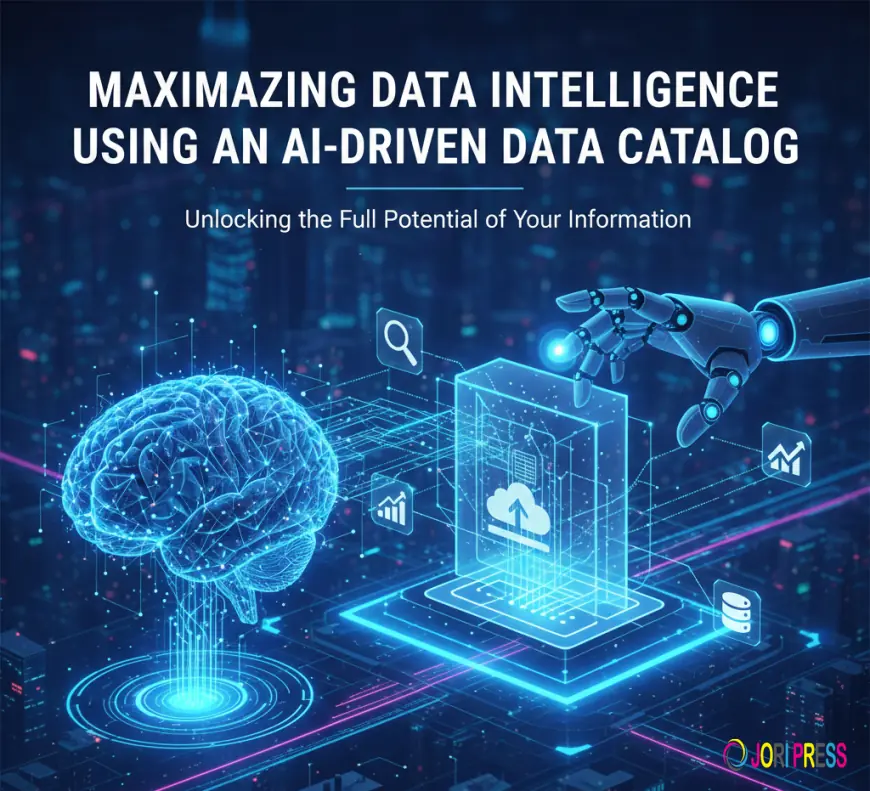
Maximizing Data Intelligence Using an AI-Driven Data Catalog
Discover how an AI-driven data catalog automates data discovery, classification, and governance to deliver faster, smarter, and trusted analytics insights.

Introduction
In today’s data-centric world, businesses are inundated with massive volumes of information. From customer interactions and operational metrics to market trends and transactional data, the challenge is no longer access to data—it is organizing, managing, and deriving meaningful insights from it. An AI-driven data catalog emerges as a powerful solution, enabling organizations to discover, understand, and govern their data efficiently.
An AI-driven data catalog acts as a centralized repository that provides a comprehensive view of all enterprise data assets. By leveraging artificial intelligence, it automates data classification, enhances metadata management, and simplifies data discovery, ensuring that data is not only accessible but also actionable. Businesses adopting this approach can accelerate decision-making, strengthen governance, and foster a culture of data-driven innovation.
Transforming Data Discovery
A critical challenge organizations face is locating the right data at the right time. Traditional manual methods of data discovery are slow, prone to errors, and often fail to provide a complete view. An AI-driven data catalog addresses these limitations by automatically indexing and tagging data from multiple sources.
Through machine learning algorithms, the platform identifies relationships between datasets, surfaces relevant data assets, and suggests connections that might otherwise be overlooked. Analysts and business users can quickly locate the data they need, reducing time spent searching and increasing productivity. By simplifying data discovery, an AI-driven data catalog ensures that insights are accessible to decision-makers across the organization.
Enhancing Data Governance and Compliance
Data governance is no longer optional—it is a strategic imperative. Organizations must ensure that data is accurate, secure, and compliant with regulatory requirements. An AI-driven data catalog provides automated tools for data governance, helping organizations manage data quality, track lineage, and enforce policies.
AI algorithms continuously monitor data usage and detect anomalies, ensuring that sensitive information is handled correctly. Regulatory compliance becomes more straightforward as the catalog maintains detailed metadata and audit trails, giving organizations confidence in their data management practices. This level of governance not only reduces risks but also strengthens trust in data-driven decisions.
Driving Operational Efficiency
Operational efficiency is another significant benefit of an AI-driven data catalog. By centralizing data assets and providing a single source of truth, organizations can eliminate redundancies, improve collaboration, and streamline workflows. Teams across departments gain a shared understanding of available data, which reduces duplication of effort and ensures consistency in reporting.
For example, marketing teams can access customer insights without waiting for IT support, while data scientists can quickly identify relevant datasets for advanced analytics projects. This democratization of data empowers employees to make faster, informed decisions, ultimately driving overall business efficiency.
Empowering Data-Driven Decision Making
In an era where competitive advantage is driven by insights, organizations must leverage data effectively. An AI-driven data catalog enables this by connecting users to trusted, high-quality data. Advanced search capabilities and intelligent recommendations ensure that decision-makers can find the most relevant datasets for analysis.
Machine learning enhances these capabilities by continuously learning from user interactions, suggesting related datasets, and uncovering hidden patterns. By providing access to accurate and comprehensive data, the catalog supports predictive analytics, reporting, and strategic planning, giving organizations a clear edge in data-driven decision-making.
Supporting Innovation and Analytics
Innovation thrives on data, and an AI-driven data catalog accelerates analytics initiatives. Data scientists and business analysts can explore datasets, uncover correlations, and test hypotheses more effectively. By reducing the time spent on data preparation and discovery, the platform allows professionals to focus on high-value analytical work.
Moreover, AI-driven insights help organizations anticipate trends and market shifts. By combining structured and unstructured data, the catalog supports complex analytics projects, from customer behavior modeling to operational optimization. This proactive approach fosters innovation and enables organizations to stay ahead in competitive markets.
Choosing the Right AI-Driven Data Catalog
Selecting the right AI-driven data catalog requires careful evaluation of several factors. Scalability is crucial to handle growing data volumes, while integration capabilities ensure seamless connectivity with existing data sources and systems. User experience is another key consideration; intuitive interfaces and advanced search features enhance adoption across the organization.
Security and compliance capabilities must be prioritized, ensuring sensitive data is protected and regulatory requirements are met. Organizations should also evaluate the quality of AI algorithms, as intelligent recommendations and automated metadata management are core differentiators. Investing in the right AI-driven data catalog is a strategic decision that can transform data management practices and drive measurable business outcomes.
Conclusion
An AI-driven data catalog is more than a technological tool—it is a strategic enabler for modern organizations. By improving data discovery, enhancing governance, streamlining operations, and supporting advanced analytics, it empowers businesses to extract maximum value from their data.
Organizations that embrace an AI-driven data catalog cultivate a culture of data-driven decision-making, reduce operational inefficiencies, and accelerate innovation. In a world where data is the foundation of business success, the ability to organize, access, and leverage information intelligently is the ultimate competitive advantage.
What's Your Reaction?
 Like
0
Like
0
 Dislike
0
Dislike
0
 Love
0
Love
0
 Funny
0
Funny
0
 Angry
0
Angry
0
 Sad
0
Sad
0
 Wow
0
Wow
0