

































Is Operation Theatre Technician (D.AOTT) a Good Career?
Is Operation Theatre Technician (D.AOTT) a Good Career?
1. What is Diploma in Anaesthesia and Operation Theatre Technology (D.AOTT)?
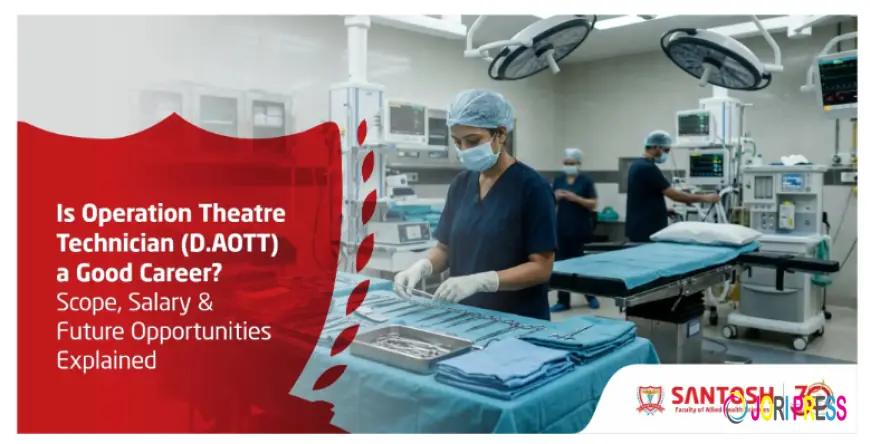
Every successful surgery is the result of a carefully coordinated team. Surgeons and anaesthesiologists lead the procedure — but behind them stands a trained professional who ensures the operation theatre is sterile, equipment is ready, and everything runs without a hitch. That professional is an Operation Theatre Technician (OTT), and the Diploma in Anaesthesia and Operation Theatre Technology (D.AOTT) is the qualification that prepares them for this critical role.
Anaesthesia and Operation Theatre Technology is a vital allied healthcare discipline that ensures the safe and efficient conduct of surgical and anaesthesia procedures in modern healthcare settings. The programme is designed to develop technical competence, strict adherence to clinical protocols, and effective teamwork — qualities that are non-negotiable in high-risk environments such as operation theatres and critical care units, with a strong emphasis on patient safety, infection control, and optimal use of medical technology.
If you are a science student after Class 12 looking for a focused, career-ready programme in healthcare, the D.AOTT course at Santosh Faculty of Allied Health Sciences, Ghaziabad could be the starting point of a deeply rewarding career.
2. Why Pursue D.AOTT in 2025–26?
India's healthcare sector is expanding rapidly — from tier-1 hospital chains to government medical facilities, every surgical unit requires skilled OT support staff. Here is why a Diploma in Operation Theatre Technology makes strong career sense right now:
- Shorter duration, faster employment: Complete the programme in just 2.5 years (including 6 months internship) and enter the workforce sooner than most healthcare graduates.
- Regulated by NCAHP: The course is aligned with the National Commission for Allied and Healthcare Professions (NCAHP) guidelines, ensuring your qualification is nationally recognised.
- Growing surgical volumes: As robotic surgeries, laparoscopic procedures, and critical care facilities expand across India, the need for technically proficient OT technicians is increasing steadily.
- Job stability: Healthcare is one of the most recession-resilient sectors. Surgical units in hospitals always need trained support staff.
3. Course Overview at a Glance
The table below provides a quick snapshot of the D.AOTT programme at Santosh Faculty of Allied Health Sciences, offered under Santosh Deemed to be University, Ghaziabad.
|
Course Detail |
Information |
|---|---|
|
Course Name |
Diploma in Anaesthesia and Operation Theatre Technology (D.AOTT) |
|
Also Known As |
DOTT – Diploma in Operation Theatre Technician |
|
Offered By |
Santosh Faculty of Allied Health Sciences, Santosh Deemed to be University, Ghaziabad |
|
Programme Level |
Diploma (Allied Health Sciences) |
|
Duration |
2.5 Years (includes 6 months compulsory internship) |
|
Regulatory Body |
National Commission for Allied and Healthcare Professions (NCAHP) |
|
Eligibility |
10+2 with Physics, Chemistry & Biology; minimum 50% aggregate marks |
|
Annual Fee |
Rs. 1,51,000/- |
|
Mode of Study |
Regular / Full-Time |
|
Internship |
6 months — Operation Theatres, ICUs, Emergency Units, CSSD |
|
Admission Mode |
University Direct Admission |
|
Core Training Areas |
OT Equipment Handling, Anaesthesia Assistance, Sterilisation & CSSD, Patient Monitoring |
|
Career Roles |
OT Technician, Surgical Assistant, Anaesthesia Technician, CSSD Technician |
|
Employment Settings |
Government Hospitals, Private Hospitals, Trauma Centres, ICUs, Surgical Clinics |
4. Eligibility Criteria
Before applying, ensure you meet the minimum eligibility requirements as prescribed by the National Commission for Allied and Healthcare Professions (NCAHP):
|
Eligibility Parameter |
Requirement |
|---|---|
|
Minimum Education |
Passed 10+2 or equivalent from a recognised board |
|
Compulsory Subjects |
Physics, Chemistry, and Biology (PCB) |
|
Minimum Marks |
50% aggregate marks in the qualifying examination |
|
Age Criteria |
As per NCAHP and university norms |
|
Relaxation |
As per applicable Government norms for reserved categories |
Note: Eligibility criteria are as per the latest NCAHP guidelines. Candidates are advised to verify current requirements at the time of application.
5. D.AOTT Course Curriculum — Year-by-Year Breakdown
Year 1 — Foundational Medical Sciences & OT Principles
The first year establishes the academic base every operation theatre technician needs. Students are introduced to foundational knowledge in basic medical sciences, operation theatre principles, infection control, sterilization methods, basic anaesthesia concepts, & patient safety practices.
Year 2 — Clinical Skills, Equipment Handling & Emergency Support
The second year shifts focus to hands-on technical training in real-world OT scenarios. Students are trained in anaesthesia assistance, patient monitoring, operation theatre equipment handling, CSSD operations, emergency support, and supervised clinical exposure in OT and critical care settings.
6-Month Internship — The Real-World Phase
This is the most transformative phase of the DOTT programme. Students undergo intensive hands-on clinical training in operation theatres, ICUs, emergency units, and sterile services departments to build practical competence and professional readiness.
6. What Makes Santosh Faculty of Allied Health Sciences the Right Choice?
Located in Ghaziabad — at the heart of the NCR healthcare ecosystem — Santosh Faculty of Allied Health Sciences is part of Santosh Deemed to be University, an institution with deep roots in medical education. Here is why students from Delhi-NCR and across Uttar Pradesh choose this institution for their D.AOTT journey:
Integrated Medical University Environment
Training at a university that also runs medical colleges and hospital means students get exposure to real clinical environments — not simulated labs alone. The integration of allied health students into active hospital settings accelerates learning in a way standalone institutes cannot match.
NCR Location Advantage
Being based in Ghaziabad gives students unmatched proximity to some of India's largest hospital networks — in Delhi, Noida, and the broader NCR — expanding both internship and placement opportunities considerably.
Strong Clinical Exposure in 900 Bedded Teaching Hospital
The 6-month internship is structured across operation theatres, ICUs, emergency departments, and CSSD units of Santosh Hospitals. This multi-department exposure prepares students for diverse surgical environments rather than limiting them to a single specialty.
Multidisciplinary Healthcare Ecosystem
Studying alongside MBBS, BDS, nursing, and other allied health students creates a rich, multidisciplinary environment. This mirrors real hospital workflows where teamwork across departments is critical to patient outcomes.
7. Career Opportunities After D.AOTT
The question most students ask before enrolling in any course is: What can I do after this? For D.AOTT graduates, the answer is both clear and encouraging. Operation theatre technicians are required across every type of surgical facility in India. With a D.AOTT from a recognised university, graduates can seek employment in:
- Government Hospitals — AIIMS, state medical colleges, district hospitals
- Private Multi-speciality Hospitals — Santosh, Apollo, Fortis, Max, Medanta, and similar chains
- Trauma Centres and Emergency Hospitals
- Surgical Day Care Clinics
- Military and Paramilitary Healthcare Facilities
- Critical Care and ICU Units
Job Roles Available
|
Job Role |
Primary Responsibility |
|---|---|
|
Operation Theatre Technician |
OT preparation, instrument handling, assisting during surgery |
|
Surgical Assistant |
Supporting surgeons during operative procedures |
|
Anaesthesia Technician |
Managing anaesthesia equipment and assisting anaesthesiologists |
|
CSSD Technician |
Central Sterile Services — sterilisation and instrument processing |
|
Critical Care Technician |
Patient monitoring and support in ICUs |
|
Emergency Room Technician |
Instrument readiness and support in emergency procedures |
With 3–5 years of experience, professionals can move into supervisory or senior technician roles. Some pursue specialisation in cardiac surgery OTs, neurosurgery, or orthopaedics — areas that command higher expertise and compensation.
8. Salary Prospects for OT Technicians in India
A common concern before choosing any career is earning potential. Here is a realistic picture of salary growth for D.AOTT graduates in India:
|
Experience Level |
Average Monthly Salary (India) |
|---|---|
|
Fresher (0–1 year) |
Rs. 15,000 – Rs. 22,000 |
|
Mid-Level (2–4 years) |
Rs. 25,000 – Rs. 40,000 |
|
Senior / Specialised (5+ years) |
Rs. 45,000 – Rs. 65,000+ |
|
Supervisory / Lead OT Tech |
Rs. 60,000 – Rs. 80,000+ |
Salaries vary by city, hospital tier, and area of specialisation. NCR-based professionals typically earn at the higher end of these ranges. Beyond domestic opportunities, there is a growing demand for trained allied health professionals in Middle Eastern and Southeast Asian healthcare systems, where NCAHP-certified graduates are increasingly considered employable.
Frequently Asked Questions (FAQs)
Q1. Is NEET required for admission to the D.AOTT course?
No. NEET is not required for the D.AOTT programme. Admission is based on your 10+2 marks in Physics, Chemistry, and Biology with a minimum of 50% aggregate, subject to NCAHP and university norms.
Q2. What is the duration of the D.AOTT course at Santosh?
The programme is 2.5 years in duration, which includes 2 years of academic training and a 6-month hands-on clinical internship.
Q3. What is the fee for D.AOTT at Santosh Faculty of Allied Health Sciences?
The programme fee is Rs. 1,51,000/- per year. For the most current fee structure, candidates are advised to contact the university directly or visit
Q4. Is the D.AOTT from Santosh Deemed to be University recognised?
Yes. The programme is offered in accordance with the National Commission for Allied and Healthcare Professions (NCAHP) curriculum and regulatory framework, which governs allied health education across India.
Q5. What is the difference between D.AOTT and B.AOTT?
The D.AOTT (Diploma) is a 2.5-year entry-level programme that builds foundational clinical skills for direct employment. The B.AOTT (Bachelor's) is a 4-year programme that provides deeper theoretical grounding, advanced clinical training, and pathways to senior roles or higher education. Santosh Faculty of Allied Health Sciences offers both programmes.
Q6. Can I pursue higher education after completing D.AOTT?
Absolutely. After completing the diploma, graduates can pursue the Bachelor of Anaesthesia and Operation Theatre Technology (B.AOTT), advanced certifications in critical care or cardiac surgery support, or allied health management programmes.
Q7. Where can I apply for the D.AOTT course at Santosh?
You can apply online at or contact the admissions office of Santosh Deemed to be University directly on 0120-4933350, 7838554401
What's Your Reaction?
 Like
0
Like
0
 Dislike
0
Dislike
0
 Love
0
Love
0
 Funny
0
Funny
0
 Angry
0
Angry
0
 Sad
0
Sad
0
 Wow
0
Wow
0